Early voting starts this week in much of the Triangle. Here’s what you need to know.
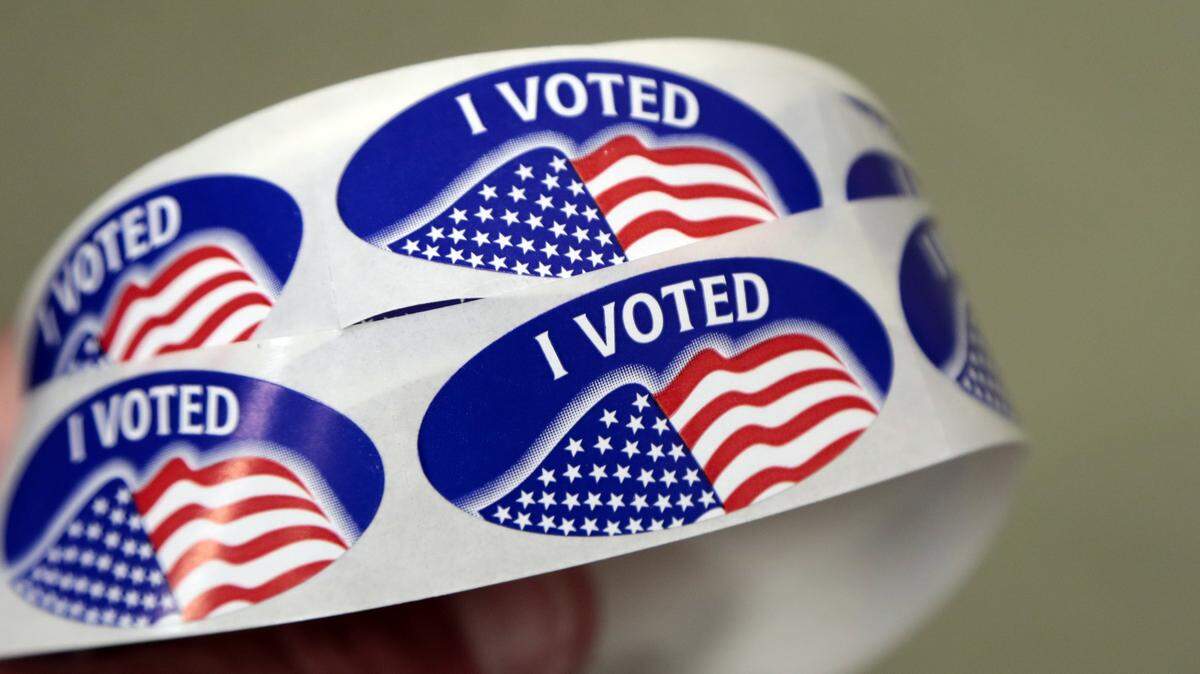
Early voting starts Thursday for city council elections in many towns all across the state, including most of the Triangle.
Raleigh and Cary have delayed their municipal elections until 2022. But nearly every other local town is holding elections this fall.
Election Day itself is Nov. 2, and early in-person voting will last from Oct. 14 to Oct. 30. People who haven’t yet registered to vote are too late to vote on Election Day itself, but if they go to a polling place during early voting, they will be allowed to register and vote on the same day there.
If you want to vote by mail instead, requests are due by 5 p.m. Oct. 26.
For more information on the times and locations of early voting sites or questions about registering to vote, visit your county’s board of elections website or go to the state elections website at www.ncsbe.gov. You can use the same state website to request a mail ballot.
What’s on the ballot in the Triangle
In Orange County, Chapel Hill, Carrboro and Hillsborough will all be electing mayors in addition to various town council seats. Durham likewise will be electing its next mayor and some city council members, although due to a candidate recently dropping out, it appears that at least the mayoral race will be uncontested, even if the town council races are not.
In Wake County there will be elections for town councils — and, in some towns, the mayors too — for Apex, Holly Springs, Fuquay-Varina, Morrisville, Garner, Rolesville, Knightdale, Zebulon, Wendell and Wake Forest. And the handful of Wake County residents who live in the city limits of Angier, which is mostly in Harnett County, can vote in that election which is also happening now.
You can find more about the candidates in our voter guide at newsobserver.com/voter-guide and heraldsun.com/voter-guide
Low turnout, narrow margins
While municipal elections tend to have strikingly low voter turnout rates, that also means people who are interested in helping shape their local government can know their vote maters more in those elections than it does in statewide races.
At least half a dozen towns in North Carolina are currently led by mayors who won election by just one or two votes, according to the group Voting Matters. And in 2019, the last time North Carolina held a round of municipal elections like the ones coming up this fall, around a dozen races for city council seats and other related offices ended in ties.
Under North Carolina law, when there’s a tie in an election the winner is decided by flipping a coin, pulling names from a hat or some other method of making a random choice.
Coin flips decided town council races in Tabor City — the candidate who called heads won – and in the towns of Sylva, Hildebran, Kelford and Sanderfield, according to Voting Matters. Officials drew names in Whitakers. Candidates pulled numbered pieces of paper out of a jar to decide an election in Creswell.
“One vote will again be decisive somewhere this year and then somebody will be mad they didn’t bother to vote,” Bob Hall, a longtime political watchdog in North Carolina who leads the Voting Matters group, said in a news release.
“Of course, many of the close contests are in small towns but they involve mayors and council members who decide major issues like police oversight, affordable housing, and zoning for a new grocery store or a landfill.”
Local elections can be close
In Chapel Hill, the town council could look very different if a few dozen people had voted differently, or at all, in 2019. One seat that year came down to just two votes. This year’s election could be similarly close.
In 2019, in an at-large election, voters had to pick their top four out of seven candidates. The fourth-place finisher who got that final seat, UNC student Tai Huynh, beat fifth-place finisher Nancy Oates — who was an incumbent on the council — by just two votes, 3,768 to 3,766.
The sixth and seventh place finishers in that election also came within 40 votes each of winning that final seat — only losing by about one-tenth of 1% each.
Even in Wake County, the most populous county in North Carolina, local elections can still come down to narrow margins.
In 2011 a town council member in Morrisville was investigated over her handling of absentee ballots. WRAL reported that county election officials eventually threw out five ballots that the councilwoman, Linda Lyons, had turned in for voters. She later ended up losing that election by just two votes to Michael Schlink.
Schlink would serve on the council for eight more years, until he lost in 2019 in another tightly contested race, falling by 133 votes out of more than 2,200 total. That was one of two Morrisville town council races in 2019 decided by under 200 votes, in a town with nearly 30,000 people.
And it’s not just Morrisville that has had dramatic election nail-biters in the Raleigh suburbs. In 2019, various elections for town council seats in Garner, Holly Springs, Rolesville and Wake Forest all also came down to around 200 votes.
And in Zebulon in 2019, two different candidates fell short of winning a town council seat there by only around 70 votes each.
For more North Carolina government and politics news, listen to the Under the Dome politics podcast from The News & Observer and the NC Insider. You can find it at link.chtbl.com/underthedomenc or wherever you get your podcasts.
This story was originally published October 12, 2021 at 5:00 AM.