North Carolina passes new maps giving GOP an edge in Congress, state legislature
North Carolina now has new political maps for the next decade — moving the battle over electoral districts out of the General Assembly and into the courts, where one lawsuit already challenges the maps and more are expected in the near future.
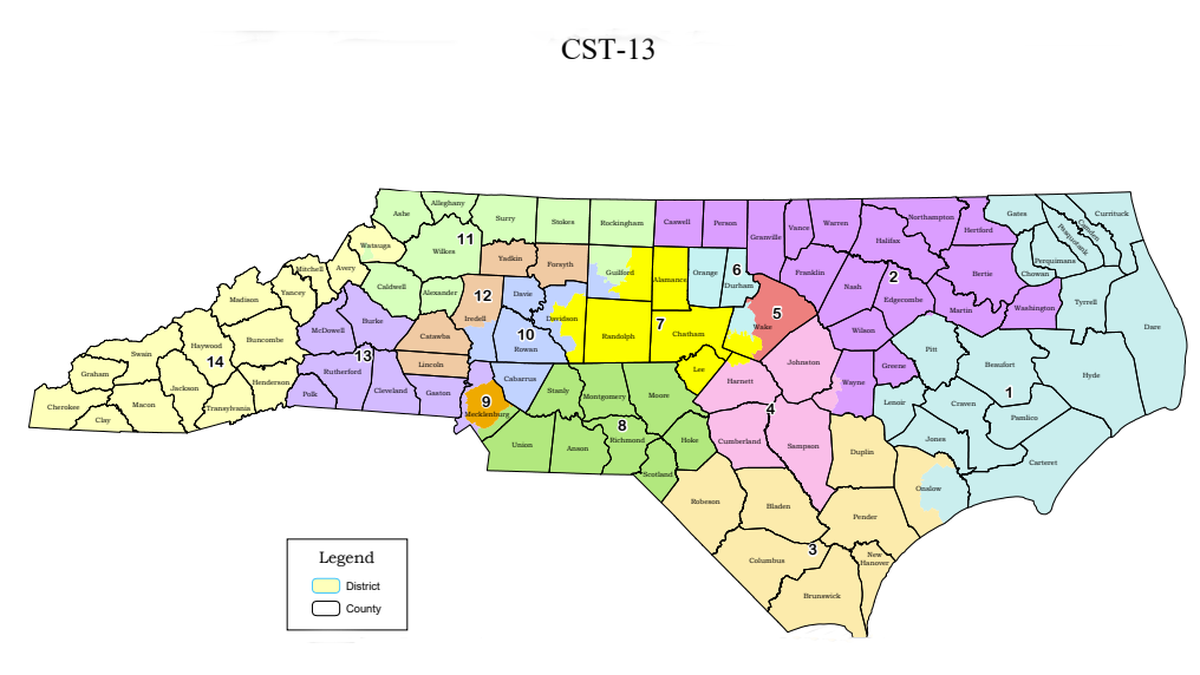
The Republican-led state legislature passed new maps Thursday for their own districts as well as for the state’s 14 seats in the U.S. House of Representatives.
All the new maps would give Republicans a sizable advantage in future elections even if the two parties roughly split the statewide vote 50-50, outside political analysis shows, and all three passed along party lines.
The new congressional map, for example, would be expected to give Republicans a 10-4 or 11-3 advantage in 2022. Democrats could expect to win the two seats that include Raleigh and Durham, one of the Charlotte-area seats and potentially the district in northeastern North Carolina that abuts the Triangle. Republicans would likely win the rest.
Over the past several weeks, Republican leaders have carefully avoided commenting on the partisan breakdown in the maps, saying they haven’t looked at any political data, and instead focusing on the process itself — which was done with a level of transparency unseen in nearly every other redistricting process in state history.
“This redistricting process has provided the public with an unprecedented view into the process,” said House Speaker Tim Moore, who has been rumored to be potentially running for the open congressional seat drawn around his home, in a news release. “In fact, not only did we hold hearings for public comments before and after maps had been drawn, but every single map was drawn in public view.”
Democrats have heavily criticized the maps, though, for what they say is a predetermined and unfair political outcome.
Political breakdown
Two Senate Democrats, Raleigh Sen. Jay Chaudhuri and Raeford Sen. Ben Clark, drew congressional maps that might be expected to lead to a 7-7 political split, according to Dave’s Redistricting App, but with some tossup seats that could go either way. Chaudhuri’s map has several highly competitive seats and a separate analysis, by the Princeton Gerrymandering Project, considers it likely an 8-6 map in favor of Republicans.
Senate Republicans previously shot down both Clark’s and Chaudhuri’s proposals. House Republicans also shot down Chaudhuri’s map Thursday when the Democratic leader, Chatham County Rep. Robert Reives, proposed it as an alternative amendment.
Reives said the plan would be ”more reflective of what North Carolina looks like today.”
Reives’ proposal failed after every Democrat voted for it but every Republican voted against it.
Just before the final vote Thursday when Republicans approved their preferred map, the top redistricting official in the House, Republican Rep. Destin Hall of Lenoir, told Democrats that maybe they should change their political messaging if they want to win more elections.
“Perhaps the problem is not the process, or these maps,” he said. “Perhaps the problem is your ideas.”
Democratic Rep. Amos Quick of Greensboro responded that there are fewer registered Republicans in North Carolina than either Democrats or unaffiliated voters, and questioned why Republicans would be expected to have such a large advantage in future elections here.
“I think it’s a map problem,” Quick said.
The News & Observer previously reported that Republicans would likely win 10 of North Carolina’s 14 U.S. House seats under the new maps and would still expect to keep at least an 8-6 edge even in a strong year for Democrats. Likewise, the state legislature would be almost certain to keep a Republican majority in the future.
▪ Congress: The new map would have eight safe Republican seats, three safe Democratic seats and three competitive seats, of which two would lean right and one would lean left. That means Republicans would be expected to win a 10-4 advantage if voters again split the statewide vote more or less evenly. It could increase to an 11-3 GOP advantage if Republicans have a strong year, and Republicans would still expect to hold an 8-6 advantage even in a strong year for Democrats.
▪ N.C. Senate: The new map would give Republicans 24 safe seats in the 50-member Senate, two short of a 26-member majority. There would be nine competitive seats out of the 50 total, of which five would lean Republican and four would lean Democratic. So Republicans would be expected to likely win a majority and could also win a veto-proof supermajority by holding all of the right-leaning competitive districts and flipping one of the left-leaning ones. Democrats have 17 safe seats and would have to win every competitive district to win the majority. If there’s a tie, Republican Lt. Gov. Mark Robinson would be the tiebreaker.
▪ N.C. House: The new map would give Republicans 55 safe seats in the 120-member House, six short of a 61-member majority. There would be 24 competitive seats, 13 of which lean Republican. So Republicans could expect to keep their majority even if they lost most of the competitive districts. Getting to a 72-member supermajority would require Republicans to win 17 of those 24 competitive seats. Democrats would have 41 safe seats, so they would have to win 20 of the 24 competitive districts to win a majority.
Lawsuits looming?
Republicans have defended the maps, saying they didn’t use any political data when drawing them. They also say they did not use racial data — which GOP leaders said is unnecessary but which Democrats say could lead to Black voters having their political rights violated.
That decision on racial data has already led to one lawsuit, which Republican redistricting leader Sen. Ralph Hise told The News & Observer was simply about “finding any excuse to sue to gain partisan advantage, no matter how contradictory”
Immediately after the maps passed Thursday, new critiques started rolling in from state and national Democrats and anti-gerrymandering groups.
“I hear it is perfect weather to be in court in North Carolina right now,” tweeted prominent Democratic attorney Marc Elias, who has previously been involved in numerous election law and voting rights cases here and in other states.
Eric Holder, the former U.S. Attorney General who now leads the National Democratic Redistricting Committee, funded two successful gerrymandering lawsuits against North Carolina’s maps in 2019 and earlier this year said the courts were maybe “the only way” to address redistricting in North Carolina.
On Thursday he didn’t immediately announce a new lawsuit against the new maps but strongly criticized them.
“Instead of listening to the people, Republican legislators did the opposite today by passing maps that are heavily manipulated in favor of their party and that will deny real political power to the most populous and diverse areas of the state,” Holder said in a press release.
Bob Phillips, the executive director of Common Cause NC, allied with Republicans on redistricting reform back in the 2000s — when Democrats controlled the legislature and shot down their reform efforts. The two parties have since switched places and switched their philosophies on redistricting reform. Phillips said the new maps show why he believes reform is still necessary.
“We are profoundly concerned that the legislature’s deeply flawed redistricting process has produced deeply flawed voting maps,” he said in a press release. “We are troubled that these districts would especially hurt Black voters, harmfully split communities and undermine the freedom of North Carolinians to have a voice in choosing their representatives. Our state deserves better.”
A spokesman for the Southern Coalition for Social Justice, which is representing the NAACP in a lawsuit that was already filed challenging the lack of racial data in the process, said they had no comment yet on whether they planned to also sue over the maps themselves now that they’re official.
“We are monitoring the process and continue to engage our clients in conversations about next steps,” said SCSJ spokesman Gino Nuzzolillo.
For more North Carolina government and politics news, listen to the Under the Dome politics podcast from The News & Observer and the NC Insider. You can find it at link.chtbl.com/underthedomenc or wherever you get your podcasts.
This story was originally published November 4, 2021 at 12:21 PM.