
Environmental groups call on Gov. Cooper to declare climate emergency in NC
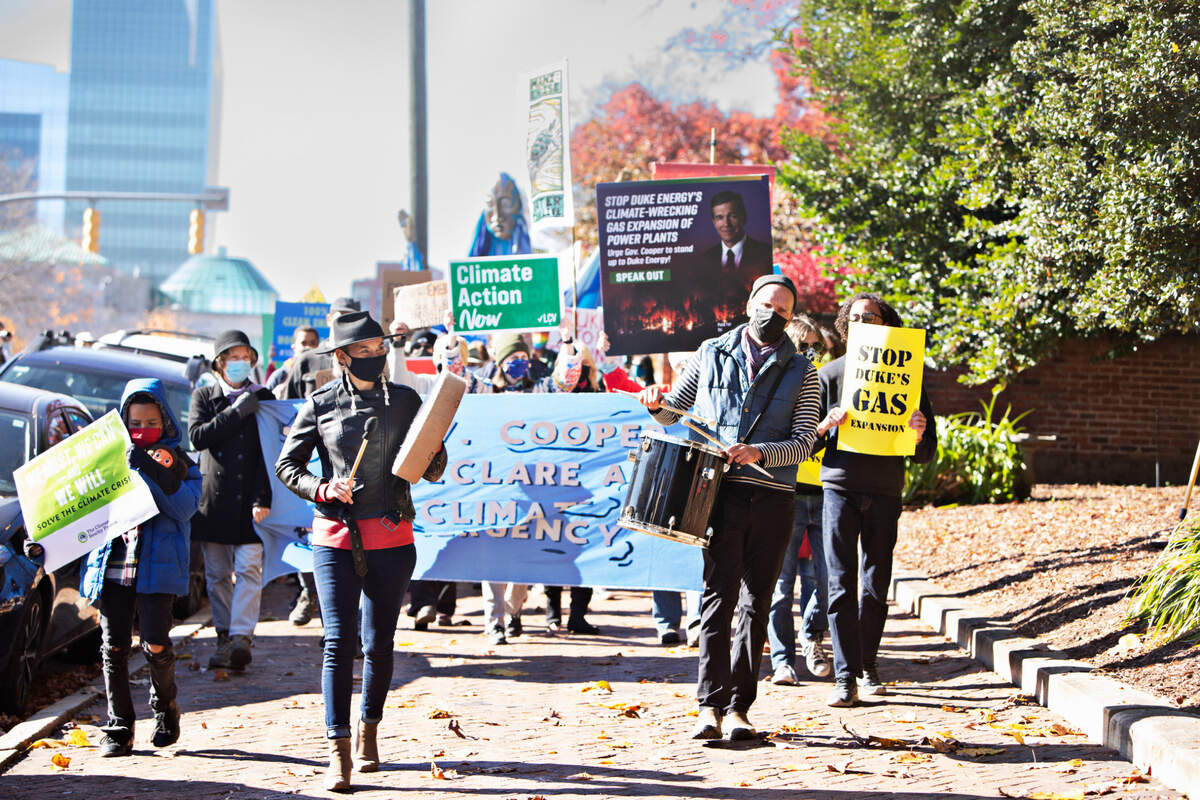
A coalition of 17 energy advocacy groups gathered Friday near North Carolina’s Executive Mansion to call on Gov. Roy Cooper to become the first U.S. governor to declare a climate emergency, a step they said could be used to prevent Duke Energy from building new natural gas plants.
Led by NC WARN, the groups called on Cooper to use powers granted to him by the N.C. Emergency Management Act. By limiting natural gas plants, they said, North Carolina would be able to limit short-term greenhouse gas increases and instead focus its efforts on building additional renewable energy sources like solar panels and wind farms.
Natural gas is mostly made up of methane, a greenhouse gas that is about 80 times as potent as carbon dioxide but much shorter-lasting in the atmosphere. Scientists have increasingly adopted the idea that limiting methane emissions could help achieve short-term greenhouse gas reductions that help curb the worst of the climate impacts while economies transition toward more renewable energy sources.
Jim Warren, the executive director of NC WARN, said that provisions in the recently signed state budget that give the Council of State additional oversight over states of emergency declared by the governor should not apply to an order declaring a climate emergency. Warren noted that the emergency power portions of the budget become effective in 2023 and that Cooper has pledged to challenge them in court.
Warren said, “Cooper’s got the authority. We laid out a good legal argument there, he’s got the authority to respond to emergencies and we’re saying these are repeated emergencies that are happening to these communities.”
Donna Chavis, an environmental organizer who is based in Robeson County, said that after Hurricane Matthew caused devastating flooding there in 2016, federal emergency management officials told residents it was just a matter of time before the next big storm.
Hurricane Florence hit North Carolina two years later, causing billions of dollars in damage.

“We have been lucky we haven’t had another Florence. That does not mean we won’t,” said Chavis, Friends of the Earth’s senior climate campaigner. “Like they said, it is not a matter of if but when, and so we are calling for our leaders to recognize that while we’re having thousand-year storms within two years of each other, that now is the time to declare the climate emergency.”
Earlier this year, Cooper signed into law House Bill 951, a comprehensive energy proposal that made goals from his Clean Energy Plan law.
The bill, which was negotiated throughout the summer, calls for the N.C. Utilities Commission to oversee a carbon planning process by which Duke Energy would reduce its emissions by 70% from 2005 levels by 2030 and to reach net zero emissions by 2050. Affordability and reliability are among the factors the Utilities Commission must consider when approving the carbon plan.
Friday, the Utilities Commission issued an order requiring Duke to file a draft version of its carbon reduction plan by April 1, 2022. The Utilities Commission is also requiring Duke to hold three stakeholder meetings before it files the draft carbon plan.
NC WARN has conducted modeling that shows that under some of the resource plans presented by Duke last year, the company would build as many as 50 new natural gas facilities across about a dozen sites.
Bill Norton, a Duke Energy spokesman, said House Bill 951 means those plans are outdated.
In a written statement, Norton said, “The passage of HB951 creates a framework for a clean energy transition that balances carbon reduction with reliability and affordability. We are fully focused on developing a proposed Carbon Plan, which the North Carolina Utilities Commission has requested we file by April 1 following stakeholder input.”
Norton continued, “That plan will require entirely new modeling, so it would be premature to speculate on the amount of potential new gas before that analysis is complete.”
In 2020, Norton added, about 60% of the energy Duke generated in North and South Carolina was from carbon-free sources like hydro, nuclear and solar. He said that percentage will continue to grow as the utility looks toward offshore wind and other “next-generation clean energy technologies.”
During an investor call earlier this month, Lynn Good, Duke’s CEO, responded to a question about whether the utility was pursuing advanced modular nuclear reactors or offshore wind by noting that in its ongoing Integrated Resource Plan case, Duke presented two options to reach 70% reductions by 2030. In one, the utility would use a small modular nuclear reactor to reach the goal, and offshore wind would be a key component of the other.
“This will be an important discussion as the carbon reduction plan is developed,” Good said, “and we will go into that — engaging with our regulators, policymakers, the communities — to come up with a thoughtful approach on how to incorporate these technologies. And so I think more to come on that as this carbon reduction plan begins to take shape in 2022.”
By pursuing advanced nuclear or offshore wind, Duke could be in a position to ask the Utilities Commission to delay meeting the 2030 and 2050 goals. House Bill 951 gives the Utilities Commission the authority to postpone those targets as long as Duke is pursuing the two technologies and needs extra time for permitting or other delays.
This story was produced with financial support from 1Earth Fund, in partnership with Journalism Funding Partners, as part of an independent journalism fellowship program. The N&O maintains full editorial control of the work.