How to watch as NC Supreme Court hears arguments in redistricting lawsuit Wednesday
Update: The Supreme Court heard arguments Wednesday morning. Read our coverage.
North Carolina’s nationally watched gerrymandering lawsuit will soon come to an end. Oral arguments begin in front of the N.C. Supreme Court on Wednesday morning.
There’s no schedule or deadline for when the justices will rule, although given that they previously moved back the date of the primary election to give them enough time to rule before then, their judgment in the case is expected quickly.
Here’s how to watch the oral arguments, if you’re a political super-nerd, plus some background for those who need to get caught up.
How and when to watch
The Supreme Court is closed to the public due to COVID-19 safety precautions. However, Wednesday’s oral arguments will be streaming live online for anyone to watch.
Court starts at 9:30 a.m. and the proceedings will be live-streamed on the North Carolina Supreme Court channel on YouTube.
The News & Observer will also be following the trial, and posting updates at newsobserver.com throughout the day.
Why are the maps controversial?
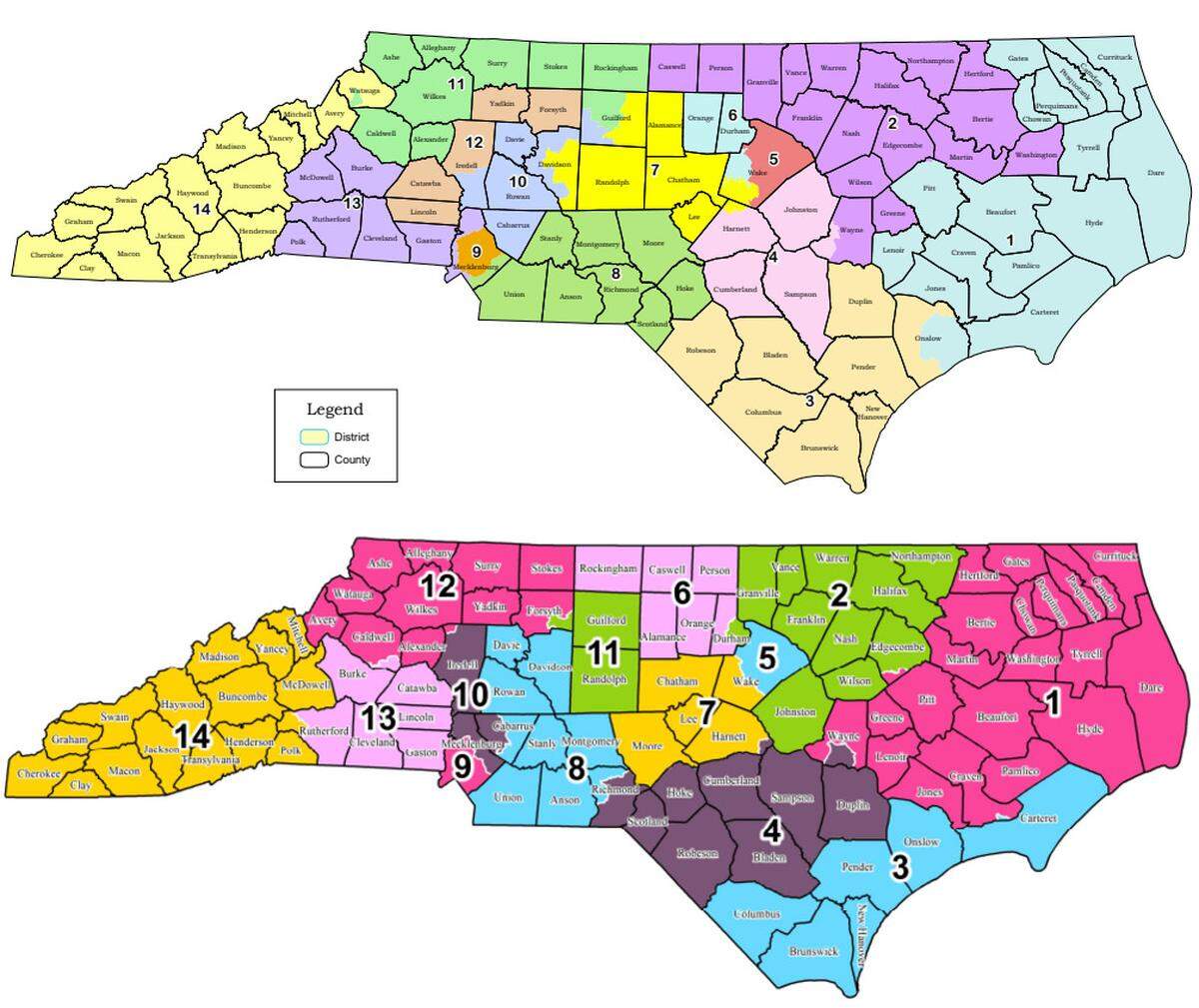
They’re drawn to all-but-guarantee that Republicans will win 10 of the 14 seats in the U.S. House of Representatives — even if Democrats win the statewide vote by several percentage points.
Republicans could also extend their advantage to as much as 11-3 if their party wins the statewide vote by several percentage points.
The maps for the state legislature are similarly lopsided in favor of Republican candidates. The left-leaning groups that sued said at last month’s trial that it’s possible the GOP would be able to win a veto-proof supermajority in the legislature, even if Democrats won a majority of the statewide vote, allowing Republicans to override any vetoes from Democratic Gov. Roy Cooper.
Why didn’t Cooper veto the maps?
All the maps were drawn last fall by GOP lawmakers and passed in party-line votes. A provision in the state constitution specifically bans the governor from vetoing redistricting bills, so Republicans didn’t need to worry about getting any Democrats on board even though they don’t currently have a supermajority.
Legislative leaders have defended their work, saying the state’s “political geography” — the fact that Democrats tend to cluster in a few urban areas while Republicans are spread out in rural areas — gives Republicans a built-in advantage that the maps simply reflect.
The left-leaning groups challenging the maps, however, said they ran billions of simulations to draw possible maps of North Carolina — and found that what the legislature passed was more skewed to the right than almost anything their computer algorithms could come up with.
A bipartisan, majority-Republican panel of judges found after a trial that the maps were intentionally gerrymandered in favor of Republicans, but they ruled that is not unconstitutional, and upheld the maps. Now the case goes to the Democratic-majority Supreme Court.
Didn’t we just go through this?
Yes. North Carolina redrew its maps in 2019 under court order, to replace a set of maps they drew in 2017 that were found unconstitutional. Those 2017 maps had been drawn to replace a different set of maps, from 2011, that were also found to be unconstitutional.
Those were all drawn by Republicans. But if you go back decades, you’ll see plenty of Democrat-drawn maps being ruled unconstitutional as well, stretching into the 1980s.
The reason for the latest redrawing is the 2020 Census. All political districts have to be redone after each Census to ensure that the districts are all the same size.
What’s next?
The justices hearing the case Wednesday can uphold the maps or order new ones to be drawn.
Whatever comes out of it will likely be what North Carolina uses in the 2022, 2024, 2026, 2028 and 2030 elections — unless, of course, another lawsuit strikes them down and starts this process all over again.
If the justices do order new maps, timing will be tight. The primary election is scheduled for May 17, which because of early voting and other requirements means that candidate filing is scheduled for late February. And since the maps have to be in place before candidate filing starts, the judges have just days to issue their ruling if they plan to strike down the maps.
Or we could see the court delay the primary again. It already did so once, moving it from March to May. The legislature recently tried moving it to June, but Cooper vetoed that bill, saying it should be the court’s decision.
For more North Carolina government and politics news, listen to the Under the Dome politics podcast from The News & Observer and the NC Insider. You can find it at link.chtbl.com/underthedomenc or wherever you get your podcasts.
This story was originally published February 2, 2022 at 5:00 AM.