
NC House approves new legislative districts, but congressional map still being drawn
North Carolina’s three most populous counties likely won’t be split more than once under new congressional redistricting maps being drawn this week by state lawmakers.
Those new lines for the state’s 14 U.S. House seats are expected to be voted on Thursday, along with new maps for the N.C. Senate. The N.C. House passed new maps for its members Wednesday night in a bipartisan vote, 115-5.
For the congressional maps, two different versions released by the state House and Senate split Wake and Mecklenburg counties just once and keep Guilford County whole. Under maps passed last year, which were recently ruled unconstitutional — hence the redraw this week — each of those counties had been split twice, dividing them among three congressional districts each.
However, the Senate complicated matters late Wednesday by announcing that it would not be voting on the map it had made public earlier in the day, but that redistricting leaders would instead work overnight to redraw the lines and release a new map Thursday morning, just a day before a court-imposed deadline.
If the early drafts from Tuesday and Wednesday are any guide, Democratic Rep. Kathy Manning, whose Triad district had been largely obliterated in the maps deemed unconstitutional, would go back to having Greensboro and Winston-Salem in the same district. Both draft congressional maps would also make another notable change farther east, in the Triangle, by separating the liberal strongholds of Durham and Orange counties.
But now that the Senate has announced a new map is on the way, it’s impossible to say whether the two chambers still agree on ideas like splitting up Orange and Durham counties, or combining Greensboro and Winston-Salem.
How did we get here?
The maps for North Carolina’s 14 U.S. House seats, as well as the state House and Senate, were ruled unconstitutional earlier this month by the N.C. Supreme Court — which gave the legislature just two weeks to propose a redraw. A trial court will now pick replacement maps, possibly what the legislature passes by Friday, or possibly a different plan submitted either by an outside expert or by one of the left-leaning challengers in the case.
Whatever maps the court picks might be used only for the 2022 elections, or throughout the rest of the decade.
The current divide in North Carolina’s congressional delegation is eight Republicans and five Democrats. The enacted maps thrown out by the Supreme Court would have increased the GOP advantage to 10-4 or 11-3, according to independent analysis.
Political data provided by the legislature Wednesday showed that both initial drafts of the congressional maps would have at least two competitive seats, compared to just one in the enacted map.
Republican leaders said the congressional maps would be more favorable to Democrats than the maps the Supreme Court deemed unconstitutional for pro-Republican partisan gerrymandering — not just at the congressional level but also for state legislative districts.
In the proposed new N.C. Senate districts, Republican Sen. Paul Newton said Wednesday, Democratic Gov. Roy Cooper would have won 25 of 50 districts in 2020, when he won 51.5% of the statewide vote.
Republican Rep. Destin Hall, the House’s chief mapmaker, said if the House’s proposed districts had been in place during the 2020 election, Republican Donald Trump would have won 62 of the 120 N.C. House districts in the presidential election, and Cooper would have won 63 of the 120 districts in the race for governor.
“If that metric does not comply with the court’s order, I’m not sure what does,” Hall said.
Hall said he and other Republicans had been working with House Democratic leader Robert Reives to try to get to a final product Democrats could support.
And in the end that’s what happened. Democrats were initially resistant to the GOP’s proposed maps, but after Republicans accepted half a dozen amendments by Democrats to tweak the lines in Wake, Durham, Orange, Buncombe, Mecklenburg, Rowan, Davie and Cabarrus counties, all but five Democrats voted for the N.C. House maps.
The Senate had fewer signs of bipartisan agreement, however, so it remains to be seen if the votes on the N.C. Senate and U.S. House maps to come Thursday will be more divisive.
The Senate’s initial map
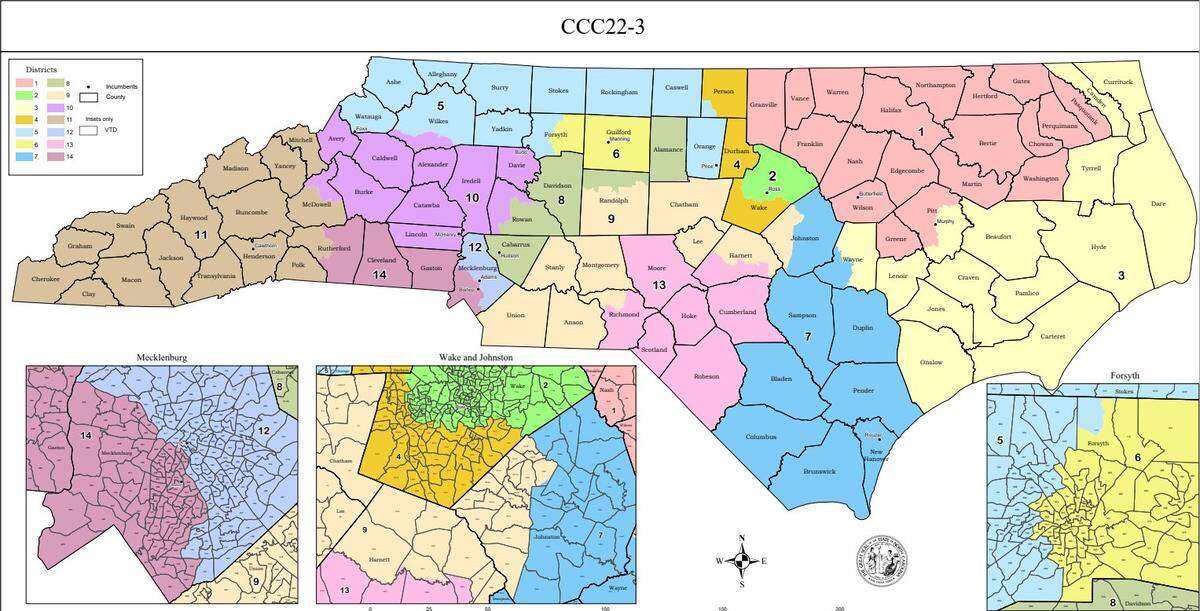
Composite election data released by the Senate along with its original congressional map shows Republicans winning seven seats and Democrats five, with two toss-up districts. So it could have ended up anywhere from 9-5 in favor of Republicans to an even 7-7 split.
But now that senators have said the map they initially showed the public will be redrawn overnight, it’s unclear what it will eventually end up looking like.
“I have suggested to the folks that are working on it to draw as many competitive districts as is feasible. That’s the only suggestion I’ve made to them,” Senate leader Phil Berger said of the original congressional map Tuesday.
The House’s initial map
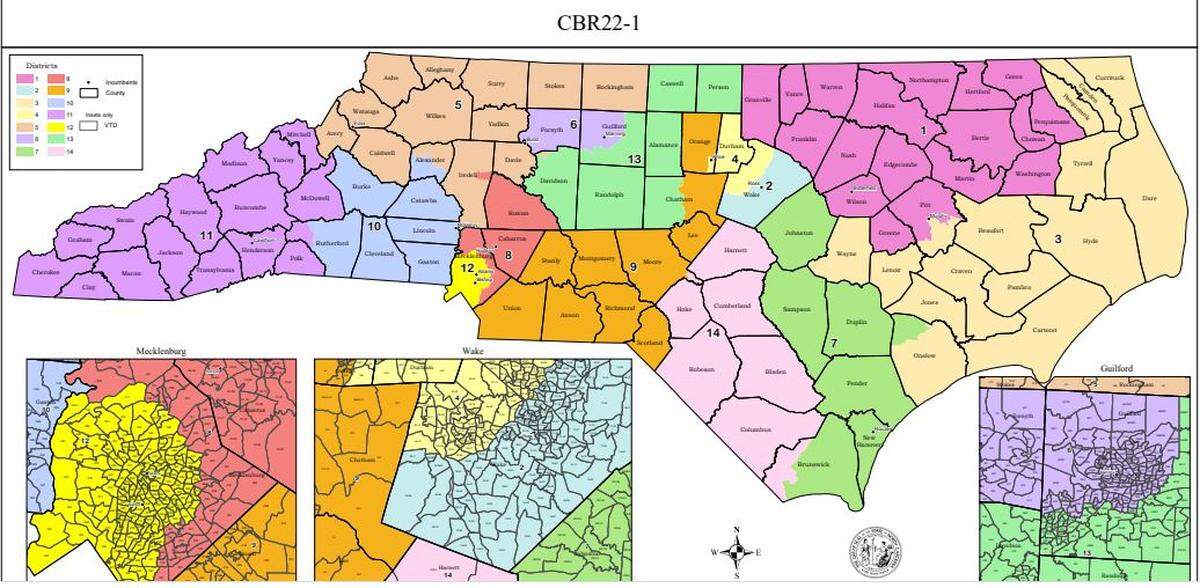
In the N.C. House’s congressional map, the far eastern and far western districts were largely similar to the Senate’s but the middle part of the state looks substantially different.
Most of Wake County would be in one district, currently represented by Democratic Rep. Deborah Ross. The suburban areas around Cary and northwest Raleigh would be combined with Durham County and a small piece of Chapel Hill in another district, which will have a competitive Democratic primary to replace retiring Rep. David Price.
Nearly all of Orange County, however, would be connected to a different district snaking through more rural parts of the state down to Union County outside of Charlotte, where Bishop would be expected to run.
Johnston County would remain attached to a largely agricultural district that stretches down to Wilmington, similar to the current district represented by Republican Rep. David Rouzer. Another district would run parallel, through Harnett and Cumberland counties down to the South Carolina border. It has no incumbent currently.
Urban splits?
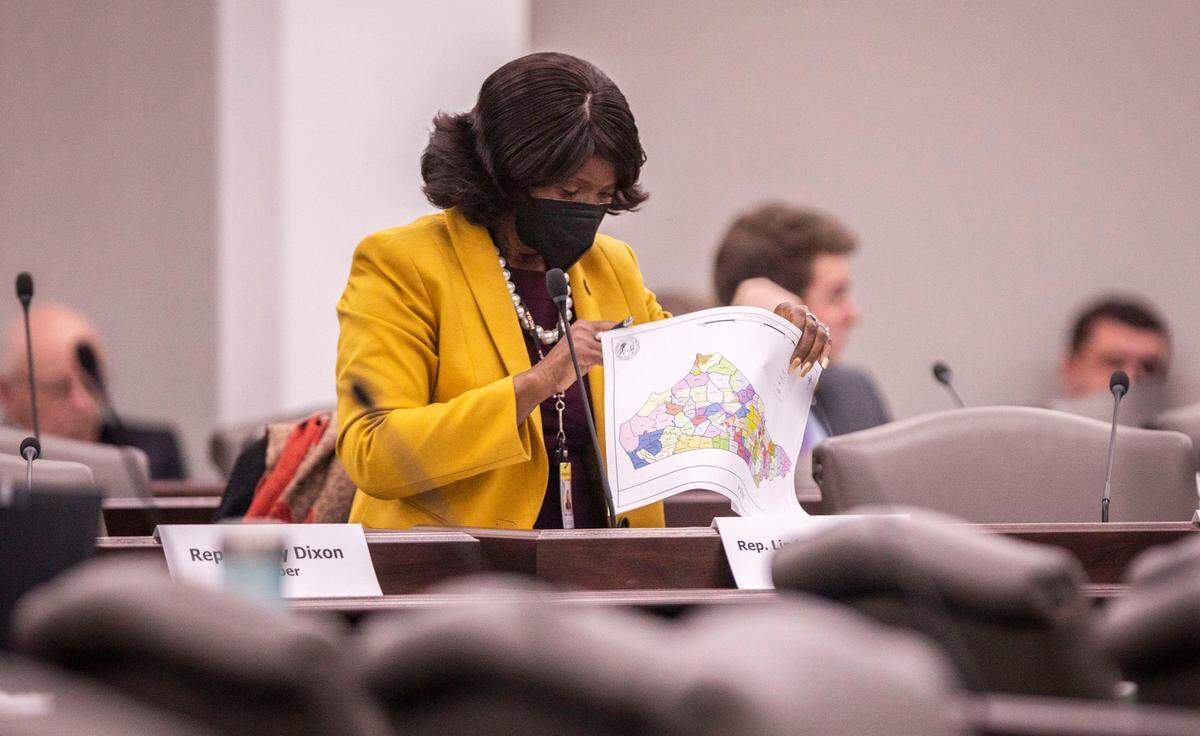
In the maps passed last year and ruled unconstitutional earlier this month, the Democratic strongholds of Wake, Mecklenburg and Guilford counties were split twice — meaning each county was in three different U.S. House districts — under the maps passed by Republican lawmakers late last year.
Based on their sizes alone, Guilford County didn’t need to be split at all, and both Wake and Mecklenburg only needed to be split once, not twice.
Splitting up the urban areas allowed Republicans to take those Democratic strongholds and combine their voters with much larger swaths of rural areas. The Triad was the most salient example; currently Greensboro, Winston-Salem and High Point are all kept together in a single Democratic-leaning congressional district. But the maps passed last year would have split those three cities between four districts, all of which would have been safe Republican seats.
“One thing ... that we’ve been trying to do is not to divide those largest counties any more than two ways if we can avoid it,” said House Speaker Tim Moore.
“What I’d like to see is a map that gets accepted by the courts. And I think one of the things that is going to make that more likely would be to do exactly what you’re talking about, is to not split those three counties more than once,” said Berger, a Rockingham County Republican.
Democratic leaders had specifically pointed to urban areas that had been split more than necessary, as examples of gerrymandering.
“There are times you look at some of these maps, and it’s ridiculous,” the top House Democrat, Reives said in a press conference last week. “And I think using the urban areas is a great example. There are times it’s clear those splits are for partisan advantage.”
No public hearings this time
On Tuesday afternoon, when no maps had yet been made public, some activist groups came to the legislature to demand more transparency.
The Rev. William Barber II, the former North Carolina NAACP leader who now leads a national group, the Poor People’s Campaign, returned to Raleigh for a rally outside the legislature. He said he wasn’t worried only about Republican lawmakers drawing the maps in private, but also about the Democratic leaders who might be willing to work with them and make certain political trades or deals, out of the public eye.
“And we call out even Democrats on this,” Barber said. “Now they want to do a backroom deal. We need public hearings. If the court says that this is unconstitutional, before those maps are redrawn we need the voices of the people to be heard. The voices of the people in those districts. Don’t rush and do a compromise.”
For Democratic lawmakers, however, their only chance of influencing the maps is to work with their Republican colleagues who control the majority at the legislature. The court order specifically said only groups that are parties to the lawsuit can submit proposed replacement maps — in other words, only the GOP-led legislature and the outside groups who brought the lawsuits.
The News & Observer reported Wednesday that Republicans allowed Democrats to draw some of the proposed U.S. House districts, at least in the Senate’s version of the congressional map, which was later pulled from committee to be redrawn again.
For more North Carolina government and politics news, listen to the Under the Dome politics podcast from The News & Observer and the NC Insider. You can find it at link.chtbl.com/underthedomenc or wherever you get your podcasts.
This story was originally published February 15, 2022 at 4:42 PM.