Wake Sheriff candidates divided on collaborating with ICE on immigration matters
Just as it did four years ago, immigration as a policy issue is playing a role in this year’s election for Wake County sheriff.
The 10 candidates in Wake County will have the option of reinstating the 287(g) program, a jail agreement with the federal Immigration and Customs Enforcement, commonly referred to as ICE. Most candidates, including both Democrats and Republicans, say they won’t be signing on to the program again.
The 287(g) agreement allows Sheriff’s deputies to partially act as federal immigration officials by enforcing immigration laws in their jails. Under the program, immigrants without legal status are screened for legal status in jail and are held so that ICE could take them into federal custody and deport them.
Under the program previously adopted by former Wake Sheriff Donnie Harrison, non-citizen and foreign-born individuals who were arrested in the county were checked for their immigration status as part of their booking process. Harrison, a Republican, signed the county onto the program in 2007.
But current Sheriff Gerald Baker, a Democrat seeking reelection, cut ties with the program in 2019 shortly after ousting Harrison in the 2018 election. Baker’s campaign was boosted by support from Latino and immigrant advocacy organizations after he voiced his intent to end the collaboration with ICE.
The primary election is May 17.
Harrison, who is running to reclaim his role as Sheriff, has argued the program helped his office identify inmates who gave an alias and were in the U.S. illegally. The program drew criticism, though, from activists and groups like the American Civil Liberties Union, which aired ads saying Harrison was “tearing families apart and stoking racial tensions” by deporting immigrants who were arrested for offenses not related to federal immigration laws.
Wake County spent at least $1.7 million on the program in 2016 but received only about $112,000 in return, according to Felicia Arriaga, an Appalachian State University professor who studied the program in North Carolina.
The sheriff’s office has said 1,483 people were deported from Wake County after being processed through the 287(g) program between 2013 and 2017, The News & Observer previously reported.
The 287(g) program is different than a detainer by ICE, which is a request for jails to hold an arrested individual for usually up to 48 hours when ICE has probable cause to believe that the person is a noncitizen who can be deported.
Durham County, for instance, never signed on to 287(g) but stopped honoring detainers under Sheriff Clarence Birkhead.
Where candidates stand on 287(g)
This year, Baker is facing a large group of candidates as he seeks to keep his seat.
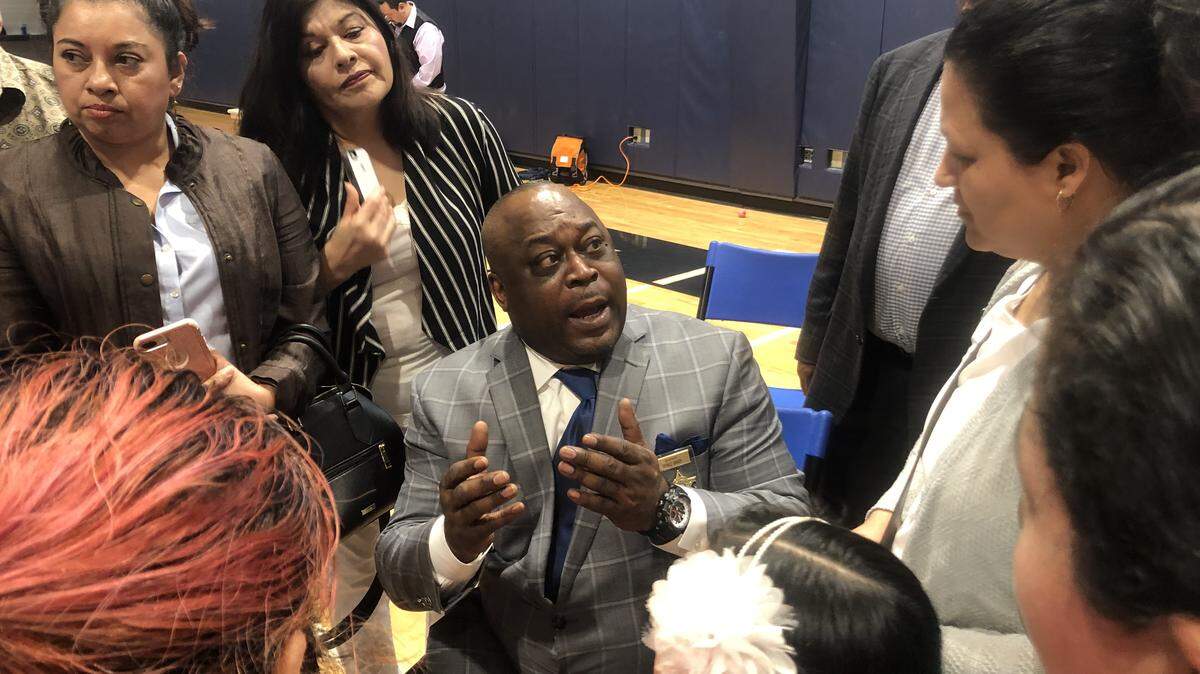
Seven of the candidates participated in a panel last month hosted by El Pueblo in Raleigh, a Latino advocacy nonprofit that has spoken out against law enforcement acting as immigration officials.
The candidates were asked several questions about a range of law enforcement topics, including 287(g).
Baker was not present at the forum but has said he will continue his opposition to 287(g) and will not reinstate it if reelected.
Candidates against 287(g)
The following candidates said they don’t support the 287(g) program and would not reinstate it: Democrats Joe Coley, Cedric Herring, Tommy Matthews, Willie Rowe and Roy Taylor.
Rowe, 62, and Matthews, 68, also said they would not honor detainer requests from ICE.
“We have a federal process to conduct this business to make a determination without detaining a person or removing them from their families,” Rowe said at the panel.
“ICE is able to do their own job without enlisting the men and women who work at the Sheriff’s office,” Matthews said.
Herring, 53, cited the mass racial profiling problems that were documented after the 1996 immigration reform laws passed by Congress and signed into law by president Bill Clinton from which 287(g) stems.
Some candidates said, however, they might honor an ICE detainer, depending on the circumstances.
Coley, 51, said he would honor an ICE detainer if he deemed that a suspect in custody “is a danger to the community.”
He said he sympathized with the Latino audience at the panel, saying he knew that immigrants are “just trying to work hard, raise a family, proceed on and move up,” from his experience in working with Hispanic people.
Taylor, a law enforcement veteran and current chief of the private agency Capitol Special Police, said he “will work with ICE on investigations” related to human trafficking cases. Taylor, 59, described his past experience in cooperating with ICE to prosecute suspects who had smuggled people illegally into the U.S. to exploit them.
Candidates who say yes
Harrison, who was Sheriff for 16 years, reiterated his support for the program, saying he was the Wake County official to first partner with ICE.
Before adopting the program, Harrison, 76, said he was “letting people back out in the street that was wanted for a whole lot of crimes” including some of whom he claimed were “child molesters.”
“The way this program works is if you violate the law is when you get involved in the 287(g),” he said. “I don’t know about splitting up the families and the whole nine yards, that ain’t for me ... I’m going to fulfill whatever job it takes make sure that you’re safe.”
Randolph Baity is the only Democratic candidate to state his support for reinstating 287(g).
“I know this is not a popular answer,” said Baity, 46. “The pros and cons went back and forth. What I’ve learned about this particular program is that their objective is to get the cartels, the drug dealers.”
As Sheriff, Baity said he would need to uphold “not just some laws” and that “at the end of the day, I have to feel that all citizens of Wake County are protected.”
Republican candidate David Blackwelder, 36, was not present at the panel but told The News & Observer that he would only use the 287(g) program in certain circumstances that involved violent crimes.
“If the violation is a non-violent misdemeanor, I do not believe they should be handed over to ICE. Violent acts should be the (determining) factor,” Blackwelder in a direct message via Twitter.
Republican candidate Tivon Howard was not present at the candidate panel. Howard’s campaign did not return requests from The N&O for comment. His campaign site indicates that he would honor ICE detainers.
This story was originally published April 18, 2022 at 6:15 AM.