
To remove PFAS, Chemours wants to ‘build the wall.’ Critics call it ‘inadequate.’
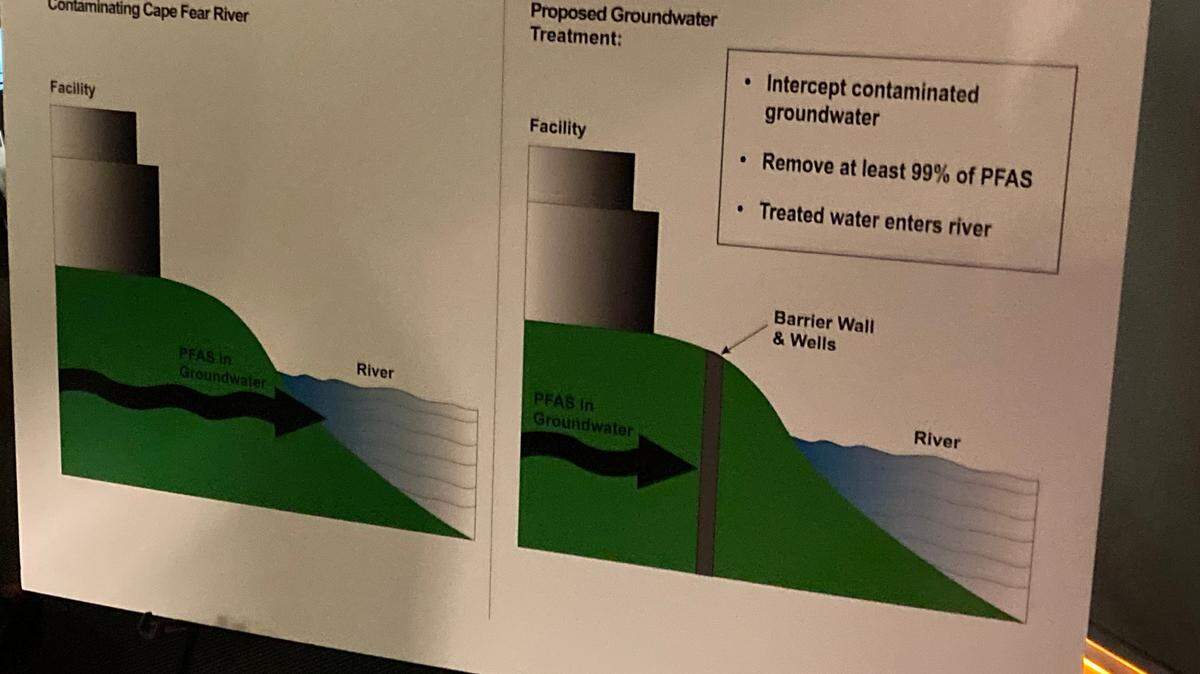
Chemours is seeking permission from North Carolina regulators to pump contaminated groundwater from underneath its facility near the Bladen-Cumberland county line, run it through filters that will remove 99% of the forever chemicals it contains and then discharge it into the Cape Fear River.
The project would also involve the construction of a 1.15-mile-long underground wall that will be 70 to 80 feet tall and two feet thick meant to keep the contaminated groundwater from reaching the river, a drinking water source for much of Southeastern North Carolina. That groundwater is now the source for about 60% of the per- and polyfluoroalkyl substances, commonly called “forever chemicals,” that are measured downstream.
Under the operation of Chemours and previous owner DuPont, the Fayetteville Works plant has been linked with decades of water contamination in the region. That includes the contamination of groundwater underneath the plant, with 2017 samples at five wells near the river side of the plant showing between 11,800 and 61,300 parts per trillion of the compound commonly called GenX.
During a public hearing this week at Cape Fear Community College’s downtown Wilmington campus, more than a dozen speakers criticized the proposed permit, their remarks ranging from general frustration toward Chemours to pointed technical critiques.
Some called on DEQ to require Chemours to remove more than 99% of the known PFAS from its discharge because other compounds have been found but not measured in the plant’s groundwater. Others argued that a stormwater system Chemours is proposing to build on the site to keep rainwater from carrying PFAS into the river should be able to handle more rain than the half-inch per day the company proposed.
Chemours has visibly stepped up public relations in Southeastern North Carolina in recent months, running television commercials where the company describes itself as a good neighbor. As part of that effort, Chemours issued a petition calling on signees “to help build the wall.”
“Under the guise of community stewardship, Chemours is actively working to ensure that our community receives less than the full accountability that we deserve,” Wilmington resident Lacey Brown said during Tuesday’s hearing.
Brown moved to Wilmington about a year ago and became an active member of grassroots environmental organization Clean Cape Fear.
Clean Cape Fear and other advocates have been calling for more action against Chemours since 2017, when the Wilmington StarNews first reported that the company was discharging PFAS into the Cape Fear River. The N.C. Department of Environmental Quality suspended the company’s water discharge permit in November 2017, but utilities downstream still regularly find PFAS that have been linked with the plant in their raw drinking water.
The wall and groundwater treatment project were required under the terms of an October 2020 addendum to the consent order signed by Chemours, DEQ and environmental watchdog Cape Fear River Watch. The original consent order also required the company to build a thermal oxidizer that captures 99.99% of emissions from Fayetteville Works and destroys it by burning it at extremely high temperatures.
Treating groundwater from Fayetteville Works
Geoff Gisler, a Southern Environmental Law Center senior attorney who represented Cape Fear River Watch, told DEQ the 99% PFAS reduction in groundwater proposed by Chemours is not good enough.
He pointed to new health advisories the EPA introduced last week for four PFAS that indicated the chemicals pose a more significant threat to human health than previously known.
Chemours, Gisler noted, routinely uses the carbon filtration devices to reduce PFAS levels at another outfall on the Fayetteville Works site to a point where they cannot be detected. The key difference, he argued, is in how often the company plans to replace the carbon filtration material that captures PFAS.
“If the limits aren’t set at nondetect, then they have the right — not just the ability but the right — to not change the carbon out,” Gisler said. “So 99% was a good starting point. It is not a lawful or an acceptable ending point.”
Lisa Randall, a Chemours spokeswoman, said in an email that the carbon filters will be designed to remove 99% of the PFAS compounds agreed to in the consent order — GenX, PMPA and PFMOAA. Randall did not say how frequently the company plans to replace the filtration material, but did write that the system will have “multiple carbon vessels” that will be monitored to see if any of the three compounds are breaking through.
The permit would not allow Chemours to discharge wastewater from its manufacturing process. Instead, all of the discharge would come from groundwater.
Julie Grzyb, the deputy director of DEQ’s Division of Water Resources, said Tuesday she does not know of another system in the United States like the one Chemours is proposing.
“We don’t have anything else to compare it to,” Grzyb said, “but it will significantly reduce the PFAS currently entering the Cape Fear.”
Kenneth Waldroup, the executive director of the Wilmington-area Cape Fear Public Utility Authority, asked DEQ to require that Chemours install a stormwater treatment system with greater capacity. CFPUA, he said, found 358 days over the last 12 years where rainfall totals measured more than the half-inch Chemours is prepared to treat.
Randall said in an email that the half-inch capacity was agreed to in the consent order.
Waldroup also said that his utility’s water treatment costs will be directly tied to the company’s PFAS discharges. The utility plans to bring a $46 million granular activated carbon system online later this year, which it expects will remove much of the PFAS from water sourced from the Cape Fear River.
If more PFAS comes downstream from Chemours, Waldroup said, CFPUA’s carbon filters will become saturated with the compounds more quickly, forcing it to replace the carbon at a cost to customers.
Economic impact
John “Chuck” Heustess, Bladen County’s economic development director, spoke in support of the company at Wednesday’s hearing, calling the permit “a step in the right direction.”
Echoing talking points about GenX on Chemours’ website, Heustess said, “Their products are critical components in the products that will make the world more green and more energy efficient in the future.”
In its most recent quarterly Securities and Exchange Commission report, Chemours said it has spent $366 million on environmental remediation at Fayetteville Works through March 31. The company estimates that the wall could cost as much as $310 million.
Chemours’ net income in the first quarter of 2022 was $234 million, with the company’s sales totaling $1.8 billion, numbers the company called “robust” in a news release.
Joe Hill, a Wilmington resident, said Chemours can and should be doing more beyond the groundwater barrier wall to prevent PFAS chemicals from reaching the Cape Fear River.
“What is really deserving of being protected here? The money that a company is able to create or the people that are directly affected by it?” Hill said.
This story was produced with financial support from 1Earth Fund, in partnership with Journalism Funding Partners, as part of an independent journalism fellowship program. The N&O maintains full editorial control of the work.
This story was originally published June 25, 2022 at 11:45 AM.