
At hearings on Duke Energy carbon plan, state hears calls for ‘swift decarbonization’
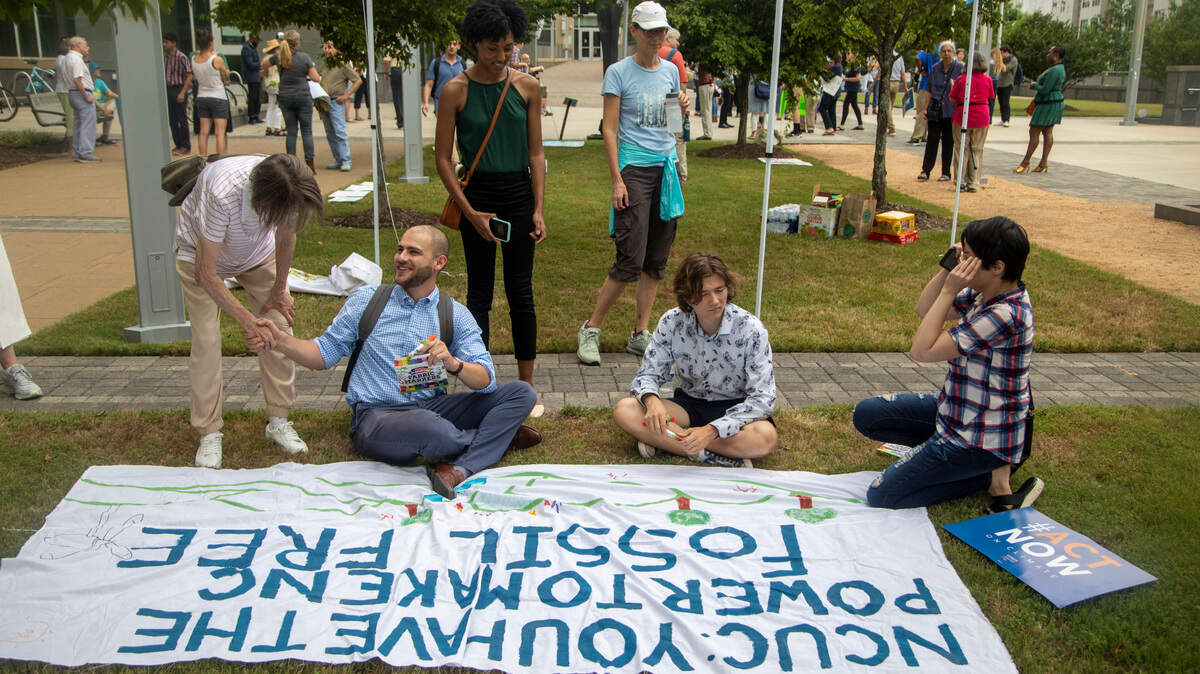
As Durham County’s sustainability manager, Tobin Freid has a vested interest in the carbon emissions reduction plan that Duke Energy put forth earlier this year.
Freid is responsible for Durham County’s effort to meet greenhouse gas emission reduction targets of 30% county-wide and 50% in government facilities by 2030.
“Even with implementing everything possible within our control, we will not be able to meet our goals without significant and swift decarbonization of our electricity provider,” Freid said.
Last year’s House Bill 951 required Duke Energy to create a plan that would meet targets of a 70% reduction in carbon emissions by 2030 with some exceptions for certain kinds of new facilities. In its proposal, Duke asked the Utilities Commission to allow it four paths that include various mixtures of renewable energy generation, gas-fired power plants and some new technologies like small modular nuclear reactors. Three of those options would extend the 2030 deadline.
The Utilities Commission must approve a charter plan by the end of the year. That plan can be shaped by suggestions from Duke, public comments, alternatives suggested by interested groups or other feedback.
Monday, interested people filled a Durham courtroom to capacity, with 36 people giving the North Carolina Utilities Commission some kind of comment on the carbon emissions reduction plan. Tuesday evening, more than 50 people filed into a New Hanover County courtroom, with 13 testifying about the plan.
The vast majority of the comments were critical of Duke Energy. Many comments focused on three of the four portfolios proposed by Duke meeting the 70% reduction after 2030 by relying on either wind energy or small modular nuclear reactors.
New natural gas, meeting goal after 2030?
Another common critique of the plan was the addition of some natural gas-fired power generation, with critics worried that customers could be left paying for assets rendered unusable by either high prices of natural gas or climate action. Methane, the largest component of natural gas, is an extremely potent greenhouse gas that lasts in the atmosphere for about a decade.
Freid called for Duke to meet the targets of a 70% reduction by 2030 and net zero by 2050. She also called for Duke to reduce its use of fossil fuels to generate power and focus more on distributed energy like rooftop solar panels.
“The carbon plan will fundamentally change the way electricity is generated, distributed, used and paid for in North Carolina and will have major impacts on the climate,” Freid said.
Power generation is the second-largest source of greenhouse gas emissions in the state, according to a N.C. Department of Environmental Quality report, causing 32.8% of North Carolina’s greenhouse gas emissions in 2018. The sector only trails transportation, which caused 35.9% of emissions.
Dale Evarts, who once served as the leader of the Climate and International Group at the Environmental Protection Agency’s Air Quality Office, testified that Duke should be using more energy efficiency and rooftop solar to meet the state’s energy needs.
“Duke is full of good, smart, creative problem-solvers, but it makes me angry that the leadership is not giving them all the cost-saving tools that other utilities are using to achieve ambitious carbon reduction goals,” Evarts said.
The Utilities Commission’s approval of a carbon plan — be it Duke’s, the alternatives provided by some interested groups or a mixture of plans — does not represent regulatory approval of individual projects. In other words, if Duke’s carbon plan calls for a new power plant or transmission line, it would need to pass through the same regulatory process as a project that is not in the plan.
Environmental justice criticism
Deborah Dicks Maxwell, president of the North Carolina NAACP, spoke at Tuesday’s public hearing. Maxwell was one of several environmental justice advocates who attended a virtual conversation about Duke’s carbon plan on May 3.
Attendees of that conversation were excited, Maxwell said, and looked forward to providing more input for the carbon plan. They did not realize that the conversation came at the tail end of a process that had started in January.
Asking advocates to participate near the end of the process, Maxwell said, showed a lack of commitment to environmental justice on the part of Duke Energy. The May 3 meeting, Maxwell said, felt like an afterthought that was held solely so Duke could say it had done so.
“You can imagine the level of enthusiasm we had ... only to be dismissed as an afterthought to be included in the plan,” Maxwell told the Utilities Commission.
Environmental justice is the idea that certain communities — typically communities with a high proportion of Black, American Indian, Hispanic or poor people — are more likely to have sources of pollution nearby. A 2019 University of California, Berkeley study found that people of color were less likely than white people to have installed solar panels and be poised to achieve long-term savings.
In an interview last week, Kendal Bowman, Duke’s vice president of regulatory affairs and policy in North Carolina, said the company is committed to environmental justice, particularly when deciding where to put transmission lines and other new energy assets. Bowman said Duke plans to use environmental justice screening tools as part of its decision-making process.
Attendees for the May 3 environmental justice meeting were selected by Duke Energy’s community relations managers, according to Bowman.
Bowman said, “We did have a discussion. I think that that’s the first of more discussions to come.”
Several speakers at the Wilmington event said addressing carbon emissions is urgent for the region. They noted a National Ocean and Atmospheric Administration report that said the city has the most sunny day flooding in the nation.
“The more we can reduce carbon, the more we can reduce methane, the safer our streets will be from coastal surges,” Maxwell said.
The Utilities Commission will hold four additional hearings on Duke’s carbon plan. Those will be held:
- July 27, 7 p.m., at the Buncombe County Courthouse, 60 Court Plaza, Asheville
- July 28, 7 p.m., at the Mecklenburg County Courthouse, 832 E. 4th St., Charlotte
- Aug. 23, 1:30 p.m. and 6 p.m. virtually. Only the first 20 speakers who register will be able to speak at these events. Those who would like to talk can register by calling 919-733-0837 or emailing ncucpublichearing@ncuc.net. Those who wish to speak will need to give their name, docket number E-100 Sub 179, the telephone number they will call from and the topic they will address.
This story was produced with financial support from 1Earth Fund, in partnership with Journalism Funding Partners, as part of an independent journalism fellowship program. The N&O maintains full editorial control of the work.
This story was originally published July 15, 2022 at 1:53 PM.