
EPA Administrator Regan announces new environmental justice office, $3B in funding
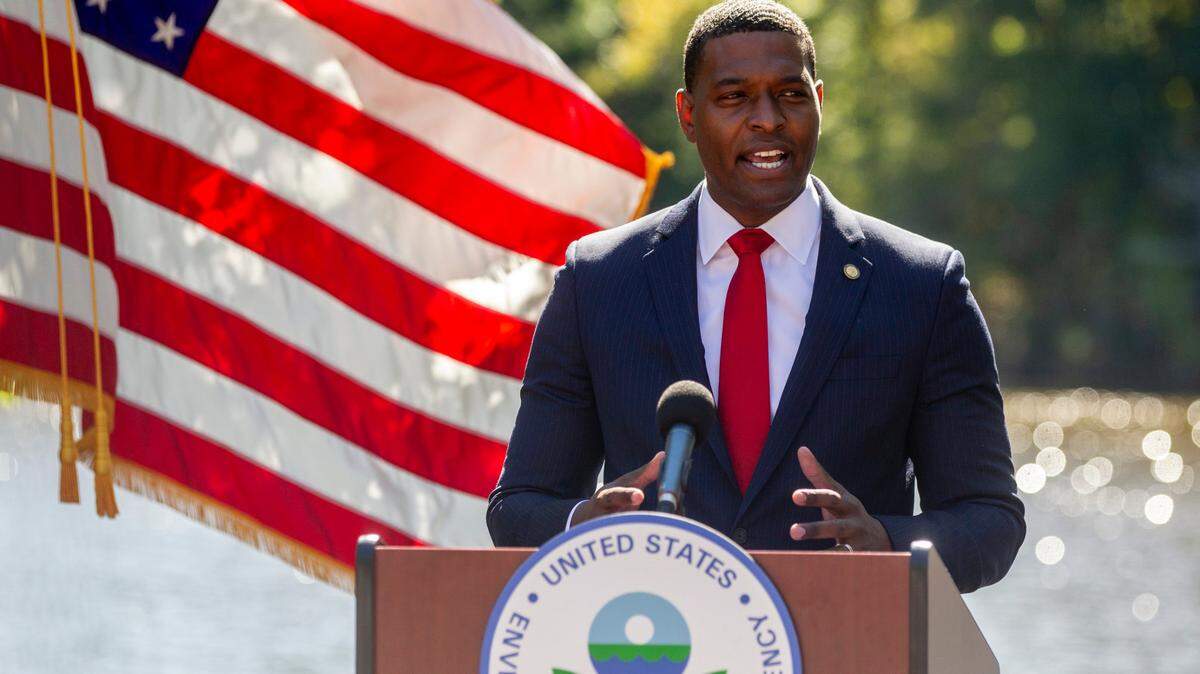
Growing up in Goldsboro, Michael Regan heard his parents talk about the 1982 Warren County protests against a PCB landfill, demonstrations that played a pivotal role in establishing the environmental justice movement in the United States.
On Saturday, Regan — now the administrator of the U.S. Environmental Protection Agency — stood in front of the Warren County Courthouse, just miles from that protest site, to announce that the federal agency is growing its environmental justice efforts, backed by $3 billion from the Inflation Reduction Act.
During a Saturday morning interview, Regan told The News & Observer, “In addition to being included in the policy and regulatory development, this office will be able to push resources to these communities and have these community-oriented solutions matched with their participation to hopefully give EPA and the communities a better shot at protecting those who have been disproportionately impacted for far too long.”
Environmental justice is the idea that everyone deserves the same protection against environmental hazards like climate change and pollution. It also contains the idea that everyone should be able to play a part in the process that shapes the environment where they live and work.
In 1982, North Carolina started to dump soil contaminated with polychlorinated biphenyls (PCBs) in an Afton soybean field. A diverse group of Warren County residents and activists pushed back, questioning why the state had decided to store chemicals whose health risks had already resulted in a domestic production ban in a community made up of a high proportion of Black people who mostly drank well water.
A years-long battle over PCB contamination in rural North Carolina ended in 1982, culminating in six weeks of protests against siting a landfill containing soil laced with the contaminant in Warren County. Over the course of the protest, local residents joined members of national groups like the NAACP and United Church of Christ to lay in front of the dump trucks, trying to impede their progress.
Police made more than 500 arrests during the protests. Then Gov. Jim Hunt pushed forward with the dumping, but pledged that the state would eventually clean the site if technology became available.
That cleanup was completed in 2004, according to The Warren Record.
Regan, who previously served as a secretary of the N.C. Department of Environmental Quality, was surrounded by many who participated in the 1982 Warren County protests as he made Saturday’s announcement.
“We’re standing on the shoulders of a lot of giants. I have to say that I’m especially proud as a North Carolinian to know that this national movement started right here in my home state,” Regan told The News & Observer.
Dollie Burwell was among those original protesters, laying down in front of trucks bearing the contaminated soil. Burwell said she was heartened Saturday to hear how many in the environmental justice movement were inspired by the Warren County protests. Burwell’s daughters, then 8 and 2 years old, joined her during some protests.
During a visit to South Africa years ago, Burwell left behind a copy of a 1987 United Church of Christ study borne out of the Warren County protests that showed race was the key factor in deciding where to locate toxic waste facilities.
“I know that as poor as we are, we have showed the world,” Burwell said.
After he signed an order creating the new environmental justice office, Regan gave Burwell the pen.
“I’m just excited about today. I’m hopeful that today will yield some good fruit and I know that we here in Warren County have to continue to bend that arc,” Burwell said.
Beverly Wright, the founder of the Deep South Center for Environmental Justice in New Orleans, was one of the organizers and researchers present Saturday whose career was shaped by the events in Warren County. Wright recalled family trips between Baton Rouge and New Orleans that were marred by acrid smells her father would attribute to progress.
Wright recalled not knowing how to describe what she was feeling and smelling until seeing Dr. Ben Chavis — a member of the Wilmington 10 who would go on to feature prominently in the Warren County protests — describe the North Carolina events as “environmental racism.”
“It gave a name to what I was feeling,” Wright recalled Saturday. “I knew it was something, I knew it was wrong, but when Ben said environmental racism, I said, yes! That’s what this is!”
To create the new office, EPA merged its Conflict Prevention and Resolution Center, its External Civil Rights Compliance Office and its Office of Environmental Justice. The Biden administration will announce an appointment to head the office at a later date, and that appointment will need to be confirmed by the U.S. Senate.
The new office will be in charge of a $3 billion environmental and climate justice block grant program that was funded by the Inflation Reduction Act. The program will fund projects led by community members in disadvantaged communities and is intended to help build capacity to address disproportionate harms caused by climate change and pollution.
Those grants could go to community organizations, Regan said. Or they could help researchers at historically black colleges and universities do scientific work to help those organizations. Or they could boost state environmental justice and civil rights programs.
Regan also hinted that the Inflation Reduction Act will likely allow those grants to be larger than those that tradtionally go to environmental justice groups, funds that are often less than $10,000.
“With the ability to empower the communities’ voices as well as provide them resources, I think we’re going to see solutions and partnerships that we’ve never seen before,” Regan said.
Additionally, the new office will help other EPA offices understand the environmental justice implications of policies or enforcement actions.
Regan previewed Saturday’s announcement on Sept. 22, when a delegation of North Carolina elected officials and mayors visited the White House. McClatchy previously reported that the room “erupted in applause” when Regan announced the initiative.
By elevating the new office to sit alongside the EPA’s offices of Air and Radiation, Chemical Safety and Pollution Prevention and Water, Regan hopes to have reached a permanent solution at the agency.
“We wanted to begin those structural changes needed that would outlast any of us,” Regan told The News & Observer. “It would cut through four years of any one individual leading this country, it would cut through politics and it would enshrine the emphasis and the priority of environmental justice and external civil rights forever at EPA.”
This story was produced with financial support from 1Earth Fund, in partnership with Journalism Funding Partners, as part of an independent journalism fellowship program. The N&O maintains full editorial control of the work.
This story was originally published September 24, 2022 at 2:09 PM.