
‘We have to change the law.’ In NC, EPA’s Regan wants stronger water pollution rules.
The nation’s top environmental regulator called Monday for stricter laws to prevent companies from contaminating drinking water with chemicals that haven’t yet been regulated.
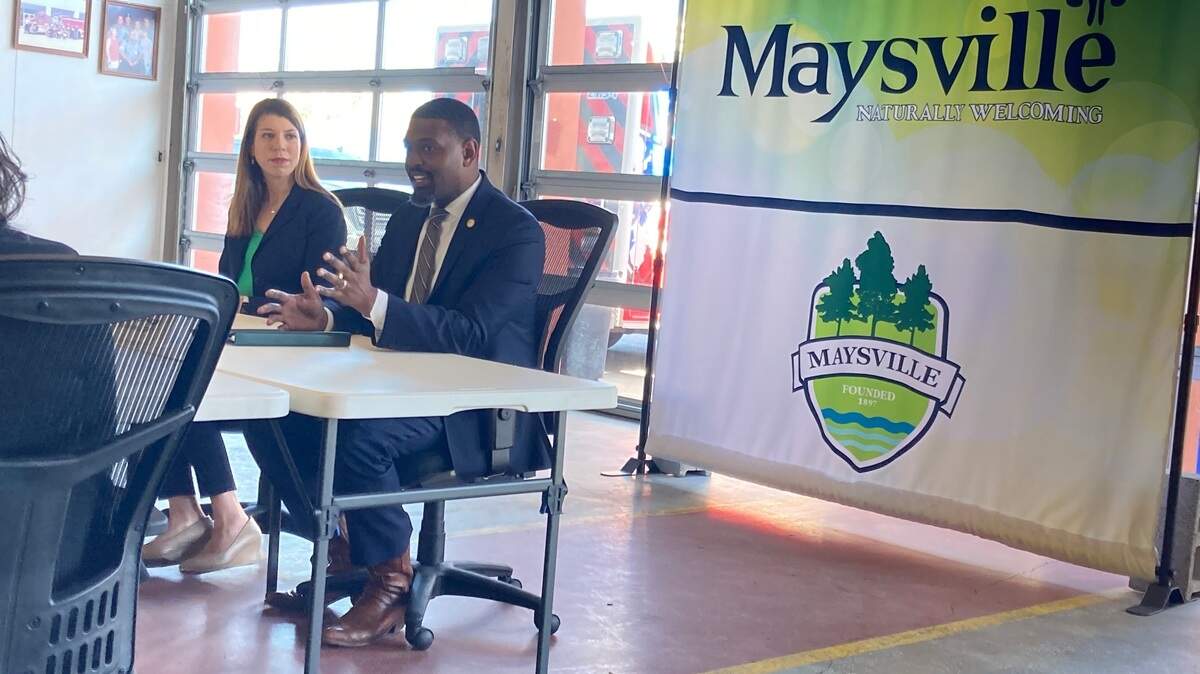
“We have to be very realistic about the fact that we have to change the law in this country,” Environmental Protection Agency Administrator Michael Regan said during a roundtable in Maysville, N.C., about 15 minutes northeast of Jacksonville.
“The laws of this country allow for chemical compounds to be put out in the atmosphere and in our water without having to prove that they are not harmful. So there’s an element of this of catch-if-you-can with industry.”
Regan was visiting the Jones County town to announce that the Environmental Protection Agency is making $2 billion in grant funds available to help water treatment systems with fewer than 10,000 customers remove so-called forever chemicals from their drinking water supplies. Before President Joe Biden appointed Regan to the EPA, he served as secretary of the N.C. Department of Environmental Quality, where he grappled with decades of contamination in the Cape Fear River.
The roundtable also featured calls from North Carolina academic and environmental officials for more resources to address contamination from per- and polyfluoroalkyl substances.
More than 9,000 PFAS have been identified, according to the National Institute of Environmental Health Sciences. The chemicals are prized by industry for their long-lasting nature and durability. They’re used across the economy in items from carpets to rain coats to computer chips.
But the same qualities that makes PFAS valuable make them dangerous, and some of the chemicals have been linked with decreased vaccine response in children, higher cholesterol levels and risk of kidney and testicular cancer, among other health effects.
The EPA also announced Monday that a draft proposed rule that will set National Primary Drinking Water Regulations is “undergoing interagency review” and will be released within weeks. Those regulations would set drinking water standards for public water systems.
PFAS in Maysville’s water
A 2019 sample of Maysville’s water contained a combination of PFOA and PFOS of 103 parts per trillion, according to the N.C. Policy Collaboratory. The EPA previously had a lifetime health advisory for total PFOA and PFOS of 70 parts per trillion, meaning exposure above that level over a lifetime would be expected to have health impacts.
Last year, the EPA lowered its interim health advisory levels to 0.004 ppt for PFOA and 0.02 ppt for PFOS, effectively declaring that any detection of the chemicals is unsafe.
Lee Ferguson, a Duke University environmental and analytical chemist, said Monday that he first visited Maysville in 2019, when he personally took the sample that would test positive for high levels of PFAS. Researchers were surprised by the findings, Ferguson said, and Maysville quickly moved to stop drawing water from its wells, instead purchasing supplies from Jones County.
Researchers and Maysville officials have said firefighting foam is likely the source of contamination for their drinking water.
The town pumps about 70,000 gallons of fresh water each day, providing it to about 450 customers. If the town tried to pay for upgrades by itself, officials said, each customer would pay more than $2,500.
“We just can’t fund a $1.5 million project,” said Schumata Brown, the town’s manager.
Brown was referencing a new granular activated carbon and ion exchange system the town is building to treat PFAS in its well water. Town officials hope the system will be online this summer.
To pay for the project, Maysville sought and received a $500,000 grant from the state and another $500,000 grant from the U.S. Department of Agriculture. But inflation has pushed costs up, and now Brown is looking for another way to fund nearly $500,000 in additional expenses.
Other small towns are facing the same problems as Maysville, Regan said.
“There’s a priority in terms of which smaller communities have identified that they have a PFAS problem and can work directly with the state without the match, specifically designed for towns like Maysville which we know have small populations, no tax base, no way of tackling this issue on their own,” Regan told The News & Observer.
The $2 billion to help small communities address PFAS this year will be followed by an additional $3 billion by 2026. Those grants will not require either local governments or states to provide matching funds.
North Carolina’s initial share of the funds, which come from the Bipartisan Infrastructure Bill, will be about $61.7 million.
Ferguson, the Duke professor who took Maysville’s sample, has spent about 25 years working on emerging contaminants. Monday, he called on Regan and Elizabeth Biser, the current secretary of the N.C. Department of Environmental Quality, to stop future contaminants from becoming threats to human health.
“I would challenge you as national and state leaders on environmental quality to be proactive about thinking, ‘What are the next challenges after PFAS?’ And let’s try to get to those before we have to sit here in Maysville and worry about water contamination that’s already happened,” Ferguson said.
NC’s resource needs
Several participants made the case for providing more state money to address PFAS contamination.
Funding researchers provides important data about where PFAS are found, said Jeff Warren, executive director of the N.C. Policy Collaboratory, but it’s also important to keep regulatory agencies like the Department of Environmental Quality staffed.
“The regulation is also important: Funding the regulators to do that work to hold producers accountable, to hold water systems accountable, to help aid in the grant programs, to help bring those folks on line with new filtration and just to have the staff to answer the questions,” Warren said.
Warren also said that the next generation of mass spectrometers are about to become available. The instruments are vital tools chemists use to determine what’s in drinking water, and each one will cost about $750,000, with Warren estimating North Carolina’s state agencies and schools could easily spend $30 million.
“Otherwise it’s unidentifiable,” Warren said.
Debates over staffing and equipment have been central to North Carolina’s PFAS issue since the Wilmington StarNews first reported in 2017 that chemicals from the company Chemours had been found in Wilmington’s drinking water. In addition to the Cape Fear Basin, North Carolina scientists have found high levels of PFAS in Pittsboro’s drinking water.
Biser said she is talking with other state environmental regulators and the EPA about the resources that will be necessary for water treatment systems to remove enough of the chemicals to come into line with the EPA’s upcoming rules.
Biser said DEQ “always” needs more staff to help identify PFAS, trace contamination sources and to operate analytical equipment.
“We want to make sure it’s easier and cheaper to stop the contamination from happening in the first place than it is to treat it at the point where it becomes drinking water,” Biser told The N&O.
Asked what laws need to change in order for the state to better address PFAS, Biser renewed a call for legislation championed last year by legislators in PFAS-impacted areas that would have required companies that pollute drinking water to pay for the technology that will remove it.
Brunswick County, for example, raised its customers’ rates by 40% to help pay for a water treatment system that will remove forever chemicals.
But last year’s House Bill 1095 was staunchly opposed by Chemours and business groups, which helped bring the bill to a grinding halt in a House committee.
“Those costs are just out of reach for a lot of our most vulnerable residents, especially in our rural parts of our state,” Biser said. “And so one area (for change) is helping make sure that when we have a known responsible party that we’re able to assign those costs to the folks that caused the contamination in the first place.”
This story was produced with financial support from 1Earth Fund, in partnership with Journalism Funding Partners, as part of an independent journalism fellowship program. The N&O maintains full editorial control of the work.
This story was originally published February 13, 2023 at 6:18 PM.