Billboard companies want to cut more trees along NC roads. One kind of tree in particular
.png "A partially-obscured billboard along Interstate 77 north of Charlotte. The North Carolina House has approved a bill that would allow billboard companies to cut more trees to make their signs visible from the road.")
Billboard owners would be able to cut more trees along North Carolina highways under a bill approved by the House.
The bill would expand the “view zone” for each billboard, allowing companies to remove trees and vegetation from state right-of-way up to 500 feet from the sign.
One type of tree gets special attention. It’s now illegal to cut native dogwood and redbud trees on highway right-of-way to improve the view of billboards. The bill would eliminate that protection for redbuds.
“A redbud can be 30 feet tall and 35 feet wide, and we’ve got some billboards that are only 25 feet high,” TJ Bugbee, executive director of the N.C. Outdoor Advertising Association, said in an interview. “We’ve got a lot of instances where there’s a redbud smack in the middle of the face of the billboard.”
The group Scenic North Carolina opposes cutting more trees to make it easier to see billboards. Dale McKeel, the group’s president, says it would allow companies to cut hundreds if not thousands of trees on public property. Scenic North Carolina is trying to mobilize opposition to the measure, which still needs approval of the Senate and Gov. Roy Cooper’s signature to become law.
“At a time when cities and states are planting more trees, why would North Carolina consider removing them?” the group says in a bulletin to supporters. “And especially why would North Carolina turn over its public rights-of-way to billboard companies?”
The state regulates billboards, but state law also refers to the “right of validly permitted outdoor advertising to be clearly viewed by the traveling public.” Lawmakers have debated over the years how far to go in accommodating the industry to ensure that right.
State law limits the billboard view zone to up to 380 feet along the roadway. The bill would set it at 350 feet on roads with a speed limit of 35 mph or less and 500 feet on roads over 35 mph.
Bugbee says billboard owners need larger view zones.
“We’ve got some billboards that are completely blocked by vegetation when you’re driving up on them,” he said. “And we’ve heard from a lot of our advertisers that a tree is in the way of a billboard and there’s nothing they can do about it.”
Dogwoods and redbuds enjoy an exemption
The special protections for dogwood and redbud trees were part of a 2011 bill that expanded the billboard view zones along highways. McKeel of Scenic North Carolina says he suspects the provisions were added to win some votes for a measure that was controversial.
The spring bloom of the dogwood tree is the official state flower of North Carolina. But redbuds, with their eponymous early spring flowers and seed pods that provide food for birds and wildlife through the winter, are worth protecting, too, according to Theresa Morr, a board member for the N.C. Native Plant Society.
“The Eastern redbud tree is one of, if not THE, showiest flowering trees that are native to North America,” Morr wrote in an email. “Redbuds give a unique sense of place to travelers, as these trees are native only to the Southeastern United States.”
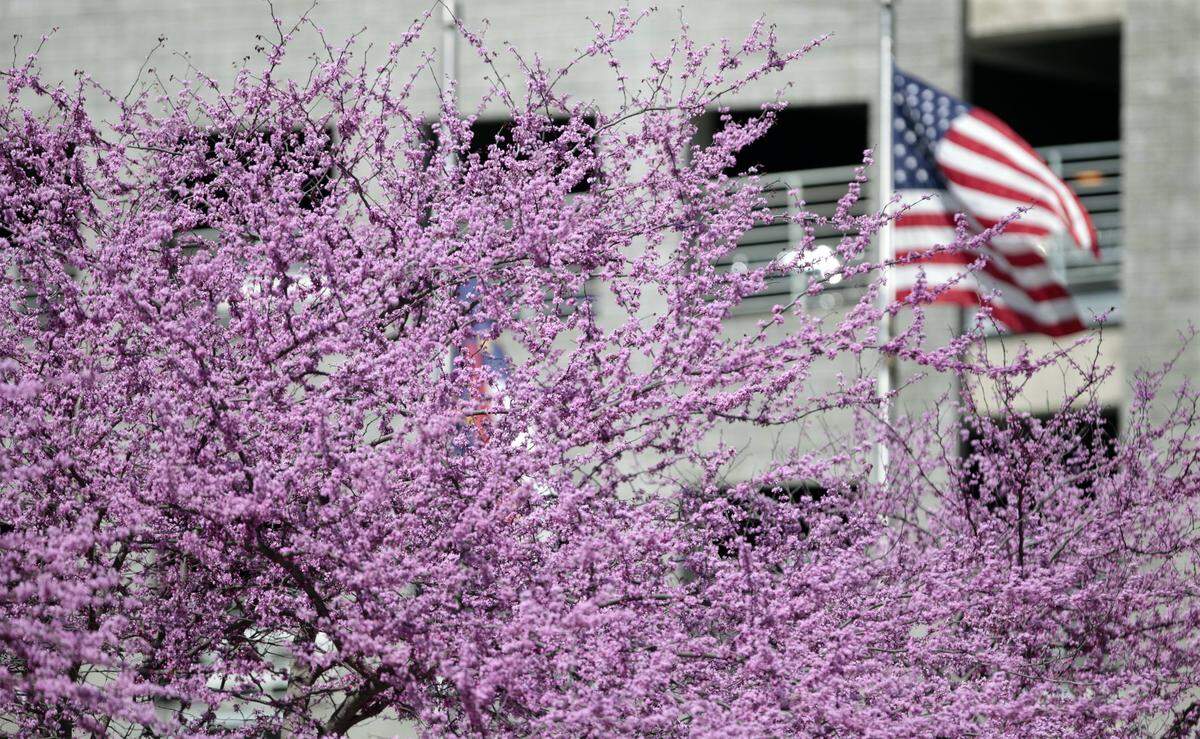
The outdoor advertising industry isn’t asking for the ability to cut dogwoods in the right-of-way, Bugbee said, because “redbuds are a bigger problem.”
He said cutting back vegetation to open up the view of a billboard can be expensive. The bill would levy a fee of $150 per caliper inch — the diameter as measured near the ground — and that cutting a good sized tree could cost $1,000 or more, encouraging owners to be selective.
“In a lot of cases, honestly, it’s going to be like one or two trees, especially the trees smack in the middle of the face,” he said. “There’s going be some instances where it’s more, but the vast majority it’s going to be a handful of trees.”
Roadside beautification study commission proposed
The billboard provision is part of House Bill 198, a larger piece of legislation known as an agency bill mostly containing changes requested by the state Department of Transportation. NCDOT did not ask that the billboard measure be included, said spokesman Jamie Kritzer.
The House passed the bill 108-8. Among those voting no was Rep. Tim Longest, a Democrat from Wake County who proposed an amendment to create a “roadside beautification” commission to study the impact of cutting vegetation along highways and to consider changing how the state regulates billboards.
Longest says he wants to get all interested parties to agree on ways to ensure billboard companies can make a living while preserving the scenic beauty along the state’s highways.
“It seems like every few years, there’s another request to expand the number of trees that are cut,” he said in an interview. “My hope is that we will reach an agreement that all parties can be satisfied with and that will preserve our trees for future generations.”
The outdoor advertising association opposed the amendment. The group doesn’t think the study is necessary, but if there is one, Bugbee said, it should include other businesses and organizations that are permitted to remove vegetation from highway rights-of-way.
Rep. Benden Jones, a Republican from Columbus County and the bill’s primary sponsor, urged House members to vote against the amendment, which failed largely along party lines, 67-48. Longest said he spoke with Jones about working on a study they could both support.
“I think we need to figure out what the exact language is going to be and the scope of the commission and perhaps the membership,” Longest said. “But he definitely was supportive of the idea of a commission to study the issue and to bring all parties, including environmental groups and outdoor advertisers, to the table.”
This story was originally published May 8, 2023 at 5:00 AM.