
NC Gov. Cooper vetoes bill that would limit how state employees can talk about race
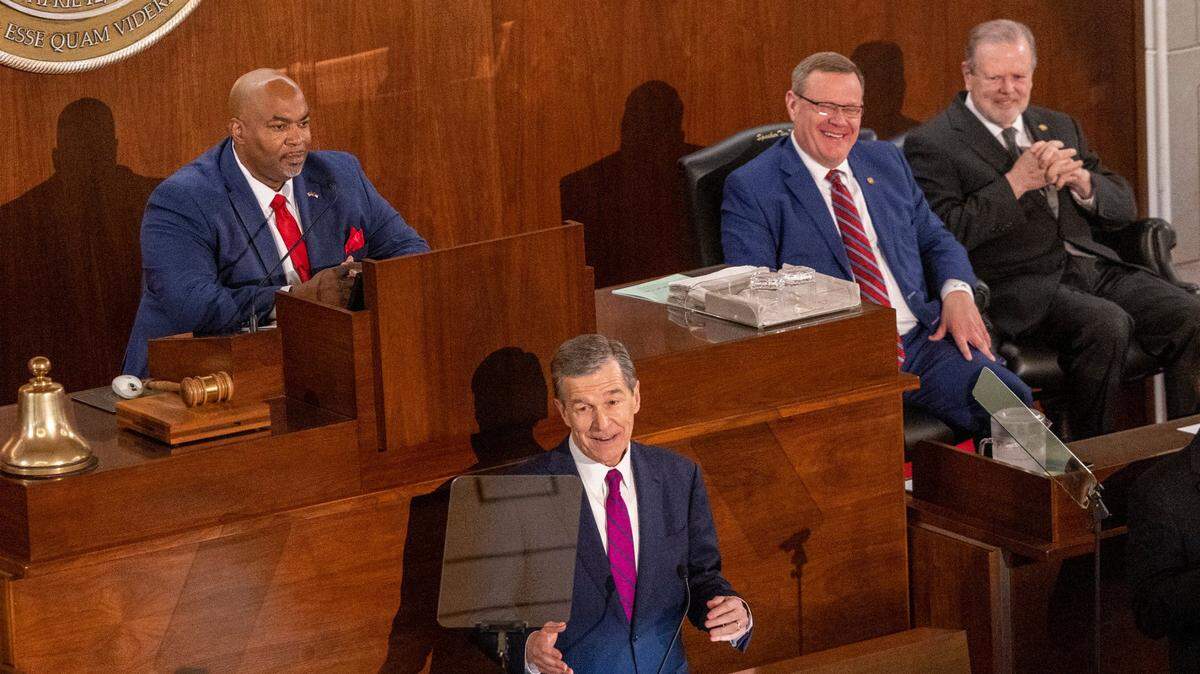
North Carolina Gov. Roy Cooper vetoed a bill Friday that would regulate how state employees can talk about race, citing the “open racism on the floor of the House” in his opposition.
The veto comes weeks after a House Republican apologized for a racist line of questioning during debate on a bill about private school scholarships.
Rep. Jeff McNeely, a Stony Point Republican who is white, asked Rep. Abe Jones, a Democrat from Raleigh who is Black, if he got into Harvard University because he was a minority or an athlete.
“In North Carolina, the diversity of our people is a strength. This legislation attempts to eliminate training that can help us understand the unconscious bias we all bring to our work and our communities. It is troubling that a legislature that witnessed open racism on the floor of the House of Representatives wants to stop training aimed at creating a more effective and understanding workforce,” Cooper, a Democrat, said Friday in announcing the veto.
“Instead of pretending that bias and racism don’t exist, the legislature should instead encourage training that can help eliminate discrimination so we can work toward common goals,” Cooper said.
Republicans have a veto-proof majority by just one vote in both the House and the Senate, meaning they can override Cooper’s veto if everyone in the party votes to override.
For the incident in the House, Jones said publicly and privately that he accepted McNeely’s apology. McNeely lost his leadership position in the House Republican Caucus as a result, but kept his committee appointments.
Jones told The N&O in May that the “greater lesson for the public is he’s not the only person who thinks that way. Being an athlete and a high academic scholar doesn’t mean you just get in (to Harvard) because you’re an athlete or a minority. I think most people know that already. That’s the myth I want destroyed.”
Compelled speech bill
Targeting what it calls “compelled speech” in hiring, Senate Bill 364 would prevent state employees from asking job applicants questions about their “beliefs, affiliations, ideals, or principles regarding matters of contemporary political debate or social action as a condition of employment.”
Republican state lawmakers and the UNC Board of Governors have also sought to crack down on such “compelled speech” in college hiring, saying that, as Rep. Destin Hall put it, “conservatives who are applying to jobs (in higher education are) feeling like they’re getting the shorter end of the stick, because they’re having to make basically compelled speech about something.”
Workplace discussions
During a Senate floor debate in May, one Democrat asked a Republican to define his use of the word “woke” in discussing the bill. The word “woke” is not in the bill. However, wording in the bill is similar to a bill Cooper vetoed in 2021, described as an anti-Critical Race Theory bill, that limits some discussions about race and gender.
The bill prevents state government agencies and institutions from promoting in the workplace, or including in any training, 13 concepts that include:
▪ “One race or sex is inherently superior to another race or sex;
▪ An individual, solely by virtue of his or her race or sex, is inherently racist, sexist, or oppressive;
▪ An individual should be discriminated against or receive adverse treatment solely or partly because of his or her race or sex;
▪ An individual, solely by virtue of his or her race or sex, bears responsibility for actions committed in the past by other members of the same race or sex;
▪ Any individual, solely by virtue of his or her race or sex, should feel discomfort, guilt, anguish, or any other form of psychological distress;
▪ A meritocracy is inherently racist or sexist.”
This story was originally published June 16, 2023 at 5:26 PM.
CORRECTION: A previous version of this article misidentified the race of Rep. Abe Jones.
.jpg)