
NC Gov. Cooper sues over new law, calling it a ‘legislative power grab’

Hours after North Carolina’s Republican-controlled General Assembly successfully overturned a veto from Democratic Gov. Roy Cooper that takes power away from the governor, he sued.
Senate Bill 512, which takes away some appointment power on boards and commissions from the governor and gives it to the legislature and other statewide elected officials, became law Tuesday along with a slew of other vetoed bills.
Described from the start as a separation of powers bill that would end up in the courts — both by Republicans and Democrats — now it has.
“This law is a blatantly unconstitutional legislative power grab,” Cooper said in a statement Tuesday evening.
“Over the years, the North Carolina Supreme Court has repeatedly held in bipartisan decisions that the legislature cannot seize executive power like this no matter what political parties control which offices. The efforts of Republican legislators to destroy the checks and balances in our constitution are bad for people and bad for our democracy,” he said.
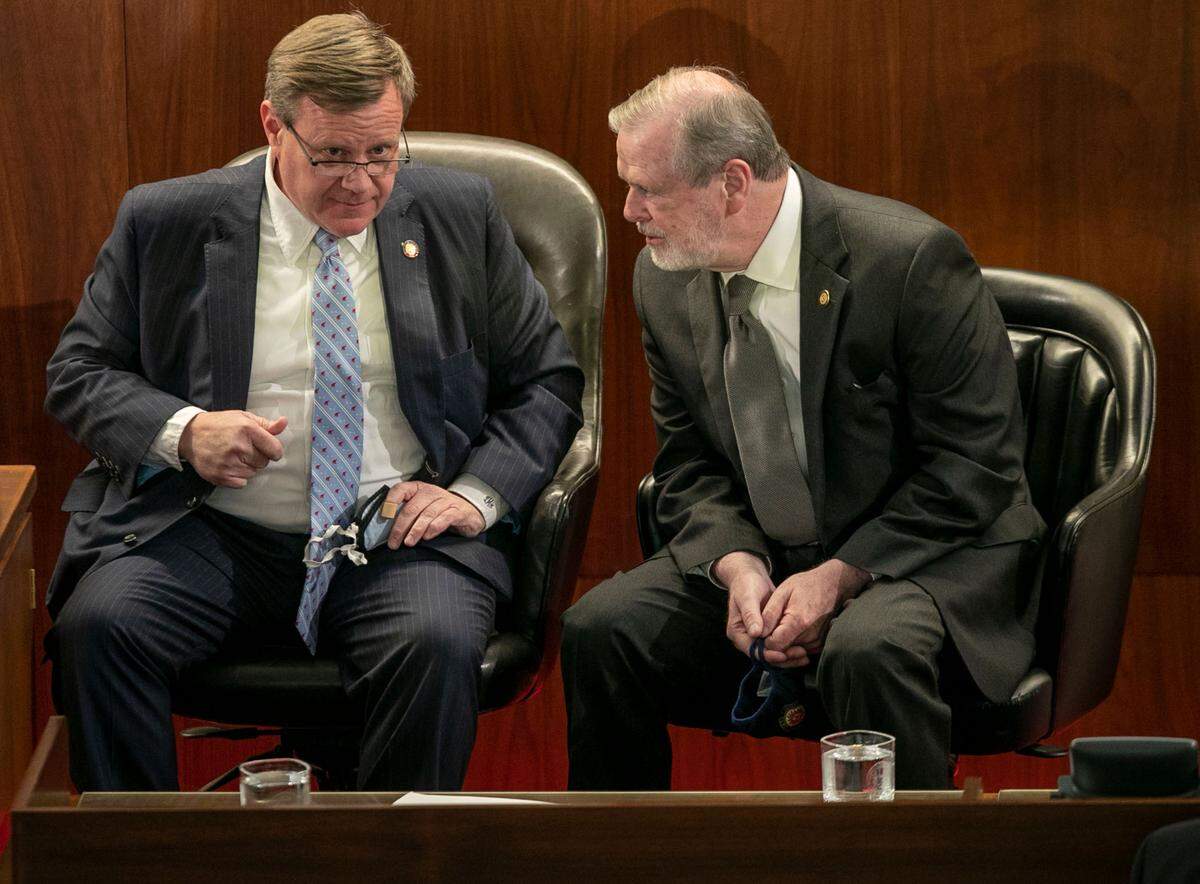
The 55-page complaint filed in Wake County Superior Court is from Cooper in his role as governor against Senate leader Phil Berger and House Speaker Tim Moore in their official roles, along with the state.
The lawsuit argues that “In 2016 and again in 2018, the Supreme Court of North Carolina reaffirmed the separation of powers as a foundational principle of our state government,” and cites previous decisions of McCrory v. Berger and Cooper v. Berger.
“In so doing, the Court held that, in order to fulfill the Governor’s constitutional duties and conform with separation-of-powers principles, the Governor must have sufficient control over administrative bodies that have final executive authority, such as the authority to enforce laws and promulgate rules and regulations, to ensure the laws are faithfully executed,” the suit states.
It also challenges a provision in House Bill 488, which reorganized the State Building Council and created a Residential Code Council. Cooper’s veto of that bill was overridden in August.
Cooper calling SB 512 a “legislative power grab” echoed the debate in the General Assembly on Tuesday before his veto was overturned.
Democratic Sen. Julie Mayfield of Buncombe County said that the legislation “represents an unconstitutional step away from our democratic system of government and toward an authoritarian one.”

House Minority Leader Robert Reives, a Chatham County Democrat, said lawmakers are “creating a monster. We’re creating a legislature that is far beyond what anybody involved in the creation of the constitution had in mind.”
During another debate on the bill this year, House Rules Chair Destin Hall, a Caldwell County Republican, said “even lawyers, judges and our state Supreme Court can’t agree on who has the authority in North Carolina.”
However, top Republican leaders Moore and Berger have said they believe the new law is constitutional.
Former governors and some candidates for governor, from both major parties, opposed the move.
.jpg)