
NC’s Patrick McHenry is offered more power as House passes 10 days without a speaker
As Republican House members fail for another day at electing a new speaker to lead them, Rep. Patrick McHenry is being asked to consider wielding more power to help Congress through the coming weeks.
McHenry, 47, a Republican from Lincoln County, became the House’s temporary speaker after eight Republicans and the entire Democratic conference voted to fire former Speaker Kevin McCarthy from his leadership role last week. McHenry found himself atop a secret list of potential successors McCarthy was required to keep if something were to happen to him to prevent him from fulfilling his duties as speaker.
But there’s debate about whether McHenry is allowed to bring legislation to the floor or if he’s simply there to help facilitate the election of a new speaker.
And after 10 days with Republicans in disarray, even Democrats are telling McHenry they will support a temporary, limited extension of his authority.
That doesn’t mean McHenry will accept.
“He said he doesn’t want to do that,” said Rep. Greg Murphy, a Republican from Greenville. “He said he doesn’t think that is correct.”
The reality that Congress isn’t functioning without a speaker came into sharper focus over the weekend when Hamas made a surprise and brutal attack against the United States’ ally, Israel. As of Friday afternoon, 1,900 people were killed, according to CNN. That includes at least 27 Americans and another 14 who remain missing, reported National Security Advisor John Kirby.
On Friday afternoon a letter from four Democratic members of a group of bipartisan legislators known as the Problem Solvers Caucus was made public that told McHenry they would support extending some of his powers.
“In light of our nation’s pressing issues, a looming government shutdown after Nov. 17, and the attacks on our key ally, Israel, we strongly support an immediate vote to expand the Speaker Pro Tempore’s authorities to allow for the consideration of a legislative agenda limited to the most pressing issues,” the group wrote.
The committee said that his power would be reconsidered every 15 calendar days.
With Scalise out, Jordan is next up
Republicans met throughout Friday, but couldn’t coalesce again behind a single candidate and sent their members home for the weekend while they whip votes. They’re not expected to return to Washington until 6 p.m. Monday.
Majority Leader Steve Scalise was the initial nominee for the speakership, but pulled out Thursday evening when it became clear that he would have to make deals with some Republicans to win the seat. On Friday, ultraconservative House Freedom Caucus leader Jim Jordan became the nominee, but with only 152 of the 217 votes he needs to win a floor vote that includes Democrats.
Right now, Democratic nominee and Minority Leader Hakeem Jeffries has more votes than Jordan and held a news conference Friday afternoon calling Jordan “an extremist extraordinaire.”
Several Republicans said as they left the conference meeting Friday they were sure that Jordan could get the votes after a weekend off.
Others spoke on what would happen if he couldn’t. And whether that meant McHenry would have to step up.
What Republicans say about McHenry’s powers
Rep. Mike Garcia, a Republican from California, said McHenry does not want to take on more power in his leadership position, which would likely require help from Democrats.
“McHenry was emphatic that we’re not a coalition government,” Garcia said. “We’re not a parliament.”
Coalition governments have sometimes been formed in countries with parliamentary systems to present
a cohesive front in national crises or to work on important issues that both parties agree on.
He said that McHenry is confident that a new speaker will be elected.
Rep. Mario Diaz-Balart of Florida said he had hoped the process to replace McCarthy would have gone quickly, and because it hasn’t, his fellow Republicans
may need to look at short-term alternatives that allow them to move forward on some key issues.
“However, we also need to make sure that we don’t do something to further disincentivize the election of the speaker,” he said. “Is that possible? Yes. And can it be done while we’re in this process? Absolutely.”
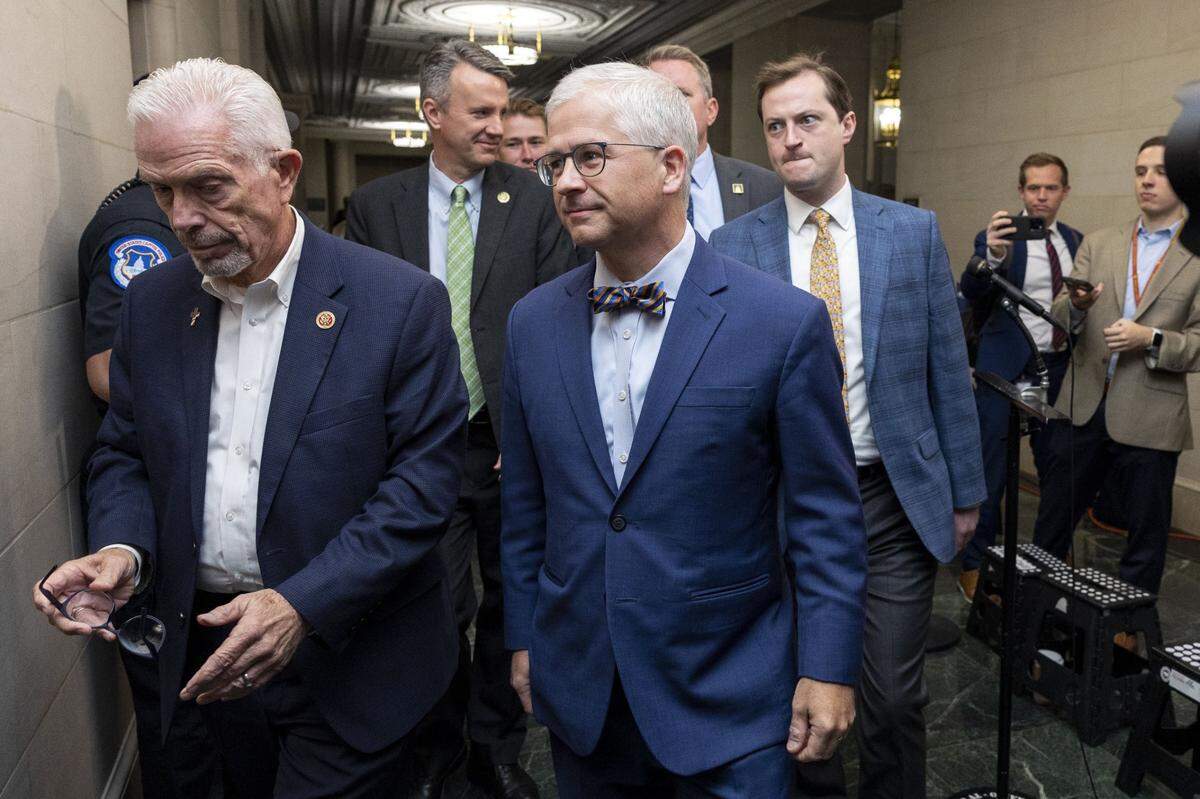
After Republicans’ private meeting, McHenry made his way past reporters on his way outside to an awaiting black SUV. He said little and would not speak to his wishes on extending his authority.
