
An Eastern North Carolina attraction will be overhauled with money from bipartisan law
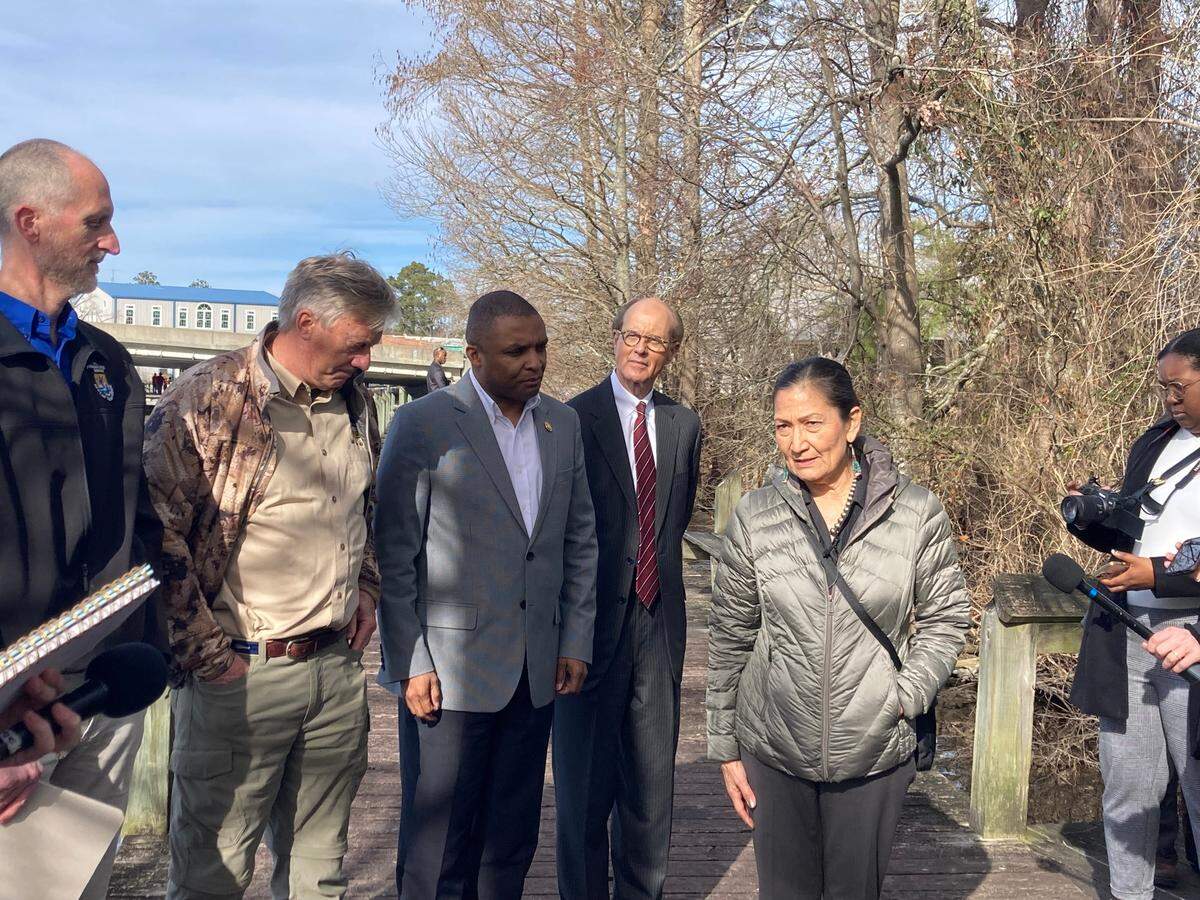
U.S. Department of the Interior Secretary Deb Haaland took a walk along the Scuppernong River Boardwalk Thursday afternoon before she announced a $1.4 million grant to overhaul it.
The Pocosin Lakes National Wildlife Refuge boardwalk was one of 206 projects the department announced Thursday as part of a $157 million investment in ecosystem restoration using money from the Bipartisan Infrastucture Law.
“At a time when tackling the climate and biodiversity crises could not be more critical, these investments in clean water, clean air, wildlife habitat, cultural resources and open spaces will benefit people, wildlife and local economies for generations to come,” Haaland said.
The Scuppernong River Boardwalk allows visitors to see what Haaland called “pristine swamp forest” and educate themselves about the biodiversity of the county they’re passing through. The boardwalk is part of the Pocosin Lakes refuge, a non-contiguous collection of about 110,000 acres spread across Hyde, Tyrrell and Washington counties.
When drivers are on their way to the Outer Banks, the boardwalk and visitor center is one of the last significant landmarks they’ll pass before reaching Manteo.. It’s folded along the eastern side of the river, wending along its bank for a time before looping through a cypress swamp.
Access points like the boardwalk help people who may not otherwise experience ecosystems like Pocosin Lakes begin to develop a connection to them, N.C. Wildlife Federation CEO Tim Gestwicki told The News & Observer.
“If there’s no connection or you just see it on TV or read about it in a book, why would you care about it? So outdoor experiences create the fostering of awareness and appreciation for natural resources,” Gestwicki said.
About 30,000 people visit the refuge annually. U.S. Fish and Wildlife Service officials tout the chance to see more than 100,000 migratory birds on its waters each winter and black bears in its fields and forests.
David Clegg, Tyrrell County’s manager, stressed the importance of ecotourism to his county’s economic well-being, noting that the phrase “business is in our nature” is painted on the side of the county administrative building.
“We are here together to protect this area, we are here to preserve this area, we are here to promote this area and we are here to profit from this area,” Clegg said.
‘How does this affect Tyrrell County?’
In his remarks Thursday, Clegg emphasized just how important the Department of the Interior’s various agencies are to Tyrrell County.
The county is home to two U.S. Fish and Wildlife Service national wildlife refuges that serve as vital habitat for red wolves, black bears and numerous other species. But Clegg also mentioned the Bureau of Ocean Energy Management and his hopes that Tyrrell County stands to benefit if an offshore wind industry takes hold in North Carolina. And the U.S. Geological Survey is vital to helping the low-lying county cope with future flooding.
“In so many of your decisions going forward, I really, not humorously, want you to think, ‘How does this affect Tyrell County?’ Because so much of what you do does,” Clegg said.
A timeline for when work on the boardwalk will start and finish was not immediately available.
North Carolina will be one of five states that is part of a project to build seagrass seedbanks in national parks and one of seven states where the U.S. Geological Survey works to restore mines in a way that protects environmental health, both projects funded in this round.
In previous rounds of ecosystem restoration funding, North Carolina-based projects have included $1 million to restore the Mattamuskeet National Wildlife Refuge and $33,000 for the National Park Service to detect and control feral swine.
“We have an obligation to our world, and together we can build a future in which we respect nature, restore balance to our environments and value every living creature on this planet,” Haaland said.
This story was produced with financial support from the Hartfield Foundation and Green South Foundation, in partnership with Journalism Funding Partners, as part of an independent journalism fellowship program. The N&O maintains full editorial control of the work. If you would like to help support local journalism, please consider signing up for a digital subscription, which you can do here.
This story was originally published February 8, 2024 at 5:13 PM.