
Republican officials want to pick the judge who hears lawsuit over NC casino claims
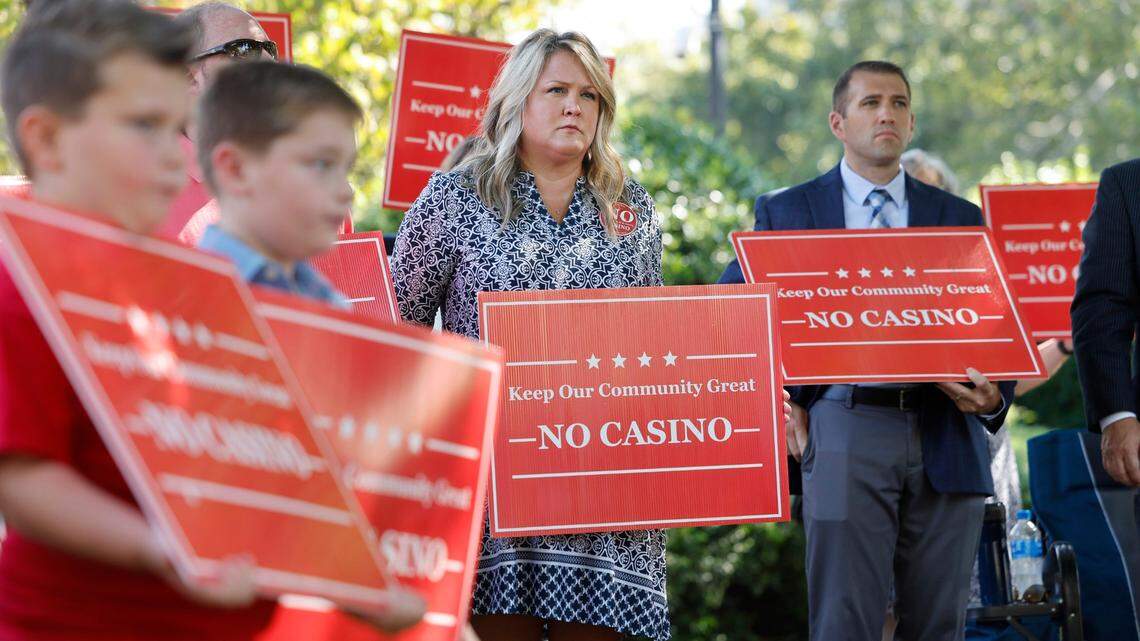
Republican officials named in a defamation lawsuit surrounding failed efforts to bring new casinos to North Carolina are asking for a specific judge to hear the case — one who has ruled in favor of casinos before and has worked for one of the state’s top lawmakers.
On July 12, lawyers representing defendants in the lawsuit filed a motion requesting Clayton Somers as the judge in the case. Defendants include Kevin Berger, a Republican Rockingham County Commissioner and son of Senate leader Phil Berger, as well as other Republican county commissioners, the local GOP chair and three political organizations.
Somers, a former UNC-Chapel Hill administrator who helped broker the university’s settlement over the Confederate Silent Sam statue, became a special Superior Court judge last year on the recommendation of Republican House Speaker Tim Moore.
That was after Republican state lawmakers included a provision in the state budget allowing themselves to appoint 10 additional special Superior Court judges. Although most judges in North Carolina are elected, these special judgeships have typically been appointed by the governor — not legislators.
In this case, lawyers for Berger and the other defendants are requesting Somers to be the judge by asking the court to deem the case “exceptional,” a designation typically afforded to complex cases with many defendants who have diverse interests. Unlike most civil suits, exceptional cases have one judge overseeing the entire process from start to finish.
Berger’s lawyers say this case should be considered exceptional because it could involve extensive discovery disputes and also involves “multiple public officials, some of whom are currently in office, and other political issues.”
Craig Travis, a former Republican Rockingham County Commissioner who brought the lawsuit, disagrees.
“Neither the familial relationship of any defendant to a person in a position of power nor the likelihood that relevant evidence may be in the possession of state legislators and/or employees should render this case exceptional,” Travis’ lawyers wrote in a court filing.
As Berger’s lawyers point out in their court filing, Somers recently ruled in a case involving the same casino proposal at issue in this lawsuit.
The filing says the case would benefit from a judge “who is familiar with this litigation and issues in dispute,” and therefore could “ensure uniformity and consistency of rulings on the multiple issues anticipated.”
In the prior casino lawsuit, a camp for children with special needs sued Rockingham County for rezoning nearby land to allow a casino to be built.
Somers ruled in the county’s favor, dismissing the camp’s lawsuit.
In Travis’ lawsuit, which was filed last month, he alleges that during the 2024 Republican primary campaign, other county commissioners and political organizations defamed him in attack ads stemming from his opposition to allowing a casino in Rockingham.
Ultimately, plans to build new casinos in Rockingham and other counties were scuttled when state lawmakers failed to negotiate a deal to approve them last year.
Travis’ lawsuit notes that out-of-state casino executives gave campaign contributions to top state lawmakers and alleges that Rep. Jason Saine, a key proponent of gambling legislation, pushed a political organization to prepare a document in support of legalizing casinos after he received his donation.
Saine said nothing alleged about him in the lawsuit is true.
Who is Clayton Somers?
Before becoming a judge, Somers served as chief of staff to Speaker Moore from 2015 to 2017.
After that, he became vice chancellor of public affairs at UNC, where he helped negotiate the university’s controversial deal with the Sons of Confederate Veterans to take Silent Sam, a Confederate monument, off campus.
The deal, which was orchestrated behind closed doors and was later overturned by a judge, first involved the UNC System paying SCV $74,999 to discourage the group from suing the university and restrict the group from holding events on the system’s campuses, The N&O previously reported.
Three months after initially approving the settlement, Judge Allen Baddour voided the agreement and dismissed the case.
Somers later took a newly created administrative position in UNC’s athletics department. His last day in this position was Dec. 31, 2023 (the day he became a judge), UNC media relations said.
When Republican lawmakers wrote the state budget last year, they included the provision allowing themselves to appoint 10 special Superior Court judges.
The budget also stated that the judges appointed by lawmakers would be allowed to serve on panels reviewing the validity of laws passed by the General Assembly.
After the budget passed, Moore tapped Somers to become one of those special judges, including him in a wide-ranging appointments bill passed by the legislature.
What is an exceptional case?
North Carolina’s judicial rules allow for certain cases to be designated “exceptional” depending on how many parties are involved, how diverse their interests are, how complicated the discovery process will be and the complexity of the legal issues involved.
In addition to allowing parties to request a judge with background knowledge of the specific legal issues, the designation also guarantees that parties will stick with the same judge throughout the entire process.
In most cases, “You’ve constantly got to be educating the judge by way of giving background on the case,” Kieran Shanahan, a Raleigh attorney, said.
While exceptional cases aren’t common, it isn’t unusual for parties to request a specific judge with knowledge of the matter, Shanahan said. Though, in his experience, these motions usually have the support of the plaintiffs and the defense — unlike in this case.
Shanahan, a Republican who served as secretary of the state Department of Public Safety under Gov. Pat McCrory, said there aren’t any rules prohibiting lawyers from trying to find a judge they think would be helpful to their case.
“Lawyers are always trying to do what’s best for their client,” he said. “I’m sure there’s some thought that goes into ‘who would be the best judge?’ ... The rules themselves don’t preclude a lawyer trying to strategize that part of their case out.”
The motion to designate the case as exceptional could go to a hearing before a judge decides on it. While the Superior Court can recommend the designation, the decision ultimately goes to the chief justice of the Supreme Court, Republican Paul Newby — who would also assign the judge.
