Pace of NC hurricane relief improving, but nearly 2,000 still wait for aid and housing
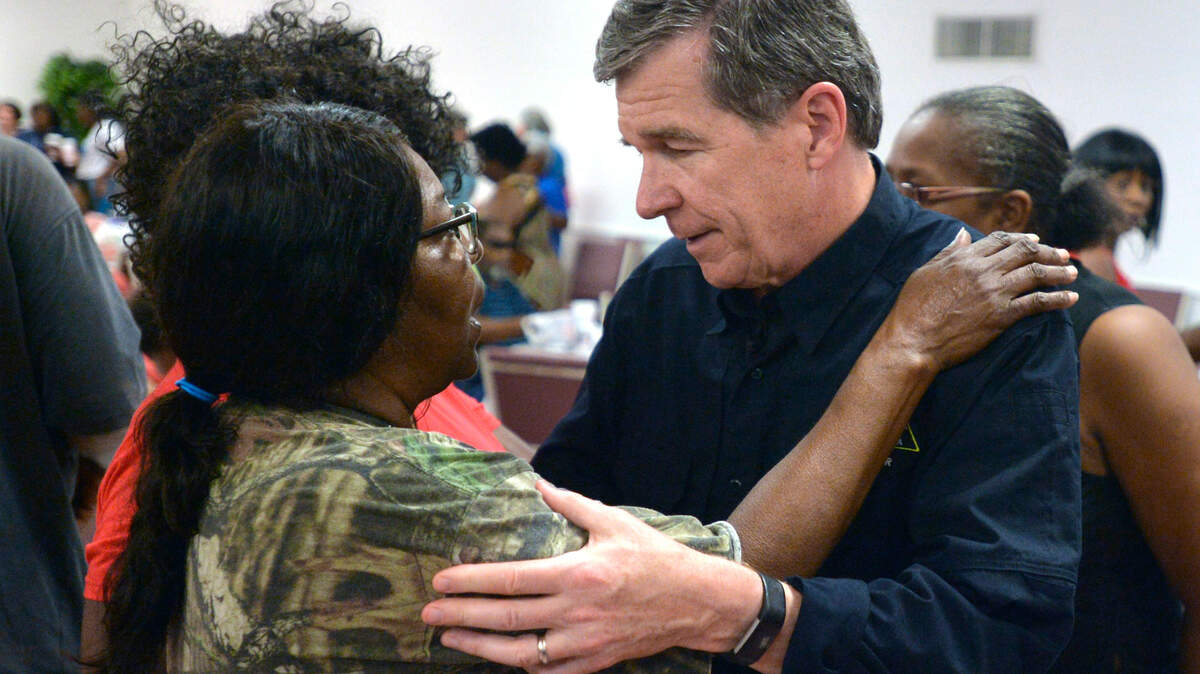
Nearly 2,000 North Carolinians are still waiting on repairs to their homes following flooding and damage from hurricanes Matthew and Florence, which struck the eastern part of the state more than five years ago.
But the North Carolina Office of Recovery and Resiliency — the agency tasked with these recovery efforts, which has faced the brunt of public scrutiny — has been making progress in comparison to past years, according to data shared by the agency.
To aid with rebuilding and repairing many of the homes damaged by the hurricanes, the state received $236.5 million for Hurricane Matthew and $542.6 million for Hurricane Florence from the federal Department of Housing and Urban Development.
However, aid was slow to materialize, and many people and families remained homeless for years after the storms. Matthew hit the state in 2016, followed by Florence in 2018.
HUD approved the state’s spending plan for Florence and Matthew in 2020. The application period for aid under the Homeowner Recovery Program opened in June 2020 and closed in April 2023.
Hurricane recovery efforts in the state span various organizations and officials. NCORR — which is also called Rebuild NC — was established in 2018 by the legislature, and is overseen by Democratic Gov. Roy Cooper. It resides within the Department of Public Safety, led by Secretary Eddie Buffaloe Jr., who is part of Cooper’s cabinet. Cooper this year also assigned Pryor Gibson to monitor NCORR’s operations, NC Newsline reported. Last year, Richard Trumper, former executive director of disaster recovery with the Office of State Budget and Management, joined DPS as senior advisor for disaster recovery.
Asked for a comment from Cooper on the recovery efforts, a spokesperson, Jordan Monaghan, said in a statement that the “Cooper Administration has overseen the repair and rebuilding of more than 13,600 homes along with hundreds of roads, bridges, and public buildings in the wake of these devastating hurricanes.”
“Despite many federal bureaucratic obstacles, NCCORR has made significant progress getting families back into stronger and more resilient homes and has outperformed other states that received this same federal grant in 2018. They will continue the effort to help families and communities rebuild,” he said.
What the data shows
According to data shared by NCORR spokesperson Bridget Munger, 2,459 applicants have had their cases completed. Of those, 2,319 had their homes repaired or replaced and 140 were reimbursed for repairs, Munger said.
One of those who is back in a home is Clara Staten, who applied for help through NCORR after her mobile home was damaged in succession by Matthew and Florence.
She finally moved into a new mobile home in December 2023 after years of waiting. Staten thinks it’s because she constantly was reaching out to NCORR leadership and pushing for answers, including attending a Sept. 14, 2022, hearing lawmakers held to question NCORR leadership. Staten said she got her award letter in October, one month after attending the hearing and speaking with NCORR employees who attended.
“I raised hell with them,” she said, “But there’s several people that I know that have not ended up like me. A lot of people don’t know what their rights are. They don’t know what they don’t know.”
While waiting for aid, Staten said she remained living in her home — despite water damage, mold on the walls and the roof falling into the bathroom — with her two sons, stepdaughter and two grandchildren.
She said she also got some aid from FEMA to make some necessary repairs to remain living in her home. She did not want to find herself stuck in a motel for years, like some NCORR applicants have been, she said.
Staten’s grandmother’s home was also damaged by the hurricanes. She also applied for help but died — at the age of 104 — while waiting, Staten said.
“Anybody that was of age, they should have been given priority. She died and never got to see her house,” Staten said.
But 1,895 applicants remain waiting, according to Munger. These applicants are in different stages of the application process, which has eight steps and begins at intake and ends with completion:
- No applicants are in steps 1 through 3, which are intake, eligibility determination and duplication-of-benefits review.
- 7 applicants are in step 4, inspection and environmental review.
- 120 applicants are in step 5, award determination.
- 1,078 applicants are in step 6, the contracting and bidding process. Of those, 972 projects are awarded to contractors and 106 are in the bidding phase.
- 690 applicants are in step 7, the construction phase.
- The remaining applicants are the 2,459 families that have reached the completion step.
Janet Kelly-Scholle, an NCORR spokesperson, said that the agency “anticipates having all awards in the hands of homeowners by the fall of 2024.”
Pressure on NCORR
For years, state lawmakers have pressed leadership tasked with recovery efforts on delays, expressing concerns about the lack of accountability and transparency with companies contracted for repairs and rebuilds.
Data presented to state lawmakers by Laura Hogshead, chief operating officer of NCORR, at the September 2022 hearing showed that 789 applications had reached completion. During that presentation, she attributed delays to supply-chain challenges during the COVID-19 pandemic and federal red tape associated with using the HUD funds.
On Dec. 14, 2022, she presented data showing that 889 applications out of 4,313 had been completed. This meant that since the September meeting, 74 construction projects had been completed, while 26 families chose a reimbursement option, Hogshead said in December 2022. The average application completion rate was at 17 at the end of November 2022, Hogshead said.
Things are running faster now, according to Kelly-Scholle, who said that between August and December of 2023, NCORR completed an average of 64 homes per month.
NCORR has averaged more than 100 homes completed per month since January, and in June, 117 families moved into the completion step, Kelly-Scholle said.
Previously, North Carolina was labeled a “slow spender” by HUD. It no longer is, according to recent reports.
“NCORR is completing more homes per month than any grantee in the nation,” said Hogshead in an email statement to The News & Observer.
Kelly-Scholle said this calculation was made by comparing HUD reports and contacting other states to verify and that NCORR agency anticipates “helping every eligible applicant” and spending funds before deadlines set by HUD.
“NCORR is working with local municipalities and with nonprofit organizations to resolve these issues. The complexity of resolving these applications is part of the reason that HUD” gives states years for funds to be spent, Hogshead wrote.
Legal Aid of North Carolina’s Disaster Recovery Project has been assisting survivors of the hurricanes with legal issues they face with NCORR.
Emily Smiley, supervising attorney with the group, told The N&O that “many of our clients still awaiting construction have faced some hurdle along the way, mostly related to NCORR policies such as proving ownership.”
“Others do not have any significant hurdles and have just seen NCORR’s process move very slowly, typically waiting for months or years to be moved from one ‘step’ of the program to the next. Few of our clients have seen significant delays due to external actors such as permitting offices or co-owners, although these issues have arisen from time to time,” she said in an email.
She also said that now they are seeing clients with concerns about the quality of construction on their homes and the lack of a quick response — or any response at all — to warranty claims.
Smiley also said that, as far as Legal Aid was aware, most nonprofits no longer have funding to assist Matthew and Florence survivors.
Money spent
- Of the $236.5 million received for Hurricane Matthew, just over $231 million has been disbursed. NCORR has until Aug. 15, 2025, to spend the money and anticipates spending it by fall of 2024, Kelly-Scholle said.
- Of the $542.6 million received for Hurricane Florence, just over $434 million has been disbursed. NCORR has until Aug. 17, 2026, to spend these funds and anticipates spending them by the fall of 2025, said Kelly-Scholle.
This story was originally published August 1, 2024 at 11:13 AM.