
Season’s 1st endangered North Atlantic right whale spotted off NC. How to protect it.
Scientists have spotted the first endangered North Atlantic right whale headed south for the winter off the Outer Banks, and they’re warning boaters to heed speed reduction rules to protect the species.
There are about 370 North Atlantic right whales alive, with the species threatened by strikes from fast-moving vessels and entanglements with fishing gear. The whales typically live off of the Northeastern coast in summer before migrating to warmer waters off the Southeast coast and Florida in the winter months to breed and give birth.
Wednesday, a team from the Clearwater Marine Aquarium Research Institute spotted a whale known as Black Heart off of North Carolina. The 19-year-old whale was about two nautical miles east of the Cape Lookout National Seashore’s High Hills, according to a release from the aquarium.
Black Heart is one of about 70 reproductively active female North Atlantic right whales and is known to have given birth to one calf. She is the first whale spotted in the Southeast during the 2024-25 calving season.
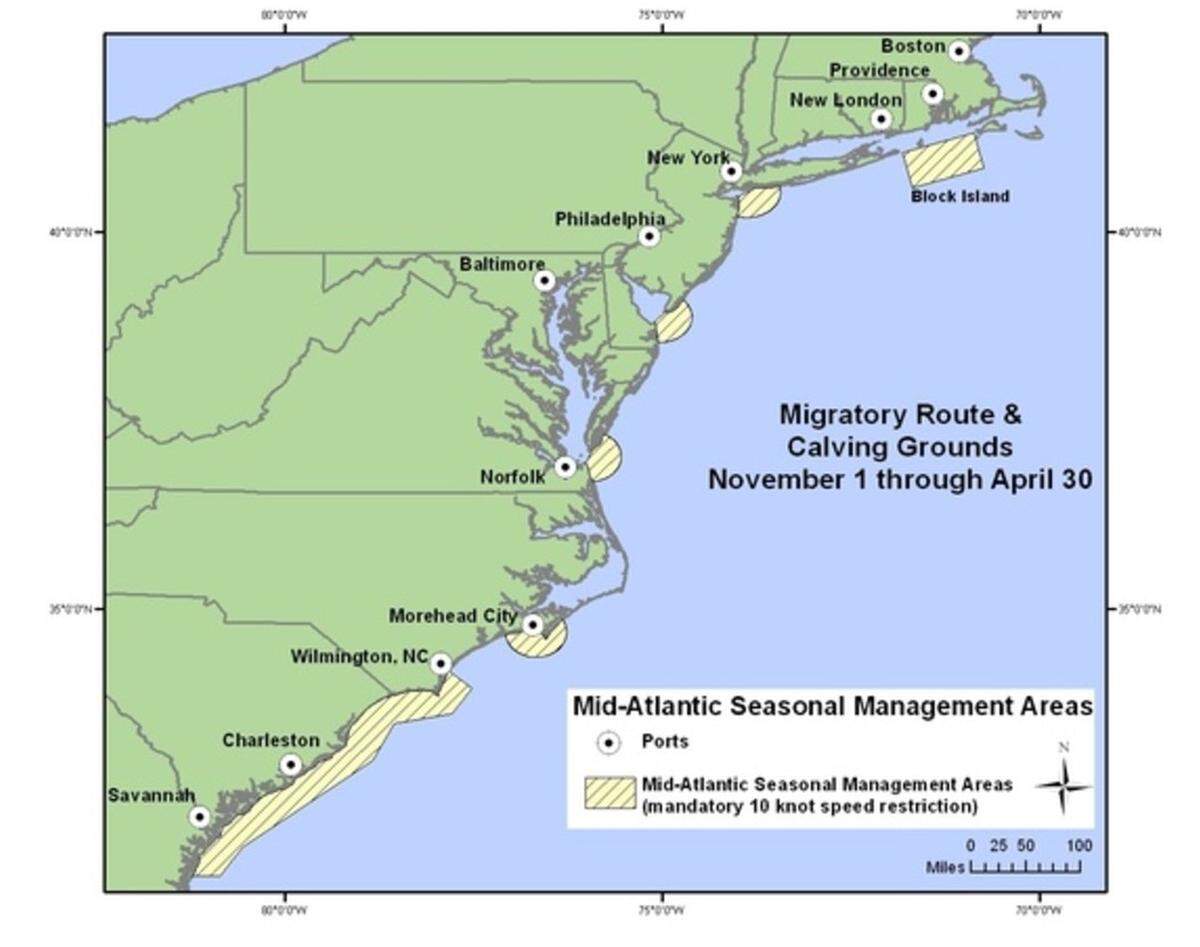
To protect the whales, the National Oceanic and Atmospheric Administration has established seasonal vessel speed regulations. Off of the North Carolina coast, those rules mandate that most boaters whose vessels are more than 65 feet long do not top more than 10 knots in areas of the Atlantic Ocean around Morehead City and Wilmington between Nov. 1 and April 30.
NOAA also encourages smaller vessels to keep speeds below 10 knots..
“It is extremely important through these seasonal management areas to provide a safe haven for mothers and calves in the only known calving ground for this species,” James “Buddy” Powell, the aquarium’s executive director, said in a press release.
Threats to an endangered species
North Atlantic right whales are slow swimmers, typically going just over 2 mph and almost reaching 6 mph at top speed.
During winter months, the whales tend to live in shallow water near the coast where they breed and calve. And they spend much of their time near the surface, NOAA scientists wrote in a 2022 memo, especially in the mid-Atlantic when they are migrating rather than diving to eat.
In the 17th and 18th centuries, this meant they were easy for whalers to kill, prized for the long baleen hanging from their mouths that could be used for crossbows or umbrella frames, among other uses. Whalers also valued their blubber.
Now, that slow pace and tendency to be found in shallow waters leaves the whales vulnerable to vessel strikes that can maim and ultimately kill them. Further adding to the risk is the whale’s dark color and lack of dorsal fin, which can make it difficult for boaters to see.
Beginning in 2017, NOAA said that North Atlantic right whales have been undergoing an “unusual mortality event” caused by human impacts. The species’ deaths are outpacing its births and, NOAA said on its website, “Endangered North Atlantic right whales are approaching extinction.”
Since the unusual mortality event was declared, 41 North Atlantic right whales are known to have died, according to NOAA. Vessel strikes were the leading cause of death, killing 15 whales, followed by entanglement with fishing gear, which caused 10 deaths.
In 2024, vessel strikes have killed three North Atlantic right whales, including one calf and the mother of another calf that has since gone missing and is presumed dead.
A NOAA dashboard indicates that between North Carolina and Georgia, boats complied with the speed zone rules nearly 69% of the time during the 2023-24 season, with pleasure boats and container ships the most frequent violators. In total, NOAA recorded boats traveling about 440,000 nautical miles in the area, with 137,572 of those traversed above the 10 knot limit.
Could more speed restrictions help?
NOAA has proposed changes to the vessel speed reduction rule that would widen its mandate to any vessel longer than 35 feet and broaden the area covered to include the entire North Carolina coastline between Nov. 1 and April 30.
The rule was proposed nearly 850 days ago and has not yet been finalized by the Biden administration.
It has met significant opposition from some members of North Carolina’s congressional delegation. In April, Rep. Greg Murphy released a statement saying that finalizing it would be destructive to boatbuilders and fishermen. Sen. Thom Tillis has also joined a group of senators who told NOAA in 2022 that finalizing the rule could jeopardize ports and ocean industries and that the rule should be modified to protect both the whales and the economy.
Updating the rule is necessary to protect the whale, environmental groups and scientists say.
The 2022 memo from NOAA scientists found that expanding the speed zones would reduce North Atlantic right whale vessel strike mortality by an average of 27.5% That memo also found that vessel strikes pose the most risk to the whales in areas between Cape Hatteras and New York where a high number of ships are approaching large ports.
In an October press release, Gib Brogan, a campaign director at environmental nonprofit Oceana, said, “President Biden must approve and implement the updated vessel speed rule soon, before we see moms and calves on our shores this calving season instead of in our waters.”
This story was produced with financial support from the Hartfield Foundation and Green South Foundation, in partnership with Journalism Funding Partners, as part of an independent journalism fellowship program. The N&O maintains full editorial control of the work. If you would like to help support local journalism, please consider signing up for a digital subscription, which you can do here.
This story was originally published November 23, 2024 at 6:00 AM.