
A Sampson County hog waste-to-energy project could benefit from Helene relief bill
Efforts to generate energy from hog waste in Eastern North Carolina received a jumpstart from a provision tucked into the 90th page of a bill passed last year that was originally supposed to focus on Hurricane Helene relief.
Current law allows energy projects that generate electricity or other energy from hog waste to claim a credit for every megawatt-hour of power they produce. The amended law would let power generators using swine waste in the state’s 40 most economically distressed counties sell three times as many credits as they generate for eight years, then twice what they generate for an additional six years.
Those so-called “Tier 1 counties” include both Duplin and Sampson counties, the epicenter of the state’s hog-growing industry. The higher number of credits could also make it easier for the state’s utilities to meet their requirements of a long-elusive hog waste-to-energy standard.
The provision was included in Senate Bill 382, legislation introduced after last November’s elections that was supposed to be about hurricane relief, but that largely focused on tweaking appointments and taking power away from Democrats, including Gov. Josh Stein. To pass the bill into law, Republicans in the General Assembly overrode a veto from then-Gov. Roy Cooper.
Montauk Renewable Energy’s project just outside of Turkey, near the Sampson-Duplin county line, is an example of one that would benefit from the enhanced credit, Rep. Jimmy Dixon told The News & Observer. Dixon, a Duplin County Republican, chairs the House Agriculture Committee.
The Pittsburgh-based company plans to dewater hog waste at nearby farms, then ship the physical material to the facility in closed-container trucks. The waste will be fed through a series of ovens, heating it up to generate biogas that will be piped to a series of microturbines, where it will generate electricity that it plans to sell to the nearby Four County Electric Membership Corporation.
That means Montauk’s products include both the sale of electricity and the sale of the renewable energy credits. It also plans to sell biochar, the dirt-like material left over after the waste is burned.
“Now you as a company are able to sell three times as many RECs, get three times as much income to pay off your investment and the utilities are able to buy and retire those RECs to meet their requirement much easier,” said John Ciroli, Montauk’s chief legal officer.
Hog waste to energy projects
There are a number of Eastern North Carolina projects underway to convert swine waste into energy. And not all of them are eligible for the enhanced credit.
The most common is a method referred to as “renewable natural gas” and championed by Align RNG, a $500 million joint venture between Smithfield Foods and Dominion Energy.
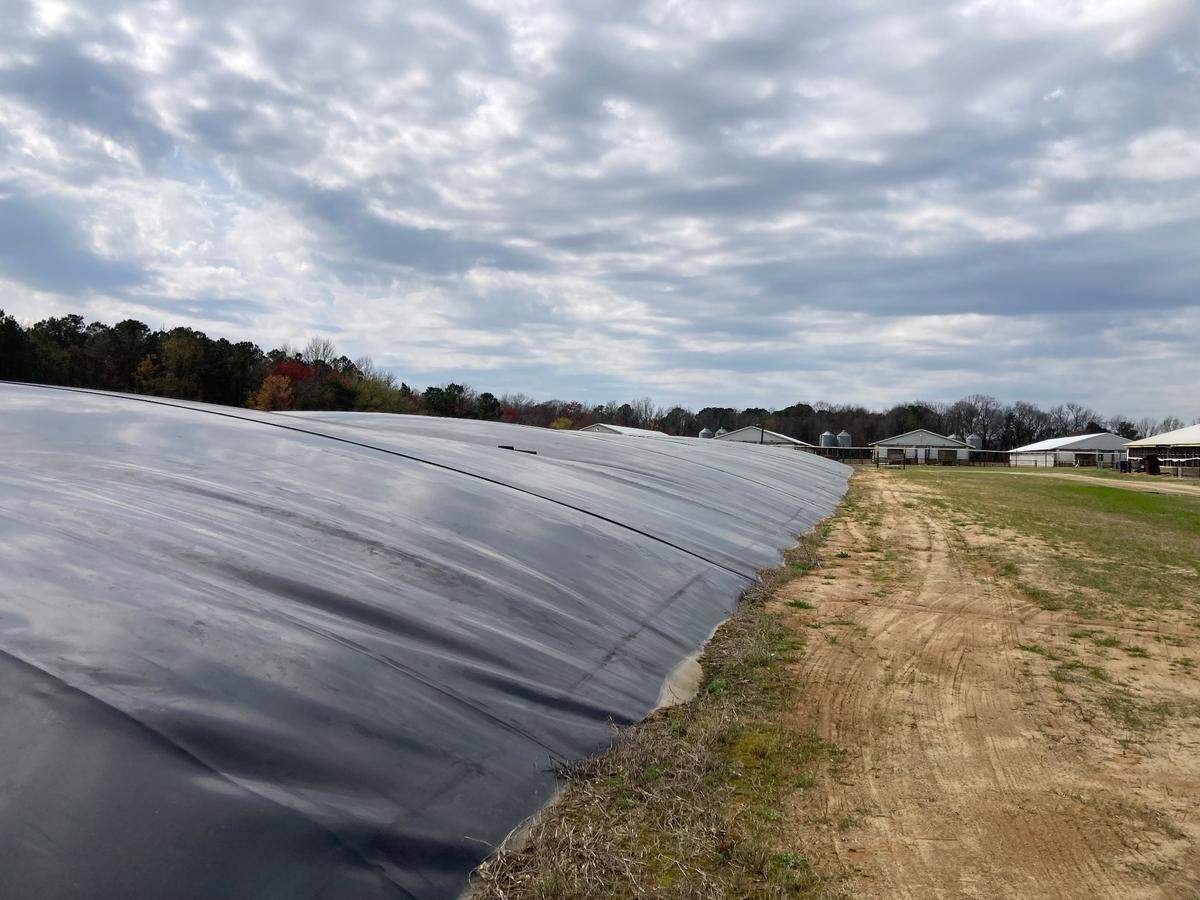
Farms that partner with Align funnel swine waste into lagoons underneath tarp-like coverings that are thick enough that someone can walk on them. Over time, methane and other gases waft upward from the waste pits. Those gases are captured and piped to a centralized processing facility where they are treated before being injected into a utility’s distribution system.
Senate Bill 382’s swine waste provision doesn’t seem to apply to either the so-called digesters on farms or to the renewable natural gas processing facilities, Roy Lee Lindsey, the N.C. Pork Council’s CEO, said in a statement. That is largely because neither the farms nor the gas processing facilities generate electricity on site, therefore they do not generate renewable energy credits.
Lindsey said the trade group neither requested nor lobbied for the enhanced credit but does support it.
“We believe this provision represents an opportunity for North Carolina to support promising technologies that may benefit the agricultural community and positively impact rural economies,” Lindsey wrote.
The Pork Council and other supporters of biogas have argued that capping lagoons slashes methane emissions and cuts down on odor concerns. Opponents argue that any method that perpetuates the practice of sending untreated hog waste into lagoons and spraying liquids from them onto nearby fields poses risks, particularly to nearby groundwater.
Blakely Hildebrand, a senior attorney at the Southern Environmental Law Center, said the General Assembly has been keen to support biogas development in recent years, including a provision in 2021’s Farm Act that created a general permit process for anaerobic digesters over lagoons.
Montauk’s project
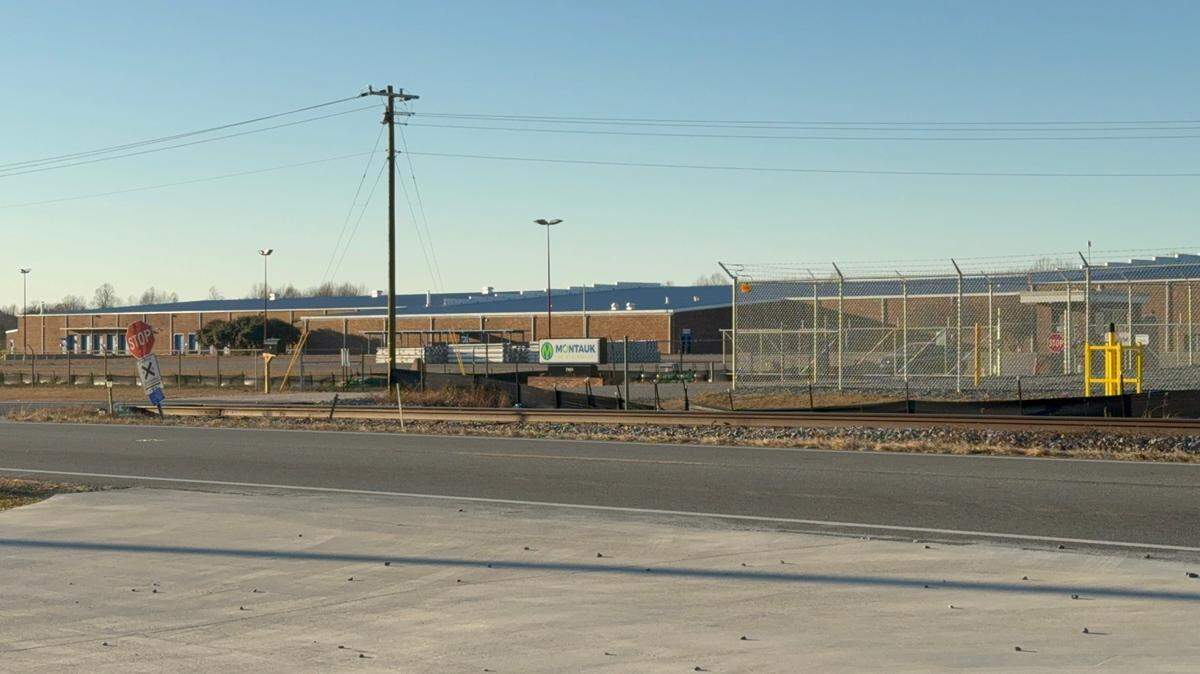
Montauk is nearing completion of a 500,000-square-foot facility in Turkey, on the eastern edge of Sampson County.
From Highway 24, the most visible evidence of Montauk’s presence is a pair of blue silos bearing the company’s logo, structures that Ciroli said are part of the warehouse’s fire suppression system. The heart of the operation sits inside the 900,000-square-foot warehouse set back from the road, behind security fences.
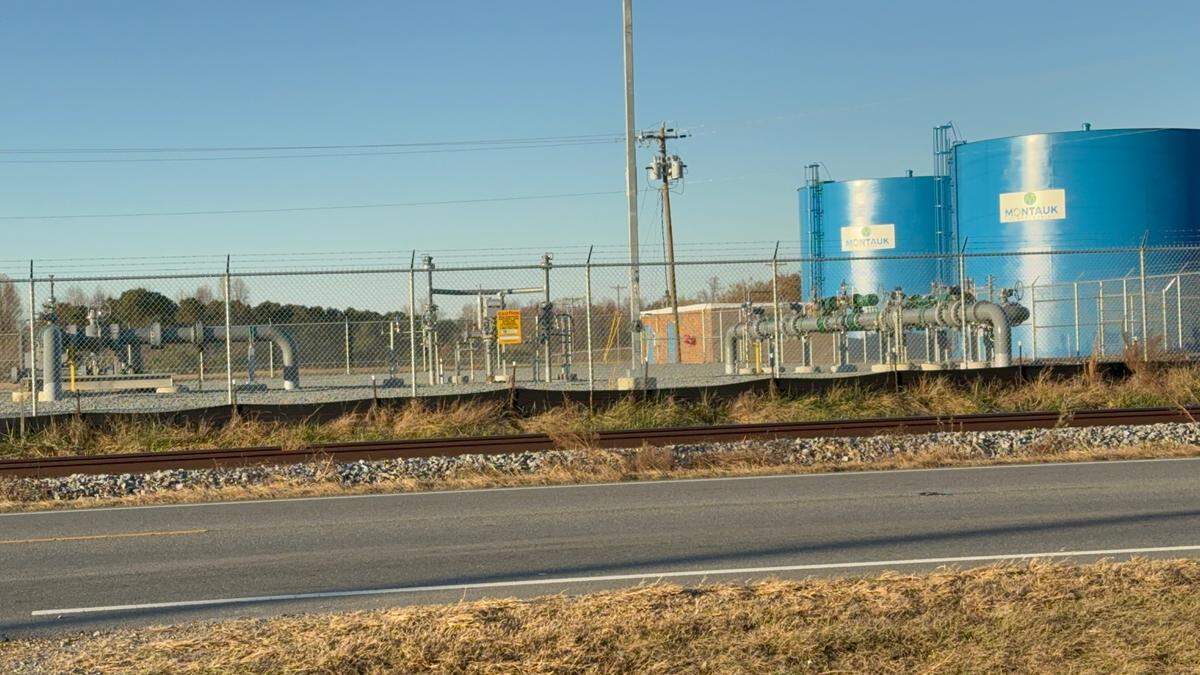
After being trucked to the warehouse, hog waste would be heated until it creates biogases. Those gases would then be used to power microturbine generators, creating electricity.
After passing through the system of ovens, there is a left-over biochar product that Montauk expects to sell as fertilizer, Ciroli said. Montauk is also exploring using the energy on-site, sending the electricity to electrolyzers where it would be combined with water to generate green hydrogen.
“It’s going to be a facility that is a showpiece of what we’re doing with hog waste,” Ciroli said.
In a N.C. Utilities Commission filing, Montauk officials said the Sampson County facility could become operational in the fourth quarter of 2025. The company has spent nearly $25 million on the facility, including $820,000 for land acquisition, according to a November presentation to investors.
Per filings with the Utilities Commission, Montauk’s Turkey facility could generate as much as 70,737 credits annually, with each renewable energy credit representing a megawatt-hour of electricity.
With the enhanced renewable energy credit, Montauk could sell about 212,000 swine waste credits for an eight-year period and 141,000 credits for six years after that.
Creating the enhanced renewable energy credits could spur investments in technologies like Montauk’s, Ciroli said, helping companies in North Carolina generate enough energy from swine waste that utilities can meet their obligations under a 2007 law.
“This is just something that is enabling businesses to know that they can come into the state and be able to get back the investment in a timely manner so that they can be sure that it’s going to be something that is going to work,” Ciroli said.
NC’s hog waste to energy law
North Carolina created its Renewable Energy Portfolio Standard with 2007’s Senate Bill 3. Under the law, 12.5% of Duke Energy’s power must come from carbon-free resources, while electric cooperatives and municipal utilities need to generate 10% of their electricity from clean sources.
The law also phased in requirements for electricity generated from poultry and swine waste. By now, the law says, 0.2% of the state’s total electricity should be coming from swine waste, and poultry waste should be generating 900,000 megawatt hours of power.
On 10 separate occasions, the N.C. Utilities Commission has issued orders delaying mandates that a set amount of energy be generated from either poultry or swine waste. The most recent of those, in November, lowered the swine waste-to-energy target for investor-owned utilities to 0.05% in 2024; canceled it for municipal utilities and co-ops entirely for 2024; and scheduled a phase-in that wouldn’t meet the original 0.2% target until at least 2026.
“Compliance with the swine waste set-aside requirements have been hindered by the fact that the technology of power production from swine waste continues to face challenges and that swine waste-to-energy projects continue to experience operational difficulties,” the Utilities Commission wrote in its Nov. 25 order.
There is some precedent for the General Assembly tweaking state law to make enhanced renewable energy credits available for non-traditional forms of energy generation.
A 2010 law would have allowed the developers of “energy demonstration parks” to claim triple credit for the first 20 megawatts of power generated at repurposed manufacturing sites employing at least 250 people. The law also allowed the extra two credits generated on the first 10 megawatts of power to be considered credits against a state requirement that a set amount of energy be generated from poultry waste.
NC Reality Check is an N&O series holding those in power accountable and shining a light on public issues that affect the Triangle or North Carolina. Have a suggestion for a future story? Email realitycheck@newsobserver.com
This story was produced with financial support from the Hartfield Foundation and Green South Foundation, in partnership with Journalism Funding Partners, as part of an independent journalism fellowship program. The N&O maintains full editorial control of the work. If you would like to help support local journalism, please consider signing up for a digital subscription, which you can do here.
This story was originally published January 13, 2025 at 5:00 AM.