
$25M federal grant will help NCDOT protect endangered red wolves along dangerous highway
Endangered red wolves received a key lifeline this month, with a federal grant supporting the construction of wildlife crossings on an Eastern North Carolina highway where three wolves have been killed since September 2023.
The N.C. Department of Transportation will be the formal recipient of the $25 million grant from the Federal Highway Administration’s Wildlife Crossings Pilot Program. The state will use the funds to install wildlife crossings on U.S. 64 through the Alligator River National Wildlife Refuge, from the eastern edge of the East Lake community to just west of Robertson Landing Road.
There are 16 known red wolves living in the wild, all in a five-county area on Eastern North Carolina’s Albemarle Peninsula. Many of those wild red wolves are located on and around the Alligator River National Wildlife Refuge, which is bisected by U.S. 64, a key route to and from the Outer Banks.
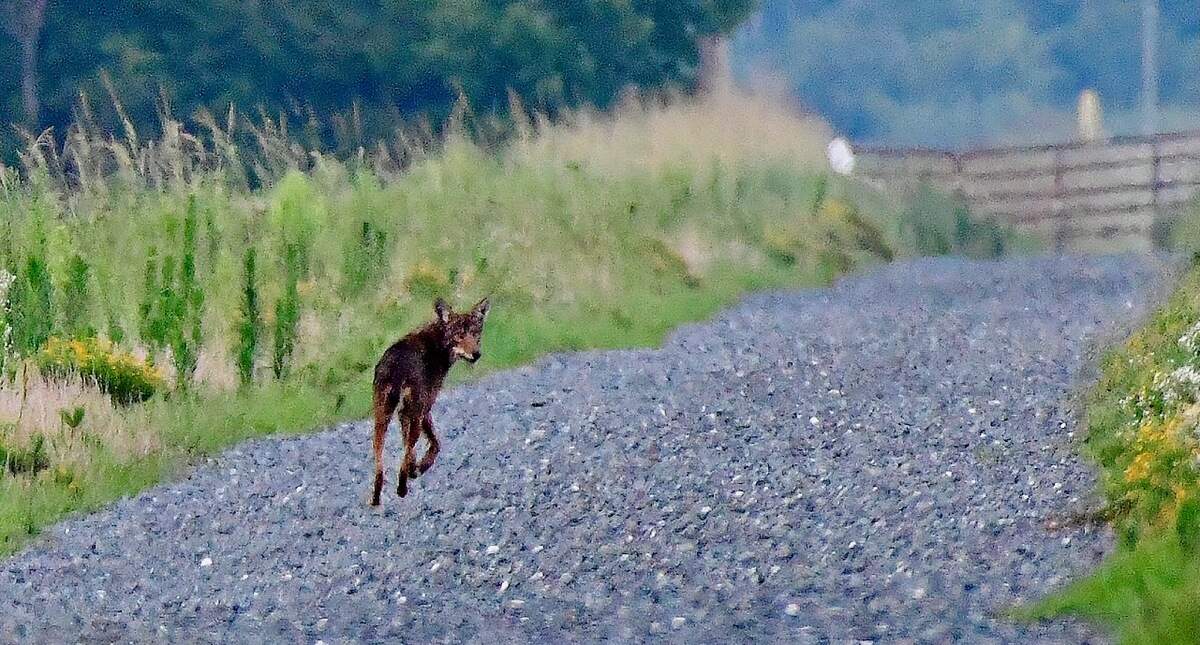
“Red wolves are one of the most endangered animals on the planet, and for the last four years, vehicle strikes have been their number one source of mortality. Building the first set of wildlife road crossing structures on U.S. 64 through Alligator River National Wildlife Refuge is a vital step towards pulling the red wolves back away from the edge of extinction in the wild,” Ron Sutherland, the chief scientist for Wildlands Network said in a statement.
When a wolf is killed by a car, there is also a chance for a ripple effect throughout the existing population. When a male wolf identified as 244M was killed in June on U.S. 64, for instance, the five pups he’d sired died shortly after.
In September 2023, the breeding male of the family group that lives on the Alligator River National Wildlife Refuge was killed on U.S. 64. Then, in April 2024, one of his offspring, a two-year-old male, was also killed on the highway.
The grant would fund a targeted 13 crossings. Of those, one would be large enough for black hears to pass through and two others would be tall enough for large mammals like red wolves and deer to cross through. The potential 10 others would be large enough for small mammals, snakes and turtles.
From June to August, U.S. 64 averages 11,800 vehicles per day on weekends and 6,600 vehicles per day on weekdays. Through the Alligator River refuge, those cars are traveling a two-lane road, often bordered by canals on one or both sides.
By building the crossings and associated fencing to keep animals off the road, the N.C. DOT expects vehicle-wildlife collisions to fall as much as 90%, according to the grant application.
Between 1990 and 2024, there were 45 reported collisions between vehicle and wildlife on the section of U.S. 64 in question, with 43 involving black bears, one involving a deer and another an unknown large animal. It is widely understood, though, that the number of actual collisions is much higher than what is reported.
Since September 2019, at least 15 red wolves have been found on or north of U.S. 64, indicating that they had tried to or successfully crossed the highway. According to the grant application, seven of those were killed by motor vehicles and another is suspected to have been killed by a motor vehicle.
At least one of the wolves that was tracked as being north of U.S. 64 is still alive, the application said, and its range is near the area where the crossings would be built.
Strikingly, the grant application said comments made to U.S. Fish and Wildlife Service personnel and on social media indicated some of the red wolves may have been hit by vehicles on purpose.
“In those cases, appropriate wildlife crossings ... that allow Red Wolves to avoid the road surface will likely be the only effective way at reducing vehicle strike mortalities,” the application states.
The NCDOT grant application was submitted in partnership with the N.C. Wildlife Resources Commission and U.S. Fish and Wildlife Service. It was also supported by the Tuscarora Nation of North Carolina.
In 2021, the Bipartisan Infrastructure Law created the wildlife crossings pilot program, with a total of $350 million available through fiscal year 2026. Projects typically require a 20% match from somewhere other than the federal government.
““Safety is FHWA’s top priority, and these roadway safety investments will ensure that motorists and wildlife get to their destinations safely while advancing a safe, efficient transportation system that benefits all road users as well as the environment,” Gloria Shepherd, the acting Federal highway deputy administrator, said in a statement.
The $25 million award for the U.S. 64 project was the second-largest of 16 funded in this round, and the only one in North Carolina.
In a message posted to X, the website formerly known as Twitter, environmental journalist Ben Goldfarb called the U.S. 64 crossings “the headline” of this round of funding. Goldfarb is the author of the 2023 book Crossings: How Road Ecology Is Shaping the Future of Our Planet.
“Red wolves are perhaps the American critter most existentially threatened by vehicles, and crossings may literally mean difference between survival/extinction. Huge,” Goldfarb wrote Friday.
The Center for Biological Diversity and Wildlands Network raised a combined $4 million to support the U.S. 64 crossings, including $2 million from an anonymous donor.
“These crossings will save human lives and protect the world’s most endangered wolves. I am immensely grateful to the agencies leading this project — and to the thousands of donors and supporters who have given red wolves a fighting chance,” Will Harlan, Center for Biological Diversity’s Southeast director, said in a statement.
Supporters of the project stress that it will help other wildlife, too.
Since Aug. 1, Wildlands Network has conducted a daily survey of roadkill on 33 miles of U.S. 64 and U.S. 264. In that time, surveyors have found 2,400 dead animals on U.S.64, including more than 700 turtles, more than 700 snakes and more than 600 frogs.
“US 64 cuts right through the top end of the immense and biologically diverse Alligator River National Wildlife Refuge, and the combination of busy beach highway and high density of wildlife leads to carnage on the asphalt every year,” Sutherland said in a statement.
This story was produced with financial support from the Hartfield Foundation and Green South Foundation, in partnership with Journalism Funding Partners, as part of an independent journalism fellowship program. The N&O maintains full editorial control of the work. If you would like to help support local journalism, please consider signing up for a digital subscription, which you can do here.
This story was originally published December 20, 2024 at 12:33 PM.