NC Supreme Court blocks state from certifying Riggs as the winner in high court election
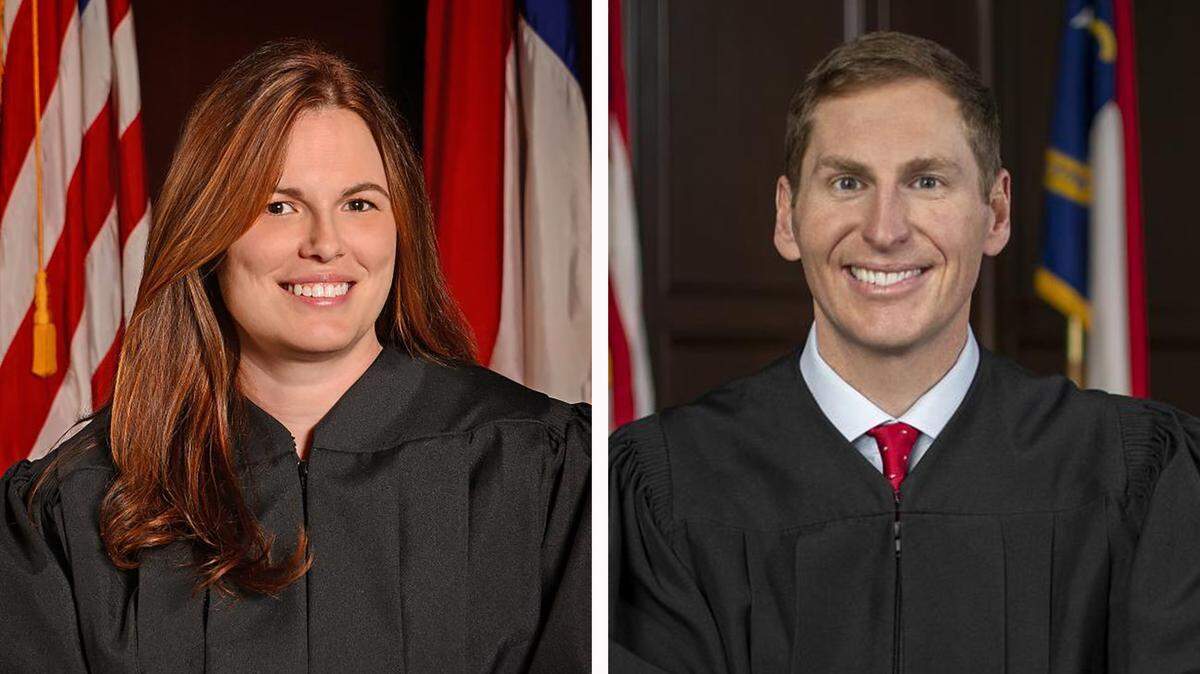
The North Carolina Supreme Court issued an order on Tuesday blocking the state from certifying a winner in the race for a seat on the high court.
Republican Jefferson Griffin trails his opponent, Democratic incumbent Allison Riggs, by 734 votes.
Granting Griffin’s request, the court’s Republican majority issued a temporary stay — with scant comment about its reasoning — that will prevent the State Board of Elections from certifying Riggs as the winner.
Anita Earls, the only other Democrat on the court alongside Riggs, dissented, writing that “the public interest requires that the court not interfere with the ordinary course of democratic processes as set by statute and the state constitution.”
Riggs recused herself from the case.
The very court which Griffin aims to join will now hear his challenge of over 60,000 ballots cast in the election and potentially decide a winner in the race.
“Justice Allison Riggs won her seat fair and square and that will continue to be demonstrated before the courts,” Anderson Clayton, chair of the North Carolina Democratic Party, said in a statement. “... We are in this position due to Jefferson Griffin refusing to accept the will of the people. He is hellbent on finding new ways to overthrow this election but we are confident that the evidence will show, like they did throughout multiple recounts, that she is the winner in this race.”
Jason Simmons, chair of the NC GOP, lauded the court’s decision.
“The people of North Carolina are ready to finally see this process brought to a conclusion and the laws (of) our state faithfully followed,” he said in a statement. “Judge Griffin is fighting to ensure election integrity and resolution of these issues in a fair manner.”
The decision comes just one day after a federal judge appointed by President-elect Donald Trump sent the case back to the state, in accordance with Griffin’s request.
The State Board of Elections appealed that decision to the 4th Circuit U.S. Court of Appeals, which has not yet weighed in.
An initial order from the Supreme Court stated that Earls was the only dissenting justice, but Republican Justice Richard Dietz joined her in an amended order later in the day.
In his dissent, Dietz wrote that while he may ultimately agree with some of Griffin’s claims, it was too late to bring the case.
“Permitting post-election litigation that seeks to rewrite our state’s election rules — and, as a result, remove the right to vote in an election from people who already lawfully voted under the existing rules — invites incredible mischief,” he wrote. “It will lead to doubts about the finality of vote counts following an election, encourage novel legal challenges that greatly delay certification of the results, and fuel an already troubling decline in public faith in our elections.”
Griffin seeks to throw out 60,000 ballots
Griffin, alongside the state Republican Party, has challenged the validity of tens of thousands of ballots cast in his race, alleging that ineligible voters were allowed to participate in the election.
The vast list of challenged voters ensnared people from assistants to state lawmakers to Riggs’ own parents.
A News & Observer analysis of the challenges found that Black voters were twice as likely to have their votes challenged as white voters.
The challenge that affected the largest number of voters was Griffin’s argument that voters who did not have a driver’s license number or Social Security number on file should not have been allowed to vote.
State election officials say there are myriad reasons a voter may not have those numbers in the database — many of which are no fault of their own. But Griffin argued it could lead to ineligible voters being able to cast a ballot.
The State Board of Elections disagreed. In mostly party-line votes last month, the board, which has a 3 to 2 Democratic majority, dismissed all of his protests.
Legal case bounces between courts
Griffin appealed the board’s ruling, kicking off a complicated legal case which has ping-ponged between state and federal courts.
Once the state Supreme Court achieved jurisdiction over the case on Monday, Griffin immediately requested that it block the state from certifying the election, which could have happened as early as Friday.
“Without an immediate stay of certification by the Board — one issued as early as possible — the board is likely to find new obstacles that procedurally bar any court from reaching the merits of Judge Griffin’s election protests,” his attorneys wrote in a court filing.
Absent any action from the 4th Circuit, the state Supreme Court will retain jurisdiction over the dispute.
Final briefs in the case are due Jan. 24.
This story was originally published January 7, 2025 at 12:20 PM.