NC Supreme Court declines to fast-track Republican challenge of 65,000 votes
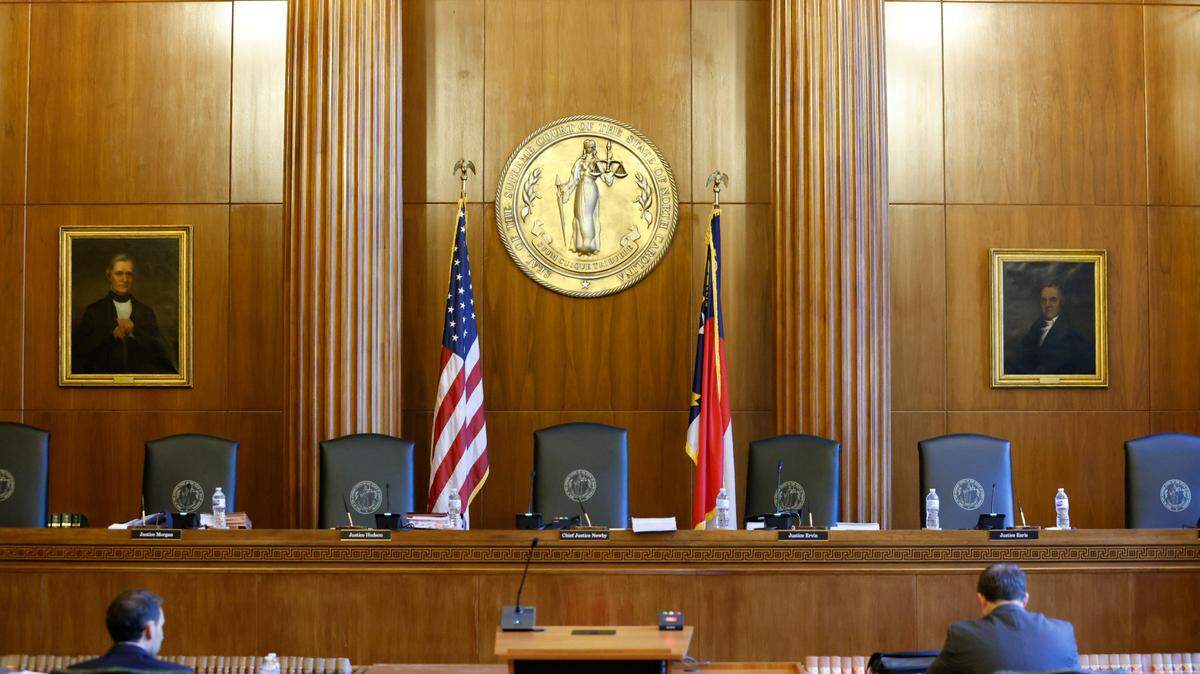
The North Carolina Supreme Court on Thursday rejected a request to bypass a lower court and immediately take up a case challenging over 65,000 ballots cast in the November election.
The case will now head to the state Court of Appeals, which has 12 Republican judges and three Democrats.
In a 4-2 decision, the Supreme Court sided with Republican Jefferson Griffin, who seeks to overturn his narrow loss in the race for a seat on that same court to Democratic incumbent Allison Riggs.
“Given the complexity and quantity of the issues presented in this case, this court and our state will benefit from a well-reasoned, thoughtful, and deliberative analysis by the Court of Appeals,” Justice Tamara Barringer, a Republican, wrote in a concurring opinion.
While Thursday’s ruling was largely procedural, it could have major implications for the outcome of the monthslong dispute, which has drawn national rebukes from critics who say it could form the playbook for attempting to overturn election results across the country.
Justice Anita Earls, a Democrat and Justice Richard Dietz, a Republican, dissented from the majority.
“Further delay at this stage continues to erode trust in our elections and calls into question the ability of the legal system to guarantee that fundamental principles of democracy are capable of being recognized and enforced by a fair and impartial judiciary,” Earls wrote.
Riggs, who maintains her seat on the Supreme Court while the case plays out, has recused herself from the case. This means there is a possibility that the court could ultimately deadlock in a 3-3 decision.
Though the high court has five Republicans and one Democrat who will hear the case, Earls and Dietz have expressed in previous rulings their opposition to Griffin’s requests, saying that he aims to change the rules after losing his election. If just one Republican joins them, the court would tie.
In that scenario, the decision of a lower court prevails.
A Wake County Superior Court judge already ruled against Griffin’s challenges earlier this month, finding that the State Board of Elections was correct to dismiss them.
Had the Supreme Court agreed to skip the appellate court, as the elections board requested, and then deadlocked on the case, the Wake judge’s ruling would be final.
But in Thursday’s ruling several justices agreed with Griffin’s argument that the judge’s one-page ruling did not sufficiently address the issues presented in the case.
“The superior court simply ruled against Judge Griffin without explaining why, in its view, his claims should be denied,” Justice Trey Allen, a Republican, wrote. “Consequently, if we were to take this case now, we would do so in the absence of any meaningful examination of those claims by a lower court.”
In his brief opposing the board’s request, Griffin wrote that the possibility of a deadlock “could render judicial review of no value and undermine public confidence in the fairness of this election.”
In her dissenting opinion, Earls said that Griffin “asks us not to hear the case because he might lose. Such outcome-determined reasoning has no place in a court committed to the rule of law.”
Griffin is currently a judge on the Court of Appeals, but he told The News & Observer he would not participate in any matters related to his case. But critics have also raised concerns about another Republican judge on the Court of Appeals: Tom Murry.
As WUNC reported last month, Murry donated to Griffin’s legal expense fund, the very fund which he is using to bring the case before the Court of Appeals.
This story was originally published February 20, 2025 at 6:38 PM.