Report: Jefferson Griffin wore Confederate uniform at 2001 UNC fraternity event
North Carolina Supreme Court candidate Jefferson Griffin, who has now spent nearly five months challenging his narrow loss in the November election, wore Confederate military attire as part of a fraternity event in college, according to a report from The Associated Press.
The report, which published Friday, revealed that Griffin, a Republican, also posed in front of a Confederate battle flag with the Kappa Alpha Order fraternity at UNC-Chapel Hill — a group which has raised controversy over the years for its embrace of the Confederacy.
The News & Observer obtained a version of the photo uncovered by the AP.

In a statement to the AP, Griffin, now 44, expressed remorse over his decision to wear the uniform during the fraternity’s 2001 “Old South” ball.
“I attended a college fraternity event that, in hindsight, was inappropriate and does not reflect the person I am today,” he said. “At that time, like many college students, I did not fully grasp such participation’s broader historical and social implications. Since then, I have grown, learned, and dedicated myself to values that promote unity, inclusivity, and respect for all people.”
Griffin also said that he supported a ban on using the Confederate flag at a Kappa Alpha convention in 2001. A representative for the fraternity, Jesse Lyons, said that “upon personal recollection and review of official records” he could confirm this.
“We believe in cultural humility, we respect the best parts of our organization’s history, and through education we challenge our members to work for a better future,” Lyons said in a statement to The N&O. “These things are not mutually exclusive.”
Lyons said that period dress has since been disallowed in fraternity matters.
Paul Shumaker, an advisor for Griffin’s campaign, accused his opponent, Democratic incumbent Allison Riggs, of engaging in a “personal smear campaign.”
“Judge Griffin has served the people of this state and our country with great honor and duty,” he said in a statement to The N&O. “Sadly, the radical left fails to share that same sense of duty.”
Riggs’ campaign did not immediately respond to request for comment.
Griffin attempts to discard over 65,000 ballots in Supreme Court race
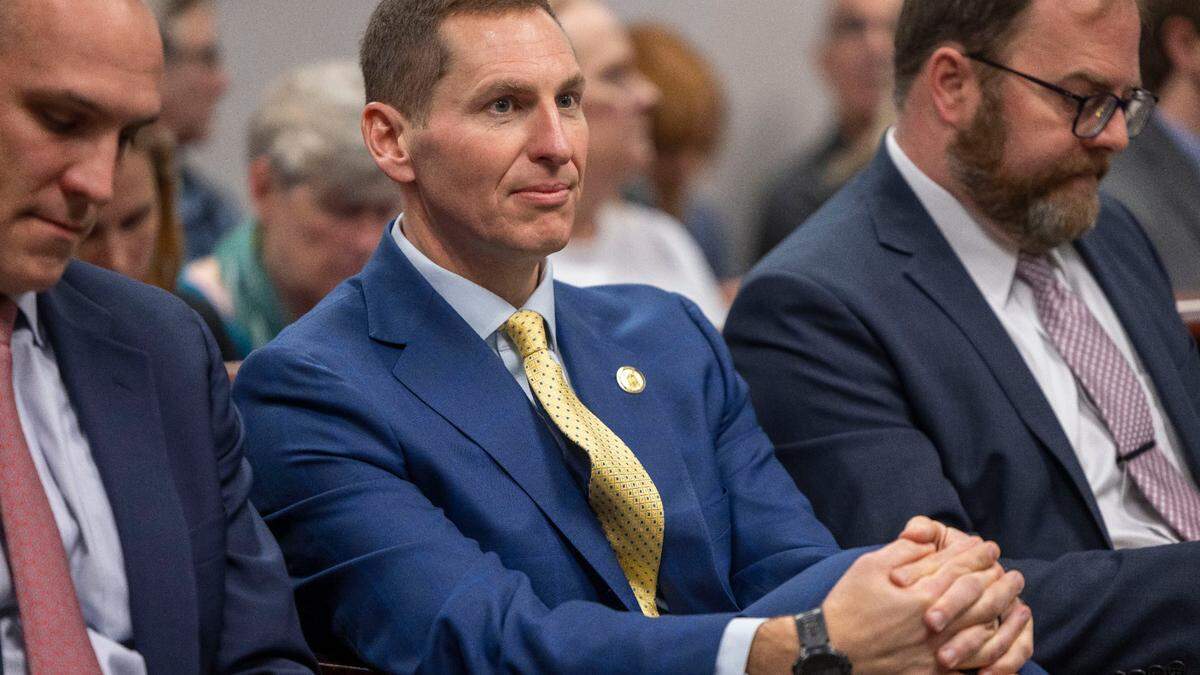
The report comes as Griffin, alongside the North Carolina Republican Party, continues to push for over 65,000 ballots cast in the 2024 state Supreme Court election to be thrown out — potentially flipping the race in his favor.
Using untested legal methods, Griffin has sought to reverse his 734-vote loss to Riggs.
His challenges target voters for a variety of novel reasons, including the lack of a driver’s license number or Social Security number in the state’s registration database.
A News & Observer analysis of Griffin’s protests found that Black voters were twice as likely to have their votes challenged as white voters.
Griffin’s case, which has ping-ponged between state and federal courts, currently rests with the North Carolina Court of Appeals, where a three-judge panel heard arguments last week.
However, their decision is unlikely to be the end to the contentious case.
Justices on the North Carolina Supreme Court, which currently has a 5 to 2 Republican majority, have said they expect the case will eventually reach the high court.
Riggs has recused herself from the case, meaning only one Democrat would participate in the deliberation.
Riggs’ recusal also opens up the possibility of a 3-3 deadlock among the justices. Anita Earls, the other Democratic justice on the court, has implied she would rule against Griffin — as has a Republican on the court, Justice Richard Dietz.
If one more justice joins them in rejecting Griffin’s claims, the resulting deadlock would mean that the most recent decision of a lower court prevails.
In this case, that would be the ruling from the state Court of Appeals.
During arguments last week, judges on the appeals panel, which consisted of two Republicans and one Democrat, did not indicate when they would rule.
This story was originally published March 28, 2025 at 2:45 PM.