
NC House Republican could return to Raleigh soon after sharing cancer diagnosis
Good morning and welcome to Under the Dome. I’m Caitlyn Yaede.
First, an update from Avi Bajpai about a House member’s cancer diagnosis and when he could return to the legislature.
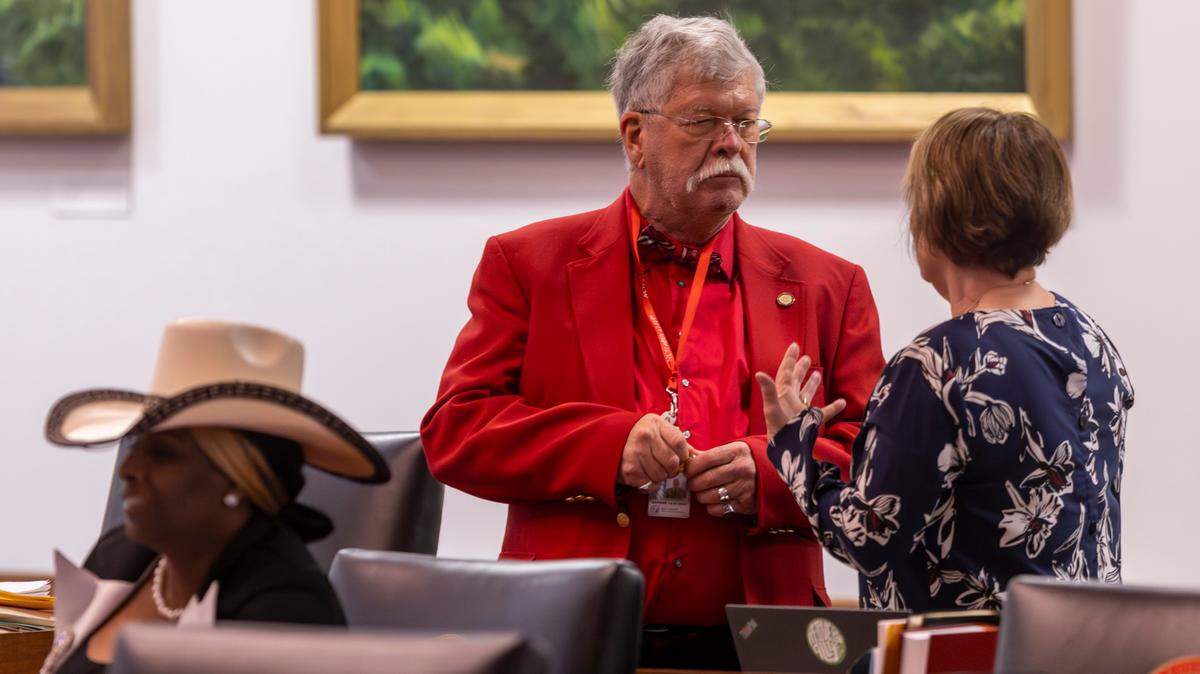
Rep. Mike Clampitt, a Republican from Western North Carolina serving his fourth term in the House, announced last week that he has been diagnosed with a rare form of blood and bone marrow cancer.
Clampitt shared the news with constituents on Friday, writing in his weekly newsletter that he had been diagnosed with Myelodysplastic Syndrome and had decided to avoid public gatherings for the time being to protect his health, according to Blue Ridge Public Radio.
“This is undoubtedly one of the most difficult periods of my life, but I remain hopeful and grounded by the unwavering support of my family, friends and this incredible community,” Clampitt said.
The treatment was expected to keep Clampitt away from the General Assembly for a while, but House Majority Leader Brenden Jones said on Tuesday that he’s been in close contact with Clampitt. He believes he’s been responding “very well” and may be able to return to Raleigh as early as today.
“We’ve been rallying around him to make sure he had all the support he needs,” Jones said. “My understanding is he did a few days in the hospital, is doing a lot better, and I think he may even be joining us tomorrow.”
The House is moving several bills through committees this week and taking them up on the floor as the Senate advances its budget proposal. Both chambers will be out next week.
Sen. Kevin Corbin, a Republican whose district includes the same counties as Clampitt’s district, told The N&O he and a few other House members found out about Clampitt’s diagnosis from him about a month ago.
Corbin said Clampitt “has got a heart of gold” and loves representing Jackson, Swain and Transylvania counties in Raleigh. He said the legislature “is a big part of what he considers his family.”
“We’re very, very sorry he’s having to go through this illness, and we’re praying for him and offering any kind of help we can while he goes through this difficult time,” Corbin said.
MAJORITY IN NC DON’T APPROVE OF COUNTRY’S DIRECTION
A majority of North Carolinians do not like the direction the country is headed in under President Donald Trump, according to a new poll this week from Meredith University.
The poll, conducted earlier this month, asked residents their opinions on the country’s direction as well as the economy and found that 60% of respondents were “dissatisfied” with the current direction of the country.
Similarly, only one in four respondents reported their finances were in “good” or “excellent” shape.
Less than one-third — 31% — said the economy was strong, and 53% were concerned about the impacts of Trump’s tariffs on the economy. His approval rating is an average of 4% lower among North Carolinians than in his first term.
SENATE BUDGET TACKLES ‘OBSOLETE PROGRAMS,’ ‘BLOATED BUREAUCRACY’
The Senate unveiled its budget plan on Monday evening, making it the first chamber to do so this year. It included raises for educators and state employees, as well as plans to slash vacant roles and some offices.
The proposed budget outlines $32.6 billion in spending in the first fiscal year, and $33.3 billion in the second. The Senate hopes to restore the state’s rainy day fund to its pre-Helene total of $4.75 billion, as well as send an additional $700 million to a Helene reserve fund.
Under the Senate’s proposal, teachers would see a 2.3% raise in the first year, and a 3.3% raise on average over two years, as well as a $3,000 bonus. Most state employees would see raises of 1.25%, with law enforcement and corrections officers seeing much higher increases. Find out more on raises in this story from Dawn Vaughan.
The Senate opened the door to eliminating some of the state’s vacant roles. The vacancy rate for state jobs is at 20%.
The budget affirms the creation of a new agency inside the state auditor’s office, called the Division of Accountability, Value and Efficiency. Echoing the Trump-created Department of Government Efficiency, DAVE would investigate potential waste in the state bureaucracy and deliver recommendations to the legislature.
Read what’s in the Senate’s full fiscal plan, how it stacks up to Gov. Josh Stein’s proposed budget, and when we can expect a version from the House.
MINORITY BUSINESS OFFICE, INNOCENCE COMMISSION TARGETED IN SENATE BUDGET
While the Senate’s version of the budget supports the creation of a DOGE-like office in North Carolina, it also calls for cuts to two programs that some say are vital.
The first of these “targeted reductions” is to the Office of Historically Underutilized Businesses. Part of the Department of Administration, the office helps minority-owned businesses compete for government contracts, Avi Bajpai reports.
While eliminating the office would save the state $1.7 million over the next two years, Sen. Gladys Robinson, a Greensboro Democrat, raised concerns over cutting the program. She says it has been effective at creating access for minority business owners.
The Senate also proposed getting rid of the Innocence Inquiry Commission — established in 2006 to investigate wrongful convictions, Luciana Perez Uribe Guinassi reports. Since its creation, the commission says its work has led to 15 exonerations.
HOUSE SPEAKER DESTIN HALL WELCOMES BABY
House Speaker Destin Hall and his wife, Madison Skeens Hall, welcomed their first child on Tuesday. Hall is a Republican from Caldwell County and lives in Granite Falls. They are both lawyers. The Halls’ son is named Henry Reece Hall.
The news was announced during the afternoon House session by House Majority Leader Brenden Jones, who said Henry “made his appearance at 2:06 p.m. today, weighing 7 pounds, 6 ounces, 20 inches long. Mom and baby are doing great.”
Speaker Hall had previously told reporters their baby was due in early May. House Speaker Pro Tempore Mitchell Setzer presided Tuesday in Hall’s absence. Jones posted a video of the House floor announcement on social media, which Hall shared with the words, “Some personal news” followed by a baby emoji. Congratulations soon poured in, including from former N.C. House Speaker and current U.S. Rep. Tim Moore.
After the Senate session, and while the House was still in session, Senate leader Phil Berger was asked if he had any advice for Hall.
“Just realize that the time goes by fast, and that child will be going off to college sooner than he thinks,” Berger said.
— Dawn Baumgartner Vaughan and Avi Bajpai
RIGGS ASKS FEDERAL APPEALS COURT TO WEIGH IN ON CONTESTED ELECTION
North Carolina Supreme Court Justice Allison Riggs is asking a federal appeals court to block a controversial ballot cure period from taking effect that could result in her 2024 victory being overturned.
Riggs, a Democrat, narrowly defeated Republican Court of Appeals Judge Jefferson Griffin by 734 votes in November’s Supreme Court election. But Griffin, alongside the NC GOP, has sought to throw out over 65,000 votes in the race using untested legal methods.
Last week, the state Supreme Court ruled that the vast majority of the challenged voters — over 60,000 — would not have their votes thrown out.
But a smaller number of military and overseas voters who Griffin challenged for not providing photo ID — still enough to flip the results — would be given 30 days to prove their eligibility to election officials or have their votes discarded. An even smaller number of voters, about 250, would have their votes cancelled without any opportunity to correct them.
On Monday, Riggs filed a notice of appeal, saying that she will ask the 4th Circuit U.S. Court of Appeals to temporarily block this ruling from taking effect.
The State Board of Elections is expected to provide details soon on exactly how many voters would be required to cure their ballots under the court’s remedy.
— Kyle Ingram
STEIN ARGUES TO RETAIN CONTROL OF ELECTION BOARDS
Judges in Wake County Superior Court heard arguments over control of the State Board of Elections on Monday, Kyle Ingram reports. Gov. Josh Stein is challenging a Republican measure that would shift control of the board, and its 100 constituent county boards, to the state auditor.
An attorney representing Republicans in the legislature said it is up to the General Assembly to delegate these powers, arguing they should be handed over to Dave Boliek. Unless a court intervenes, Boliek is slated to assume control over the election boards on May 1.
Boliek joined the lawsuit, saying his position is less political and better suited for the job.
The judges did not issue a ruling yet, although control of the election boards could have major impacts on the ongoing battle for Justice Allison Riggs’ seat on the state Supreme Court.
WHAT ELSE WE’RE WORKING ON
Durham County Sheriff Clarence Birkhead penned a three-page letter to county leaders, claiming his department was critically underfunded, citing operational and maintenance issues in county jails and courthouses. But county commissioners say they’ve addressed Birkhead’s concerns, and that the department is operating with a surplus. The department underspent by $1.84 million last fiscal year, and $1.96 million the year before that. Lexi Solomon has the full story.
A watchdog legal group accused Cabarrus County commissioners of appointing a new board member illegally, The Charlotte Observer’s Joe Marusak reports. The group filed a lawsuit, claiming the vote for a new member was held with only three of the five commissioners present — and that it was intentionally held at a time when one commissioner was undergoing dialysis. Commissioners were replacing Chairman Christopher Measmer, who was sworn in Tuesday to a state Senate seat, replacing Paul Newton.
Today’s newsletter was by Caitlyn Yaede, Avi Bajpai, Dawn Vaughan and Kyle Ingram. Check your inbox tomorrow for more #ncpol.
Not a subscriber? Sign up on our website to receive Under the Dome in your inbox daily.

.jpg)