Republican majorities named to North Carolina’s 100 local election boards
AI-generated summary reviewed by our newsroom.
- Republicans gained control of all 100 county election boards across North Carolina.
- State board approved mailers to collect missing voter data from 194,000 voters.
- Auditor Dave Boliek appointed GOP chairs, reversing Democratic influence on local boards.
Republicans now hold majorities on all of North Carolina’s 100 county election boards, flipping the partisan control of these local authorities for the first time since 2016.
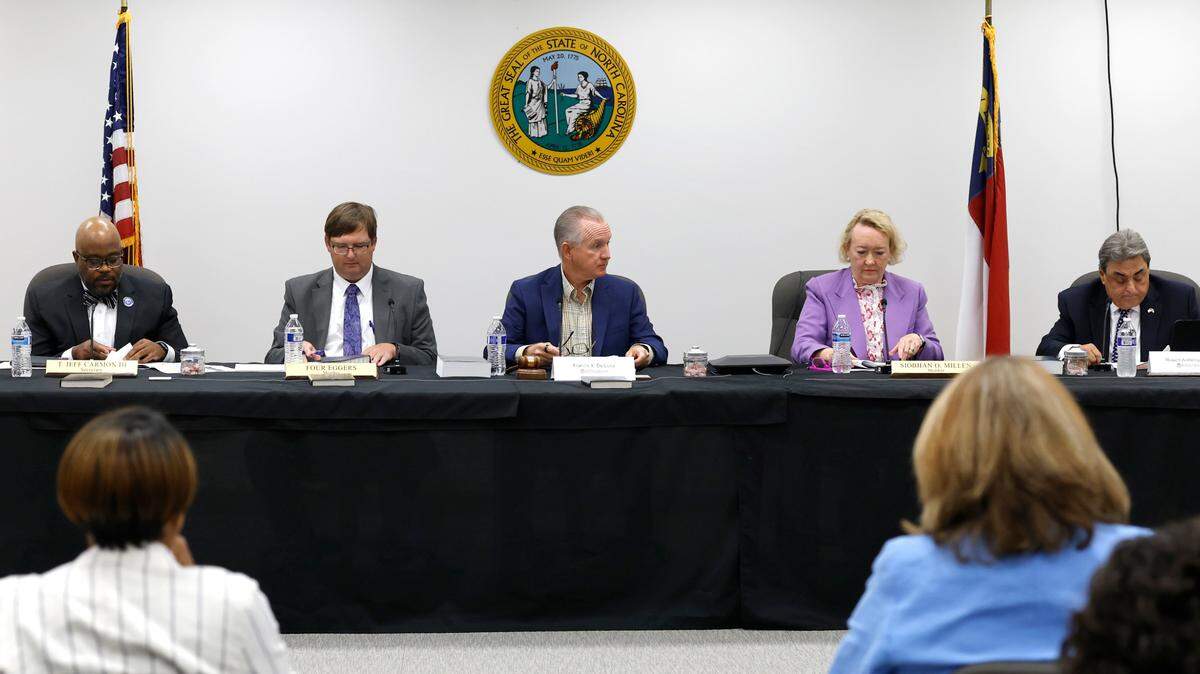
The State Board of Elections and State Auditor Dave Boliek appointed a new slate of county election officials Tuesday, giving the GOP a 3-2 majority on each board.
The newly Republican state board also approved a plan seeking to collect additional registration information from nearly 200,000 voters, some of whom were challenged in the state’s chaotic six-month legal battle over the results of the 2024 Supreme Court race.
President Donald Trump’s administration has sued the state demanding that it address the missing information.
Appointments to county election boards
Tuesday’s appointments are the latest step in the overhaul of North Carolina’s election apparatus, per legislation passed in the final days of Republicans’ supermajority in the General Assembly last year.
Lawmakers stripped Democratic Gov. Josh Stein of his appointments to the State Board of Elections and transferred them to Boliek, a Republican. A trial court initially struck down this transfer as unconstitutional, noting that it broke with over a century of precedent.
The state’s Republican-controlled appellate courts, however, reversed the lower ruling and allowed the law to take effect.
Auditor Dave Boliek appointed a 3-2 Republican majority to the state board, which quickly voted to oust its longtime director and replace her with a lawyer who has worked for the state’s top legislative leaders.
Replacing county election board members was the next step in the law’s implementation.
Previously, the state board selected two Republicans and two Democrats for each county board from a list submitted by the local political parties. The governor then appointed a chair to each board, which determined the partisan majority.
Now, that chair appointment power resides with the auditor, Boliek, who selected a slate of Republicans to lead the boards.
Among Boliek’s appointees is Linda Rebuck, who will chair the Henderson County Board of Elections.
Last year, Rebuck was reprimanded by the State Board of Elections for spreading “false and misleading statements” to state lawmakers and advocating for Republicans to win the 2024 elections.
Asked why Rebuck was selected, a spokesperson for Boliek said: “Chairs were picked based on conversations with a variety of stakeholders across the state and careful deliberation. It’s our belief that the appointed chairs will execute their management of county boards of elections to the best of their ability, and in accordance with state and federal laws and state board guidance.”
State agrees to collect missing voter information
Also at Tuesday’s meeting, the state board unanimously approved a multi-step plan to collect missing voter registration information from roughly 194,000 voters.
Beginning with a series of mailers this summer, the board will ask these voters to provide either a driver’s license number or the last four digits of their Social Security number to complete the state’s records.
The missing information, which is required by the national Help America Vote Act, has sparked numerous legal challenges, including the recent lawsuit from the U.S. Department of Justice.
The HAVA information also formed the basis for Supreme Court candidate Jefferson Griffin’s main challenge of his 2024 election loss, in which he argued that voters who lacked these numbers should have their votes thrown out.
The plan approved Tuesday will begin this summer by sending a series of mailers to voters who lack the required information in the state’s database.
Of those affected voters,98,000 will have to cast provisional ballots in future elections until they provide the information. That triggers a special review of each ballot after Election Day.
However, Executive Director Sam Hayes noted that records show that another 96,000 of the affected voters complied with HAVA when they registered to vote, even though the state does not have a driver’s license or Social Security number on file for them. This could be due to a matching problem with national databases that isn’t the fault of voters, he said.
Those voters will be able to vote regularly, though the board will continue to try to collect the missing information from them.
Meanwhile, county boards of elections will review their own records to determine if they already have the missing information, but hadn’t entered it into the state’s databases.
This story was originally published June 24, 2025 at 1:34 PM.