
Who is US Senate Democratic candidate Roy Cooper?
North Carolina’s Democratic Gov. Roy Cooper entered the U.S. Senate race Monday, his latest bid for office in a lengthy political career.
Cooper, 68, is now the most prominent candidate in the race that is drawing national attention and is expected to break spending records. Democrats are already rallying around his campaign.
Here’s more about Cooper’s background and experience.
Roy Cooper’s political experience
Cooper, 68, finished out his second term as governor on Dec. 31. The state limits governors to two consecutive terms.
Cooper has never lost an election and won the governor’s mansion twice: in 2016 and 2020.
He started his career as an attorney after going to UNC-Chapel Hill for both undergraduate and law school.
Before becoming governor, he served in both the House, beginning in 1987, and Senate, starting in 1991. After 10 years in the Senate he was elected, and spent four terms, as attorney general.
Cooper chaired the Democratic Governors Association in 2022.
National spotlight
In July 2024, Cooper was widely speculated to be a vice presidential contender for Democratic candidate, Vice President Kamala Harris, following President Joe Biden’s abrupt withdrawal from the race.
National media and political experts put him on Harris’ short list, thanks to his relationship with her when they were both attorney generals. But he privately declined to be considered from the start, The News & Observer reported.
He didn’t publicly reveal this decision until July 29, 2024, saying it “just wasn’t the right time” for a run for national office.
“I strongly support Vice President Harris’ campaign for President. I know she’s going to win and I was honored to be considered for this role. This just wasn’t the right time for North Carolina and for me to potentially be on a national ticket,” Cooper posted on social media.
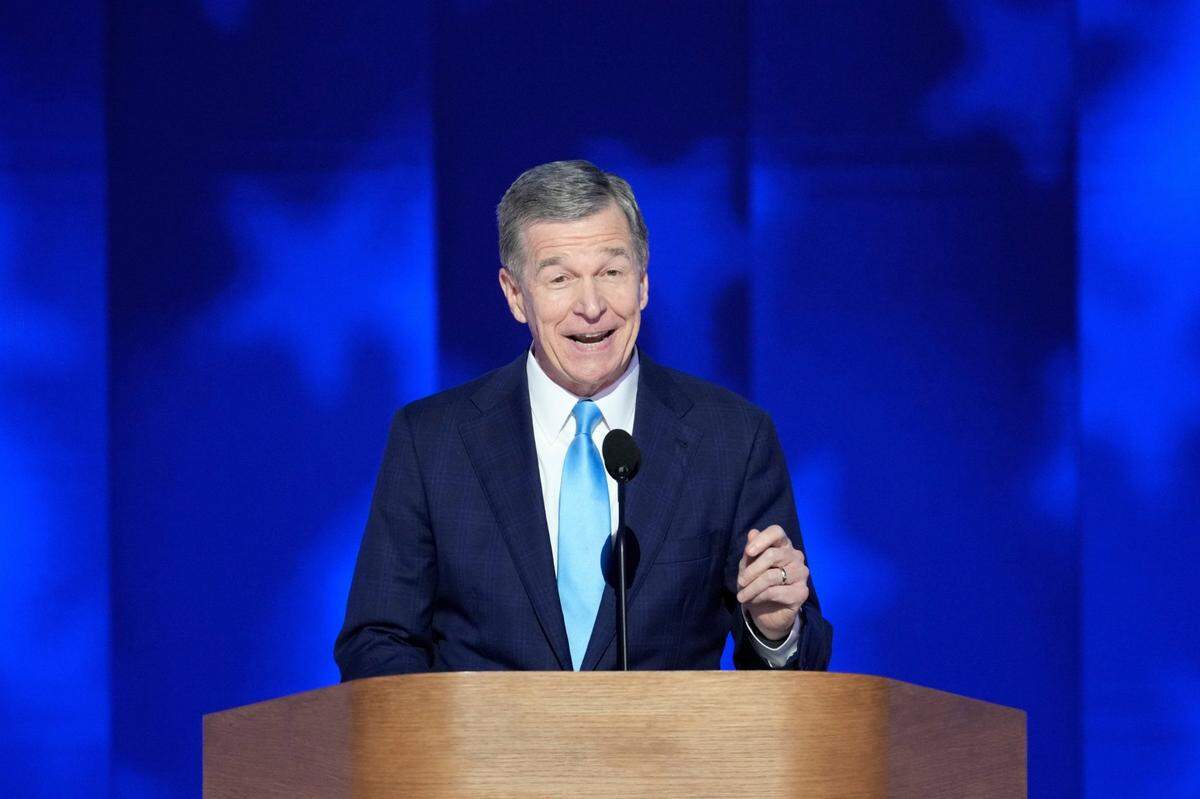
Cooper continued to be a surrogate for Harris’ presential campaign and spoke at the Democratic National Convention to introduce her. His five-minute speech was a high-profile role and the first national convention he had attended.
He appeared on stage with Harris and Vice Presidential nominee Tim Walz in their numerous visits to North Carolina.
After leaving office, Cooper spent eight weeks at Harvard University as a fellow at the T.H. Chan School of Public Health teaching about the intersection of government and public health.

Cooper vs. Republicans in NC
Republicans controlled the General Assembly during Cooper’s two terms as governor, and have continued to since he left office.
While Republicans overturned his vetoes once they gained a supermajority in 2023, they also made compromises with Cooper on some issues, like Medicaid expansion.

Cooper worked well enough with Republican legislative leaders to bring major new jobs to the state. North Carolina often tops lists of the best places to do business. Republicans, however, also take credit for the state’s business climate.
Major issues he championed as governor included public education funding and teacher raises, Medicaid expansion, expanding infrastructure and addressing climate change.
But he was scrutinized for his COVID-19 restrictions, which resulted in a new law limiting the governor’s powers to issues states of emergency and executive orders without agreement from other top officials. He has also been criticized for the pace of his administration’s response to hurricane relief.
Cooper also faced backlash for the number of pardons and commutations he issued as governor — 34 pardons and 43 commutations — the most this century for the state. That included 15 death row inmates whose sentences are now life in prison without parole. Cooper made the announcement of that change on New Year’s Eve before he left office.

Cooper’s family and early life
Cooper, whose full name is Roy Asberry Cooper III, is from the town of Nashville in North Carolina’s Nash County.
His father, Roy Cooper Jr., was a lawyer and farmer, and his mother, Beverly Cooper, was a school teacher. His brother Pell is a judge.
Roy Cooper is married to Kristin Cooper, also an attorney, and they met at the General Assembly, where she worked as legislative counsel. They have three grown daughters — Hilary, Natalie and Claire.
This story was originally published July 28, 2025 at 8:15 AM.

.jpg)