Texas wants to redraw its map to give GOP more seats. Could NC do the same?
In Texas, a chaotic fight is brewing over Republicans’ plans to redraw the state’s congressional map to give the GOP the potential for five more seats in the midterm elections.
Democratic representatives have fled the state to block a vote on the new map, prompting the governor and attorney general to threaten to declare their seats vacant and remove them from office — a complicated and legally murky tactic with little precedent.
President Donald Trump has endorsed the effort, telling CNBC on Tuesday that Republicans are “entitled to five more seats.” Other states are considering joining the fray, including Republican-led legislatures in Ohio and Missouri and Democrats in New York and California.
North Carolina is no stranger to controversial and nationally significant redistricting efforts, prompting questions about whether the state may jump in on the escalating maps battle ahead of the 2026 midterms.
Here’s what we know:
Where do NC’s electoral maps stand now?
For decades now, courts have frequently found that North Carolina lawmakers — Democrat and Republican — gerrymandered electoral districts to benefit their party when they were in power.
In recent years, however, courts at the state and federal level have held that partisan gerrymandering is no longer a legal claim they will rule on — essentially giving state lawmakers free rein to draw maps that benefit their party.
Typically, electoral maps are meant to be redrawn every decade following the decennial Census.
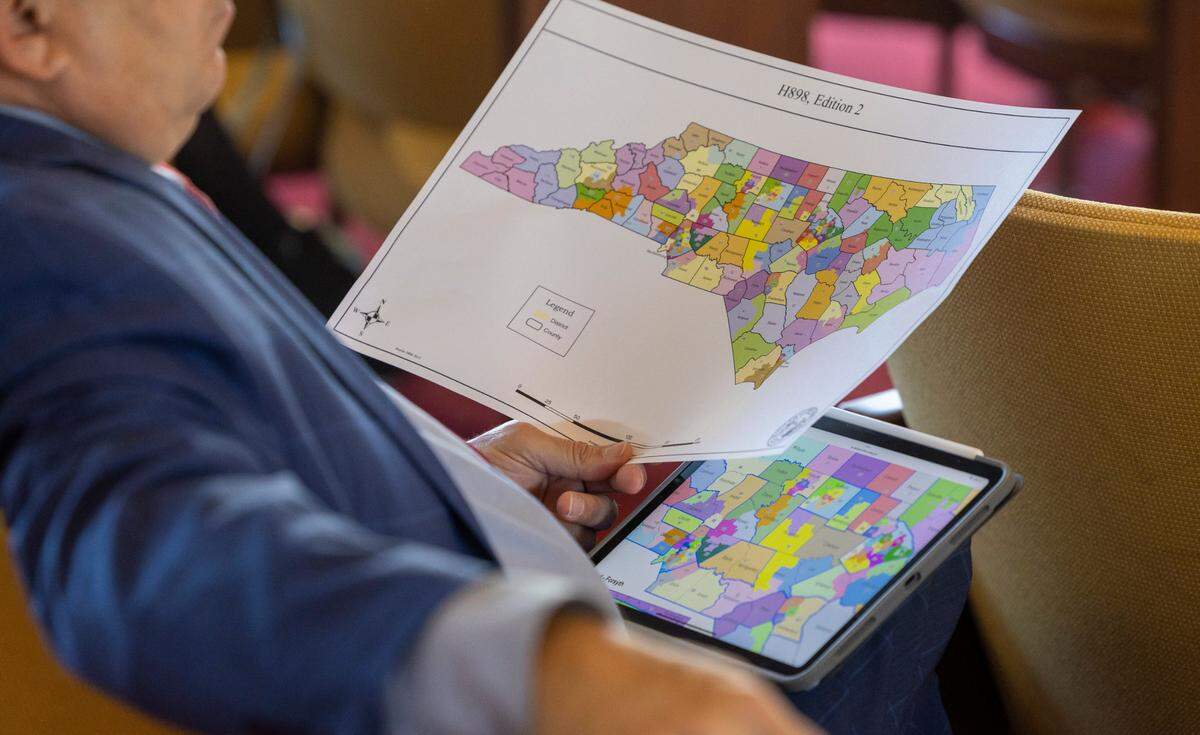
However, North Carolina Republicans already redrew the state’s electoral maps in 2023 after the Supreme Court’s newly elected Republican majority ruled that partisan gerrymandering was a political question that the courts could not weigh in on.
That new congressional map resulted in North Carolina electing 10 Republicans and four Democrats in 2024 — a consequential shift from the 2022 elections, in which a court-drawn map elected an even seven Republicans and seven Democrats.
The redrawn map resulted in only one competitive race: the 1st Congressional District in northeastern North Carolina.
Democratic Rep. Don Davis narrowly won that race, coming in less than two points ahead of Republican Laurie Buckhout.
Voters have filed federal lawsuits against all of the redrawn maps alleging that they illegally dilute the voting power of Black North Carolinians and other members of racial and ethnic minority groups. Those lawsuits have yet to reach a resolution.
Could NC Republicans redraw maps again before 2026?
It is hypothetically possible for North Carolina lawmakers to approve a new congressional map in time for the midterms, but Western Carolina University political scientist Chris Cooper said the prospect seems unlikely.
For one, Republicans likely stand to gain just one additional seat in Congress: the 1st district. It’s the only district that could feasibly be reworked to more significantly favor Republicans, Cooper said.
“It’d be really hard — bordering on impossible — to draw a map that didn’t have at least three Democrats, given the size of the Democratic population of the state,” he said.
Redistricting Davis’ district could also present new legal problems.
The current maps already face allegations of racial gerrymandering in federal court, and redrawing the lines in the northeastern corner of the state — which has a significant Black population — could draw further legal scrutiny.
Defending the new map in court would likely require a lot of time and money when “the Republican Party writ large is already going to be expending massive sums of money in all of these other states to defend new maps,” Cooper said.
In short, “there’s just not a lot of bang for the buck.”
Senate leader Phil Berger and House Speaker Destin Hall did not respond to a request for comment about potential redistricting plans ahead of the midterms.
Could NC Democrats flee to block a vote on new maps?
If North Carolina Republicans did go through with a plan to draw new maps, Democrats wouldn’t be able to block the vote by fleeing, as Texas Democrats did.
In Texas, the absence of over 50 Democrats from the state House meant that the chamber did not have a quorum, which is the number of lawmakers that must be present to take a vote.
But in North Carolina, the quorum requirements are lower. Even if every single Democrat was absent, Republican lawmakers would still have a quorum and be able to vote on new maps.