
The NC campaign for the ages that altered Gov. Jim Hunt’s presidential prospects
AI-generated summary reviewed by our newsroom.
- Hunt challenged Helms in a nationalized, record-spending 19-month Senate slugfest.
- Helms used the King holiday filibuster and sharp TV ads to erode Hunt’s lead.
- Helms won 52-48 during Reagan’s 1984 landslide, altering Hunt’s presidential prospects.
It seemed inevitable that the two major figures of Tar Heel politics would clash in 1984.
Republican Sen. Jesse Helms was up for reelection. And the time seemed ripe for Democratic Gov. Jim Hunt to step on to the national stage.
The two men represented different political strains in North Carolina politics. Hunt was the bearer of the progressive tradition of Gov. Kerr Scott, Sen. Frank Porter Graham and Gov. Terry Sanford, while Helms was in the tradition of a long line of conservatives including Sens. Furnifold Simmons, Josiah Bailey and Sam Ervin Jr.
Hunt, whose death at 88 was announced Thursday, was prevented under the state Constitution from running for a third consecutive term. If Hunt could go to Washington as the giant killer, could the presidency be far behind?
The Hunt-Helms race produced a clash between the two dominant North Carolina political figures — and two powerful political machines — of the last three decades of the 20th century.
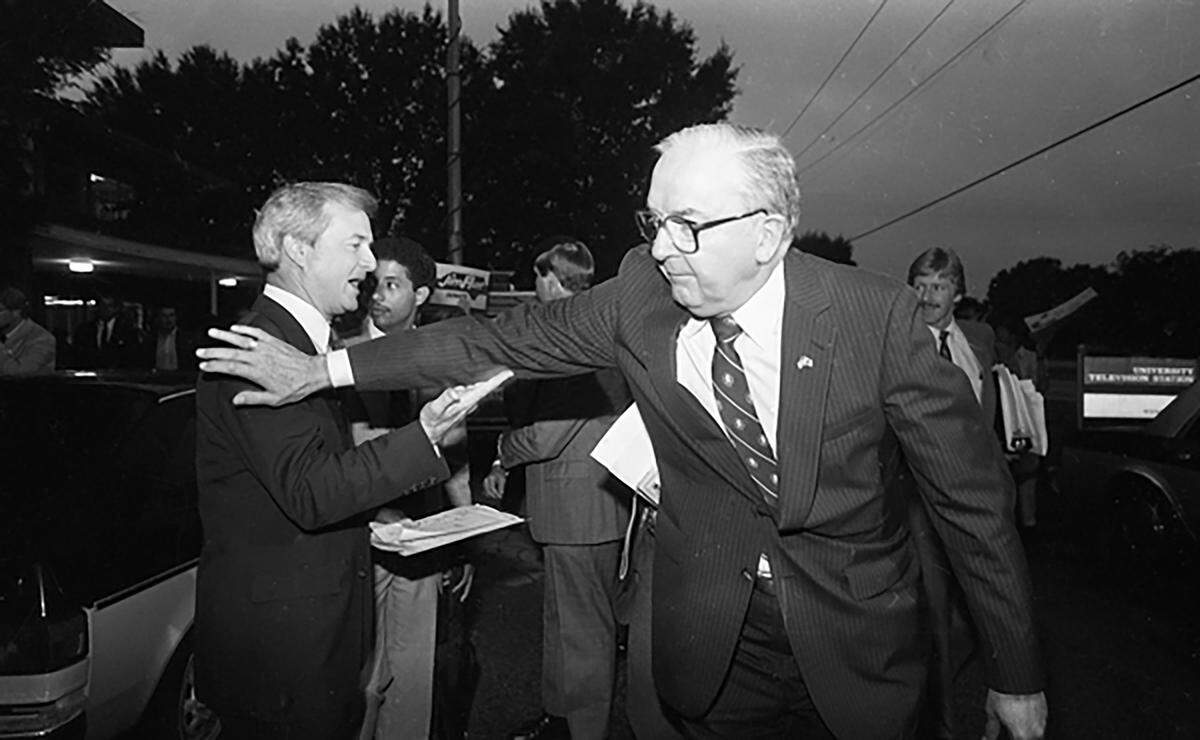
Their contest lasted not months but years. The campaign set a national record in spending for a Senate race; rivaled the 1950 Senate race of Willis Smith against Graham in personal viciousness; and left many North Carolinians exhausted and disenchanted with politics.
The first Helms ads began in April 1983, an astounding 19-month marathon advertising campaign that broke only for a week at Christmas.
Although Helms — by his own polls — started the race 25 points behind Hunt, the race began to tighten in October 1983, when Helms launched a heavily publicized filibuster against legislation making the Rev. Martin Luther King Jr.’s birthday a national holiday. For several days, Helms attracted headlines as he hammered away at the slain civil rights leader’s alleged communist connections.
The King holiday was not only an important issue. One could argue that it was the defining issue in the race the one that fundamentally altered the chemistry of the election. The Hunt campaign’s polling found that the best predictor of how people would vote in the race was how they viewed the King holiday.
The Helms campaign also ran a series of TV commercials exploiting one of Hunt’s vulnerabilities — his desire to seem to be all things to all people.
The Helms ads were short and simple. They laid out Helms’ view on a controversial issue such as the King holiday, school prayer, school busing and a nuclear freeze, and then asked the question: “Where do you stand, Jim?”
“I’m Jesse Helms, and I want you to know where I stand,” Helms said in one ad. “I oppose the Martin Luther King holiday. Where do you stand, Jim?”
Soon people everywhere could recite the “Where Do You Stand, Jim” mantra just like an advertising jingle for Coca-Cola or some other popular commercial product.
Helms reinforced that image by describing Hunt in speeches as a windshield-wiper politician who went “first one way and then the other.”
With polls showing Helms forging into the lead, the Hunt campaign in June toughened the edge on their commercials. They began portraying Helms as an extremist, tying him to pariah nations around the world, from Argentine dictators to the apartheid regime in South Africa, to death squads in El Salvador.
The Republican Party threw its weight behind Helms. President Ronald Reagan, Vice President George H.W. Bush and more than 30 Republican senators campaigned for Helms.
On the campaign trail, Helms, the consummate outsider, would remind voters of his close ties to Reagan and his chairmanship of the Senate Agriculture Committee.
The campaign had a macabre twist. Just four days before the election, Velma Barfield, a 51-year-old grandmother, was executed in Central Prison. She had been convicted of killing her boyfriend by giving him arsenic poisoning and had admitted killing three others.
The execution drew national attention, in part because of the political implications in the Senate race and because Barfield was the first woman put to death in the United States in 22 years. Hunt’s decision not to grant clemency disappointed some of his liberal supporters, but may also have gained him some conservative backing.
On the final day of the campaign, Helms flew around the state and tied Hunt to “homosexuals,” “labor union bosses” and “crooks.” And he said Hunt would only win if he got “an enormous bloc vote” — Helms’ euphemism for Black voters.
“The man is not to be trusted,” Helms told reporters in Charlotte. “And I hope that he never has another day in public office after he’s finished his term as governor.”
In the end, Hunt failed to convince a majority of North Carolina voters that Helms was a political extremist.
Starting the race 25 points behind a popular governor who owned a well-oiled political machine, Helms defeated Hunt by a 52-48% margin.
Helms was swept back into office as part of a national Republican landslide. Reagan carried the state with 62% of the vote, providing Helms with strong coattails.
David Broder, the dean of Washington political journalists, wrote that Hunt might well have been the Democratic presidential nominee in 1988 if he had not lost to Helms four years earlier.
Rob Christensen wrote about North Carolina politics for The News & Observer for 45 years. He is the author of two award-winning histories of Tar Heel politics and most recently wrote a history of The N&O and the Daniels family. He can be reached at robchristensen1920@gmail.com.
This story was originally published December 18, 2025 at 6:29 PM.