Cooper, Whatley win primaries in NC’s Senate race, setting up November showdown
Former Republican National Committee Chairman Michael Whatley and former Gov. Roy Cooper, a Democrat, were declared winners in their U.S. Senate primaries Tuesday night almost immediately after the North Carolina Board of Elections released early results.
The Associated Press called the race for both men at 8:41 p.m. That was just 11 minutes after the state started releasing results. After the race was called, both men immediately walked on stage at their respective campaign victory parties — Cooper’s in Raleigh and Whatley’s in Charlotte — to thank their supporters.
Official results at 11:18 p.m. with less than 100 precincts outstanding statewide showed Cooper had 92% of the Democratic vote and Whatley had 65% of the Republican vote.
The Senate seat for North Carolina is up for grabs this election cycle after Sen. Thom Tillis, a Republican from Huntersville, chose not to seek reelection following a public dispute with President Donald Trump that a policy proposal would leave hundreds of thousands of North Carolinians without Medicaid coverage. Tillis served two six-year terms in the Senate, after previously serving as the state’s House speaker.
Winning North Carolina is critical for Republicans if they want to maintain the majority. In the Senate, there are 53 Republicans, 45 Democrats and two independents who caucus with Democrats. And the Cook Political Report lists four Senate races as toss-ups: North Carolina, Georgia, Michigan and Maine. So, Democrats are betting big on Cooper to be able to flip the Senate seat blue.
That hasn’t been done since 2008, when Sen. Kay Hagan won the Senate seat, but she was succeeded after one term by Tillis, who was the state’s speaker of the House at the time and took in more votes than Hagan in the 2014 election.
Who are the other candidates?
Here are the six people who were on the Democratic ballot:
- Darryl Farrow
- Justin Dues
- Roy Cooper
- Robert Colon
- Orrick Quick
- Marcus Williams
And on the Republican side:
- Margot Dupre
- Richard Dansie
- Donald (Don) Brown
- Michael Whatley
- Elizabeth Temple
- Michele Morrow
- Thomas Johnson
Despite appearing first, Dupre was disqualified from running after the Board of Elections learned she’s registered to vote in Florida. That decision came after ballots were printed.
Democratic primary
In Raleigh, Cooper’s supporters gathered at TRAINE at Seaboard Station, an event space.
“Good evening North Carolina,” Cooper shouted on stage. “I’m humbled and excited to accept the Democratic nomination to become North Carolina’s next United States senator.”
Cooper told his supporters his campaign is for them if they want change in Washington, want to throw out D.C. insiders, and if they think things cost too much.
“I’ve never been in a race this crucial for the people of North Carolina and for the country,” Cooper said, “and I need all of you to get this job done.”
Since 1987, Cooper has won every election he’s run in. He served as the state’s attorney general for four terms and two terms as governor. He led North Carolina when COVID-19 infected the country.
Also notable: Cooper’s two wins for governor came at the same time President Donald Trump, a Republican, won North Carolina.
“I didn’t plan to go to Washington,” Cooper told his supporters. “All of my public service has been here in North Carolina because this is where I wanted to serve, right here at home. But these are not ordinary times.”
Democratic Party Chairwoman Anderson Clayton addressed the crowd to saying “we have one hell of a primary election season.”
“We’re so excited heading into November because North Carolina is prepared to take on people like Michael Whatley,” Clayton said.
She said people are tired of “Republican politics that are hurting our communities.”
Cooper, who has been slower to criticize Whatley this campaign cycle, did so during his victory speech, calling him out of touch.
“He has pushed schemes that raise healthcare costs, make communities less safe, and make life harder and more expensive for working families,” Cooper said.
Republican primary
Unlike Cooper, Whatley has been attacking Cooper frequently on the campaign trail calling him soft on crime.
Two people dressed in orange prison jumpsuits held signs that read “criminals for Cooper” outside of Whatley’s victory event at Noble Smoke in Charlotte.
One person cited Cooper’s “soft-on-crime” policies and the 2021 Covid-era prison settlement as his motivation for demonstrating.
“We see a rise in crime here in Charlotte, specifically with the murder of Iryna Zarutska, and a lot of that is motivating people to turn out and support Michael Whatley,” the man, who declined to share his name, said.
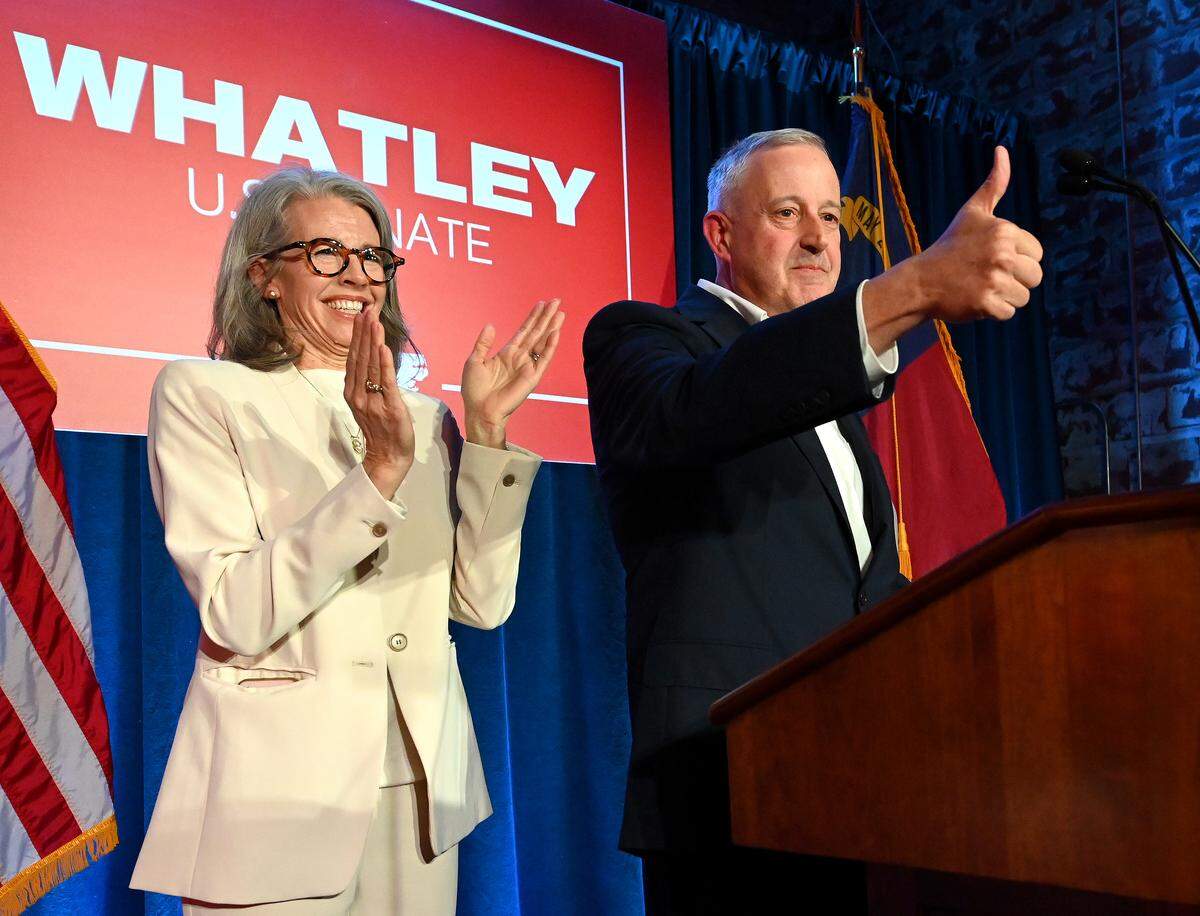
After learning he won the primary, Whatley walked out in front of his supporters.
“God bless North Carolina,” Whatley said. “Tonight, I am honored and humbled by the support of so many hardworking North Carolinians.”
Whatley thanked his family and Trump for “his strong and unwavering support in this race.”
“I’m proud to stand with him in the fight to secure our border, strengthen our economy and put America first,” Whatley said.
Mecklenburg County Republican Party Chair Kyle Kirby said Whatley’s decisive primary win and choice to hold his election night event in Charlotte signal where Republicans plan to focus the race ahead.
Kirby said issues tied to crime and public safety, including in the Charlotte area, are likely to remain pillars of the campaign. “I think Charlotte is going to take center stage in this race,” Kirby said, pointing to debates over cashless bail and Cooper’s role in Brown’s release from prison. “I think it says a lot that Michael Whatley chose Charlotte when he could have chose Raleigh to do his victory party at.”
Whatley’s next closest finisher on Tuesday was Brown, 65, of Charlotte, a judge advocate general officer and author.
Morrow, 54, of Cary, expected to perform better in the race but spent most of the night in fourth place behind Johnson. But Morrow was notable because of previous campaigns she ran where she made controversial comments she made that included calling for the executions of Presidents Barack Obama and Joe Biden.
Whatley told his supporters, that Republicans voters across the state needed to unite, “because the stakes were too high for North Carolina to stay divided.”
“We begin the next chapter of this campaign together, because this election is bigger than a primary,” he said, turning back to his attacks on Cooper.
General election
Cooper and Whatley now will move on to face off against three others: Shaunesi Deberry, an independent; Shannon Bray, a Libertarian; and Brian McGinnis, a member of the Green Party.
Deberry, Bray and McGinnis do not have primary opponents and will automatically appear on the general election ballot.
Senate seat
Tillis’ past two election cycles have broken fundraising records, and this is expected to be no different, even without him in the race.
Early estimates expect no less than $700 million to be spent on this race.
Already, Cooper is listed on the Federal Elections Commission website as having raised the fourth-highest amount of money in the entire nation at more than $21 million. Only Sens. Jon Ossoff, Cory Booker and Rep. Raja Krishnamoorthi have out-raised him.
Whatley is listed at 29th, at more than $6.2 million raised.
Republicans hold the majority in both the House and Senate by very few seats.
This story was originally published March 3, 2026 at 8:58 PM with the headline "Cooper, Whatley win primaries in NC’s Senate race, setting up November showdown."