Autism therapy costs soar for NC Medicaid. Auditor and lawmakers take closer look
AI-generated summary reviewed by our newsroom.
- Auditor scan quickly identified a major Medicaid spending spike on autism therapy costs.
- NC Department of Health and Human Services projects therapy costs to rise 425% by 2026.
- Lawmakers will hear more information from NCDHHS Secretary later on Tuesday.
A sharp rise in spending on autism therapy in North Carolina’s Medicaid program has prompted the state auditor’s office to take a closer look, State Auditor Dave Boliek told lawmakers Tuesday morning.
Lawmakers also heard later on Tuesday about Medicaid’s autism benefit from Health and Human Services Secretary Devdutta Sangvai and other officials, as well as providers and the mother of a child with autism receiving services.
That was Meredith McCumbee from New Hanover County, who said her son Aaron was diagnosed with autism when he was 4.
“For years, communication was one of his greatest barriers. Aaron had so much inside of him, thoughts, preferences, humor, so much to say, but limited expressive speech and ways to communicate,” McCumbee said. “ABA, in close partnership with our speech therapy, changed his trajectory.”
Applied behavior analysis therapy, or ABA, uses positive reinforcement to help children with autism build communication, social and daily living skills.
It “didn’t change who he is. It gave him access to who he already was,” she said. “Funding decisions can feel abstract, line items, service codes, budget allocations, but for families like ours, access to ABA was a difference between isolation and inclusion. Crisis and stability. Marriage and divorce.”
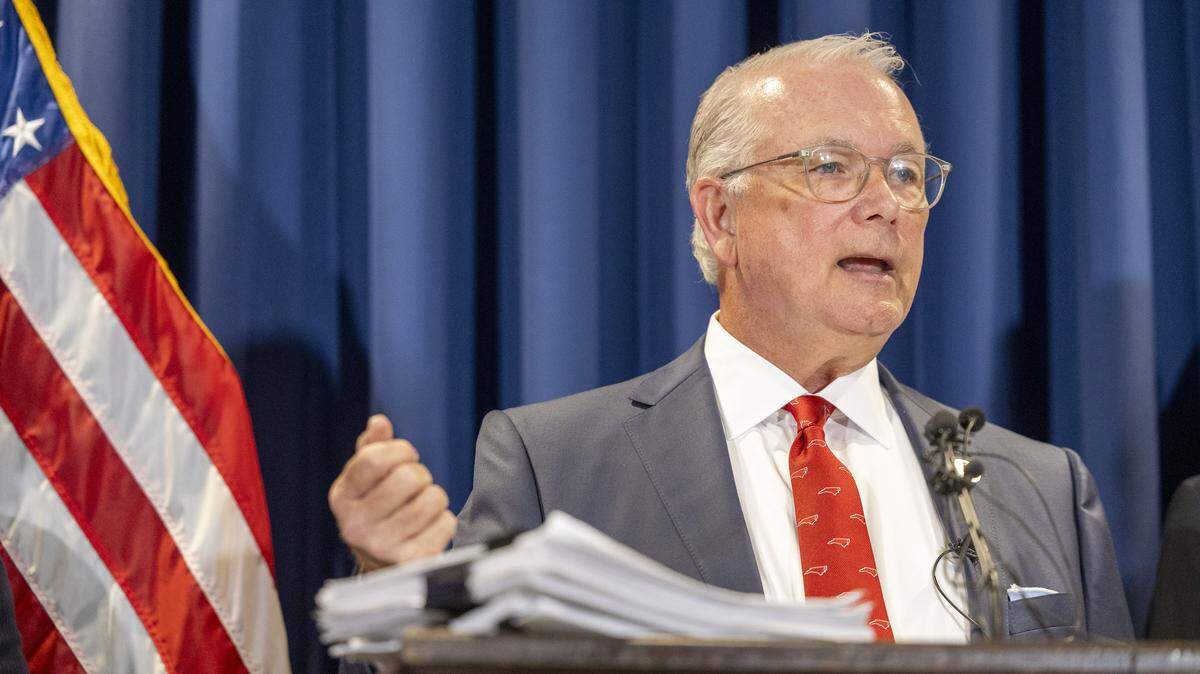
During a joint legislative oversight committee meeting Tuesday morning, Sen. Ralph Hise, a Spruce Pine Republican, asked Boliek whether his office planned to investigate potential fraud in North Carolina programs — particularly in light of federal fraud investigations into social service programs in Minnesota.
Boliek said his office recently began scanning state programs for unusual spending increases and quickly identified a major spike in Medicaid spending on applied behavior analysis therapy for children with autism.
“The first thing we did was scan across our government to look for spikes that would be clearly obvious that our team would need to go and take immediate audit action on,” said Boliek, a Republican in his first term.
“Our team has identified an area that has spiked in North Carolina, and that is the provision of ABA services in the autism arena,” he said. “There’s been a tremendous spike in the amount of money that Medicaid spends in that particular area. Our team has begun a detailed look at that.”
“That was one area that we did identify that needed a really, really, really close look,” Boliek added. “We’re not asleep at the wheel. We are looking at it very hard.”
The state Department of Health and Human Services, which oversees Medicaid as well as child care and other social service programs, flagged the same trend in an October report on services for children and youth diagnosed with autism spectrum disorder.
The report said North Carolina Medicaid is “currently experiencing an exponential increase in utilization and spending” on ABA therapy.
How much has spending increased?
Spending on ABA and related behavioral therapies was projected to increase about 425%, from $121.7 million in the 2022 fiscal year to about $639 million in 2026, according to the report.
Projections have since increased.
The DHHS report said part of the increase may be due to more providers entering the market and a 15% reimbursement rate increase for providers in 2024.
However, the report noted that spending increases are not evenly distributed across providers and are rising much faster than the rate of autism diagnoses in the state.
The agency recommended several reforms, suggesting the therapy may sometimes be used even when less intensive options are available and that treatment plans may not always be sufficiently individualized.
On Tuesday, lawmakers reviewed information on the program from interim N.C. Medicaid Deputy Secretary Melanie Bush showing:
- ABA services are primarily delivered to children age 6 and under, and spending on these services grew by 347% between 2022 and 2025.
- The average patient’s service hours for ABA and related services jumped from 47.5 hours per month to 54.1 hours per month.
- Total N.C. Medicaid members receiving services grew from 3,844 in fiscal year 2022 to 13,447 in fiscal year 2025.
- Projected costs are expected to reach $1.1 billion by fiscal year 2027.
Other states have also seen spending on ABA therapy under Medicaid balloon and seen access challenged as states make cuts to Medicaid following federal changes to the program affecting state budgets, KFF reported.
KFF also noted that “heightened awareness and diagnosis of autism means more families are seeking treatment for their children” and that ABA therapy is a relatively recent coverage area for Medicaid.
North Carolina added autism therapy services as a Medicaid benefit in 2019.
What could change?
Some states, Bush said, have implemented or are considering reducing payment rates to providers, requiring parent participation in treatment planning and sessions, or instituting prior authorization requirements.
Among options for North Carolina, DHHS recommended collaborating with Medicaid health plans and the N.C. Department of Justice to strengthen program integrity; ensuring all treatments are individualized; and reviewing licensing and supervision requirements.
“It’s a billion-dollar increase,” said Sen. Benton Sawrey, a Clayton Republican who was chairing the hearing.
“That’s state employee raises, that’s public education dollars. Dollars aren’t independent. We’re making choices with scarcity of resources,” he said.
After hearing from McCumbee and from two providers, he added: “Therapy does work; we want to make sure it’s sustainable.”
Hise, who is a top budget writer, questioned whether the services were actually being provided, considering the sharp uptick. Sangvai said the private companies that run the Medicaid health plans oversee the services and DHHS also gets feedback from families. He said there’s always an “opportunity to understand” whether services are being provided as expected. “But right now, we have no reason to believe that services aren’t being provided.”
Matt Filer, chief executive officer of Mosaic Pediatric Therapy, said that of the roughly 3,500 behavior analysts licensed to work in North Carolina, 47% do not live in the state. Mosaic provides in-person care rather than telehealth services.
Board Certified Behavior Analysts are nationally accredited clinicians with master’s or doctoral degrees who supervise behavior technicians working directly with families. Filer said it is important to maintain an appropriate ratio of these analysts to technicians. Technicians typically have a bachelor’s degree or a high school diploma and receive 40 hours of training.
Sen. Jim Burgin, an Angier Republican, asked whether DHHS could pause the services. Bush replied that the General Assembly would need to change the law to permit that.
Boliek told lawmakers the auditor’s office has the capacity to investigate fraud and is hiring a senior Medicaid audit director to expand that work.
Cuts to ABA therapy
The scrutiny comes amid broader tensions over Medicaid funding. In early October, North Carolina reduced Medicaid provider reimbursement rates by 3% to 10%, with DHHS and the governor citing a funding shortfall. ABA therapy faced the maximum 10% cut.
After multiple lawsuits over the reductions, Gov. Josh Stein, a Democrat, reversed the cuts.
Stein on Monday urged the House and the Senate — both led by Republicans, and which have struggled to reach agreement on a state budget and other provisions — to approve additional Medicaid funding. He called for $319 million for the current fiscal year, which has less than four months left, The News & Observer previously reported.
This story was originally published March 10, 2026 at 1:02 PM.