NC is collecting enough taxes to automatically cut them, but there’s a hitch
AI-generated summary reviewed by our newsroom.
- Forecast projects over $35 billion in individual income tax revenue this year.
- Forecast predicts meeting $33B trigger, cutting rate to 3.49% in 2027.
- Stalemate: House wants higher triggers; Senate backs 2023 plan; governor opposes cuts.
North Carolina is expected to rake in more than $35 billion in individual income taxes this year, which means taxpayers’ individual income tax bills are set to drop in 2027.
The expended revenue meets a benchmark the Republican-controlled General Assembly set in 2023 for reducing the individual income tax rate. It has repeatedly dropped the past several years, and for the 2026 tax year the rate is 3.99%.
But there’s been a legislative tax battle for several months, so that could change. The news comes from the annual consensus revenue forecast by the Office of State Budget and Management, which is a Cabinet agency under Democratic Gov. Josh Stein, and the Fiscal Research Division of the General Assembly, which is controlled by Republicans.
The forecast notes uncertainty in North Carolina’s economic outlook that goes beyond the halls of the Legislative Building and your tax bills. It extends to the U.S. conflict with Iran.
“Economic forecasters predict higher GDP growth, wage and salary growth, retail sales growth, and corporate profits growth” compared to the last forecast, they wrote — but that could change, too.
Inflation, costs from Iran war
The forecast reports:
- There is “significant uncertainty” around the U.S.-Iran war.
- Higher oil prices could mean higher prices on other goods, and that could mean more sales tax revenue.
- That oil price spike is also expected to increase inflation at the start of the new fiscal year in July.
What it means for your taxes
That tax cut to a 3.49% rate for the 2027 tax year will happen once final revenue amounts are tallied by the end of this fiscal year, which ends June 30. But there’s also a major battle happening in the legislature over the pace of those tax cuts.
Republican lawmakers failed to send the governor a budget in 2025, primarily because they couldn’t come to an agreement on changing the state revenue benchmarks that activate income tax cuts in 2027 and beyond.
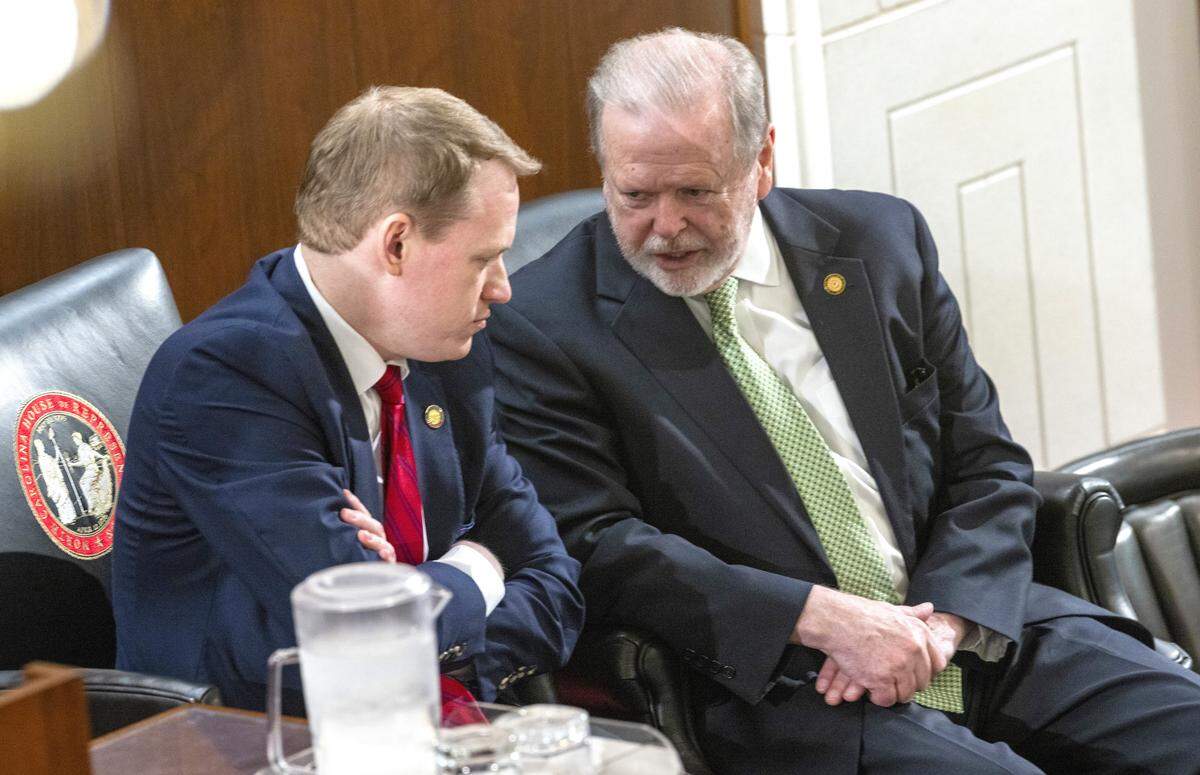
The battle has become a stalemate, with both Republican House Speaker Destin Hall dug in his trench over changing the tax cut trigger amounts because of recent inflation , and Republican Senate leader Phil Berger, who just lost his primary race, dug in over keeping the 2023 plan.
The trigger is set at $33 billion in state tax revenue in 2027, which the forecast predicts will be reached, and then $34.1 billion in 2028, which the forecast also predicts will be met. That means a 3.49% rate for 2027 and then another decrease , to 2.99%, for 2028.
The House’s 2025 proposal would change the 2027 trigger amount to $36.3 billion, followed by $37.7 billion in 2028. So under the House’s plan, there wouldn’t be tax cuts, given the forecast.
The forecast will be revised in May, after money is counted following the April 15 Tax Day.
Budget still waits, as do funding needs
Berger told The News & Observer in a statement on Tuesday that the forecast “once again confirms that Republican-led, pro-growth fiscal policies have transformed North Carolina into an economic juggernaut.”
“As we prepare for the legislative session, this forecast provides a roadmap to continue those efforts and ease the tax burden for hardworking North Carolinians,” Berger said.
The new legislative session begins on April 21.
Hall — Berger’s counterpart in the House — cautions about spending needs, especially Medicaid funding.
Hall said the “surplus demonstrates the success of the fiscally responsible policies enacted by our Republican majority over the last 15 years. Unfortunately, this surplus revenue will be entirely consumed by a projected billion-dollar Medicaid rebase. This program must be reformed in order to preserve our ability to fund public safety, education and other priorities.”
Hall also mentioned the budget impasse.
“We must protect North Carolina’s hard-earned reputation for fiscal strength by passing a responsible budget sooner rather than later,” he said.
Stein said he is worried that the planned tax cuts mean a coming shortfall, saying the cuts will reduce future revenue and mean the state “will soon fall into a budget gap of at least $2.8 billion, causing the state to have to make painful cuts to critical services like public safety, education and health care.”
Stein urged the legislature “to study these new realities, hit pause on outdated, irresponsible tax triggers, and invest in our most important resource: our people.”
The governor has made several offers to Hall and Berger to work out some sort of budget deal. On Tuesday, Senate Democratic Leader Sydney Batch told reporters she and other Democrats are ready to work with Republicans on a budget deal.