
Budd praises Mullin’s momentum on NC Helene relief. He sees more red tape to cut.
AI-generated summary reviewed by our newsroom.
- Mullin rescinded Noem’s approval rule and released $134 million to NC.
- Budd blocked Homeland Security nominees to press for release of relief funds.
- Lawmakers urge topping off Disaster Relief Fund and FEMA reforms before hurricane season.
Before the Senate finished voting to confirm Department of Homeland Security Secretary Markwayne Mullin, he was already reaching out to members of North Carolina’s delegation gathering contact information for state and local leaders impacted by Helene.
It was a welcome relief for lawmakers like Sen. Ted Budd, a Republican from Davie County, who made a rare move against President Donald Trump’s administration by blocking DHS nominees from a Senate hearing in order to get the prior secretary, Kristi Noem, to release allocated relief funds to the state.
“(Mullin) is well-suited to what we need here in North Carolina and the rest of country,” Budd said. “He’s already started getting the ball rolling for Western North Carolina. It shows he is a man of action; and there is a lot less politics.”
Helene ravaged Western North Carolina in September 2024, causing around $60 billion in damages and at least 108 deaths.
Months later, Trump began his second term in office and appointed Noem to serve as Homeland Security secretary. Noem then implemented a policy that any funding over $100,000 needed her personal approval before being funneled to states.
This caused a backlog, and small North Carolina communities were suddenly fronting money they couldn’t afford for storm relief while waiting on Noem to approve the funding already approved by Congress.
Budd said some communities spent $30 million. This resulted in some of them having to take out loans to pay for other required services in their towns.
“Every invoice and request needs to be reviewed, but still, it doesn’t all need to stack up on the desk of the secretary,” Budd said. “There’s a lot of very competent people that can review those, and so he’s allowed that to happen.”
Mullin makes changes
When Mullin took over from Noem, that was one of the first policies he rescinded. He also released $134 million to the state over the past two weeks.
Budd said he expects North Carolinians to benefit from that funding quickly, but added that it needs to first pass through the state to be distributed to local communities.
It’s rare for Budd to take a stand against the Trump administration, but last September, he voted against one of Trump’s nominations to DHS and announced he would block any future agency nominations from reaching the Senate floor until Noem released North Carolina’s money.
Sen. Thom Tillis, a Republican from Huntersville, railed against Noem in a Senate hearing last month, saying that her response to Helene showed she lacked leadership skills. He called for her resignation.
Days later, Trump announced he was removing Noem from her Cabinet position and replacing her with Mullin, a senator from Oklahoma.
Visiting North Carolina

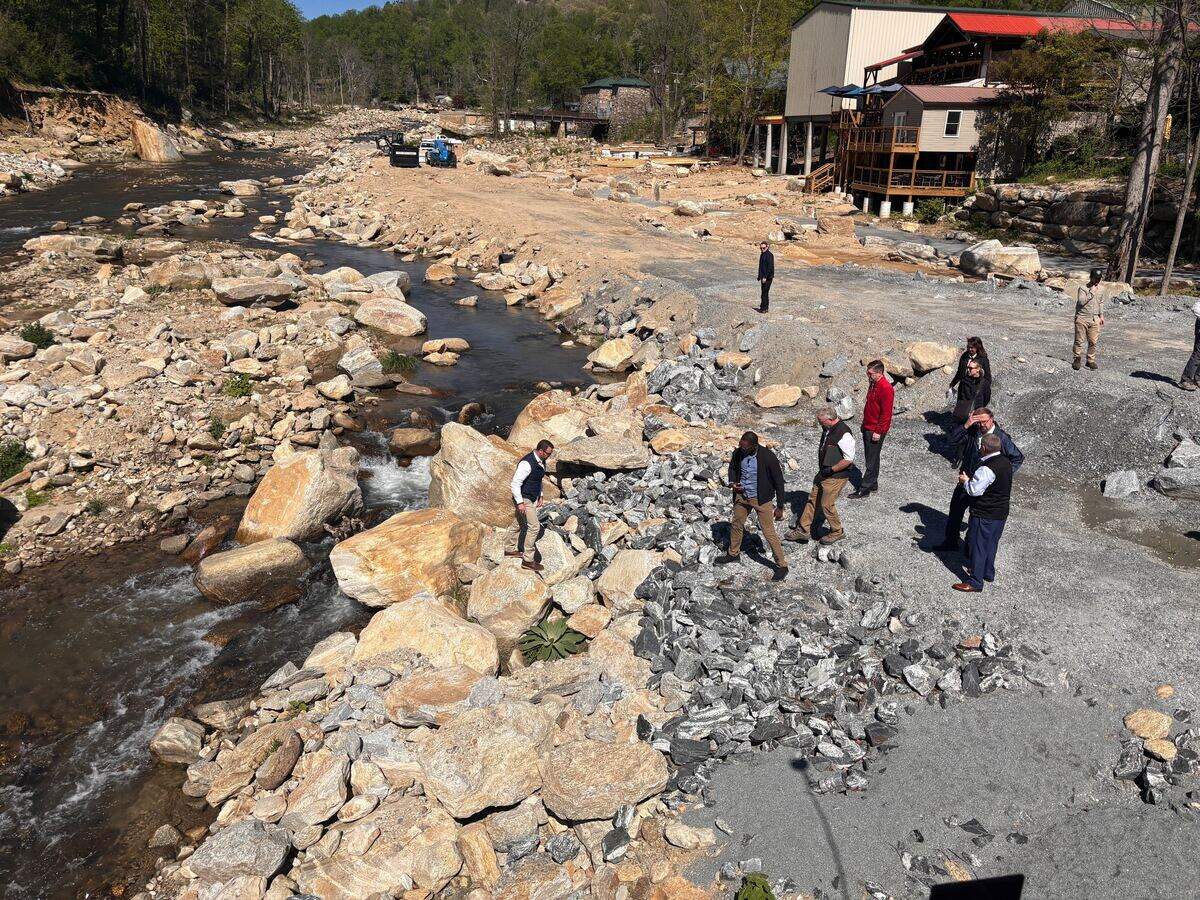
On Tuesday, on his first official trip as secretary, Mullin visited Chimney Rock, one of the North Carolina communities affected by Helene. Budd said his trip was the result of some of the early conversations he had with North Carolina officials about Helene relief.
During his trip Tuesday, Budd said, Mullin was very open with stakeholders, from the local to the federal level.
“He brought his team there to hear firsthand from the people of Western North Carolina,” Budd said. “It was a very productive meeting, and I think we’ll know in the coming weeks of how effective we were.”
Mullin announced he wouldn’t get rid of FEMA, but does plan to reform it.
Making policy changes
Budd said policy changes related to hazard mitigation and continuity are needed. He added that he’s heard stories about some people in Western North Carolina who would be working with one FEMA official, only to be assigned a different person, and have to start their process with the agency over.
“They were being bounced from agency to agency,” Budd said. “So I think he just wants to get things done, get it done efficiently and quickly, but also making best-use for the taxpayers.”
Budd said Mullin was “tremendously responsive” to North Carolina’s needs. He said Mullin comes from a business and entrepreneurial background and likes to cut through red tape.
Surveying the damage
Videos from Mullin’s visit Tuesday showed the secretary navigating boulders as he crossed a river near Chimney Rock surveying the damage. Budd, and Reps. Chuck Edwards, a Republican from Hendersonville, and Tim Moore, a Republican from Kings Mountain, stood nearby.
Budd stressed to McClatchy that Western North Carolina is open for business and people should still travel there.
But Mullin saw where damages remain. Budd said some two or three-lane roads are down to one lane. Temporary bridges have been built. He said there are places where the back half of stores are still gone, sheared off by overflowing rivers.
“But I’ve also seen a lot of rebuilding,” Budd said. “Rebuilding of stores and places of business. Some of this was volunteer efforts, donations of materials, donation of labors. People working together with great groups like Samaritan’s Purse and so many others — the Red Cross — and just volunteers from the East Coast and all over the country who came in to help.”
Budd said while they visited they took note of reopened coffee shops, outdoor outfitters, restaurants and marinas.
Lake Lure, he said, is hoping to reopen Memorial Day weekend. Budd added that 225,000 dump trucks were used to remove debris from the 700-acre lake, originating from towns upstream.
“That’s just one incident of the 25 western counties,” Budd said. “That was just one town that we were really able to dive deep in today, but it was a good representation of what had happened in lots of other places as well.”
What’s next
Mullin inherited an agency that is facing a partial government shutdown.
Congress couldn’t reach an agreement on DHS funding, forcing the department to close temporarily starting Feb. 14. Some employees are still being paid, but others are being forced to work without a paycheck.
“Let’s fund DHS,” Budd said. “We really need to top off the Disaster Relief Fund. It’s sitting near empty right now, and we need to top it off so that we will be ready for anything.”
Hurricane season begins June 1.
Congress is in the second week of a two-week recess. Senate Majority Leader John Thune passed a DHS funding bill out of his chamber during the recess, but House Speaker Mike Johnson failed to take it up, knowing that Republican hardliners would object.
The House is scheduled to return April 14.
