Gov. Josh Stein announces new plan to solve NC housing shortage. Details
AI-generated summary reviewed by our newsroom.
- Gov. Josh Stein signed an executive order to address the state's housing shortage.
- The order creates a new senior advisor for housing policy to lead efforts.
- NC needs to build new housing of all types, using public-private partnerships, Stein said.
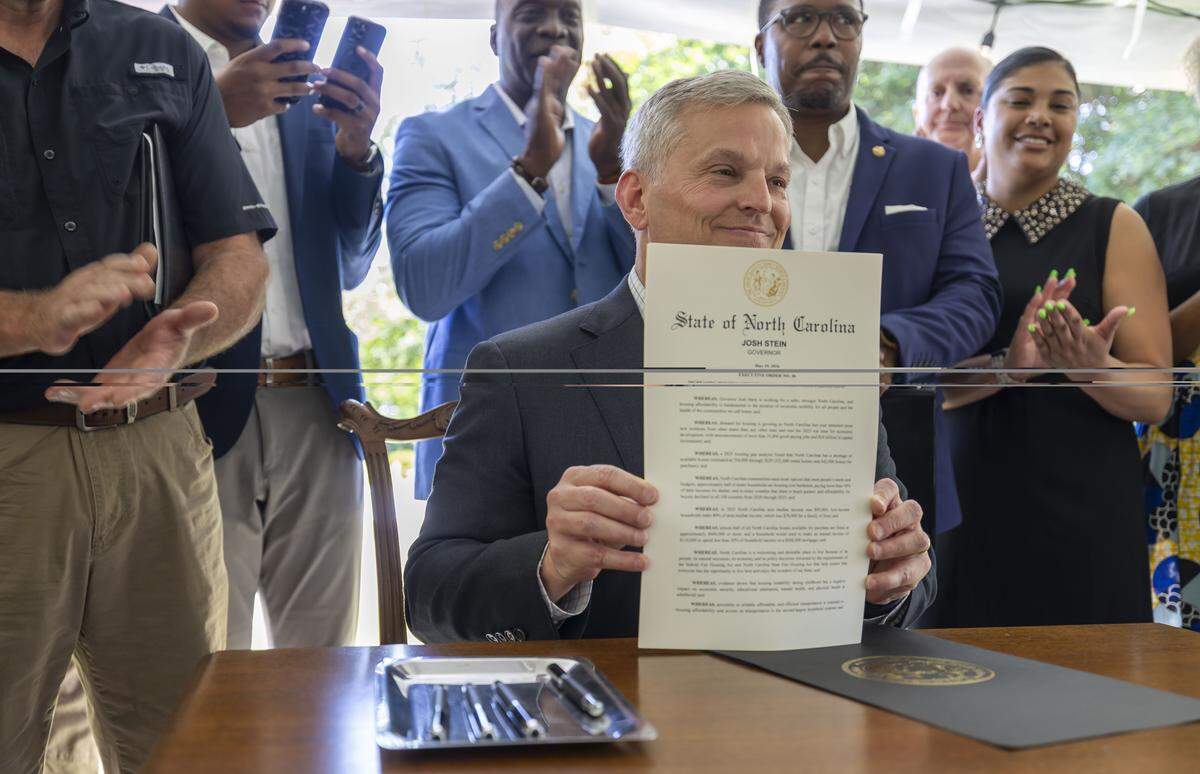
North Carolina Gov. Josh Stein signed an executive order Tuesday aimed at increasing the availability of affordable housing across the state.
The executive order creates a new senior adviser for housing policy within the governor’s office.
The senior adviser, Janneke Ratcliffe, will work with state agencies, local and tribal governments and others to create and oversee a statewide housing strategy, including setting affordability goals and metrics and identifying solutions.
Ratcliffe, a longtime North Carolinian and UNC graduate, has spent years studying housing. She was a senior research fellow in housing policy at the Center for American Progress and served as executive director at the UNC Center for Community Capital, according to her LinkedIn, where she led a research center that examined topics including housing finance and affordable homeownership.
In 2021, she joined the nonprofit research organization Urban Institute, where she served as vice president of the Housing and Communities Division and the Housing Finance Policy Center.
It’s no secret that North Carolina has a housing shortage, Ratcliffe said. This order marks a “call to action,” she said.
“The excitement is already there,” Ratcliffe said. “It’s in all kinds of places — a sense of what their communities need, a sense that we got to get up and do something about it. I think we’re tapping into that already.”
The executive order gives Ratcliffe 90 days to present to Stein a proposal for tracking progress toward creating more affordable housing. Ratcliffe said a dashboard would be set up so the public can follow progress.

“A lot of people are moving to North Carolina, and that’s good, because it shows we have a lot of good things happening,” Stein told reporters after signing the executive order. “But when you have that increase in demand and you do not increase supply, prices go up.”
By 2029, North Carolina will be facing a housing inventory gap of more than 764,000 units, according to a February 2025 report from the NC Chamber Foundation, North Carolina Home Builders Association and NC Realtors.
The study also found that only nine counties in the state had a median list price under $200,000.
North Carolina needs more housing of all types, Stein said. That includes single-family housing, duplexes and triplexes, condominiums, apartments and special needs housing.
“Each community knows best what they need, but what we want to do is remove red tape, free up the market so that they can produce whatever housing the market needs,” Stein said.
Why is this order needed?
The executive order comes as North Carolina continues to attract businesses and residents.
In 2025, CNBC named the state the best for business, a spot the state has claimed three times in recent years. And in the year ending July 1, 2025, North Carolina added an estimated 145,907 people to its population, more than every state except Texas and Florida, The N&O previously reported.
“You all have heard the expression that if you build it, they will come,” Stein said. “Turns out, in North Carolina, if you don’t build it, they will still come.”
In late April, legislators introduced a bipartisan bill, House Bill 1072, that would create a $50 million loan program offering below-market interest rate loans to eligible nonprofits wanting to acquire, develop and improve properties for affordable housing.
The governor told reporters after Tuesday’s event that he hopes lawmakers “come up with as many proposals as we can that will increase supply.”
But building new housing isn’t the only action the state needs to take, Ratcliffe said. The state also needs to preserve and rebuild its existing housing and provide safe places for people to live and remain in their communities.

NC needs more higher-paying jobs, too
Stein and Ratcliffe were joined by speakers Schumata Brown, the town manager of Maysville in Jones County, and Ryan Shaver, representing the North Carolina Masonry Contractors Association.
Brown talked about the importance of collaboration and partnership, touting the wins of the Jones County for Life collaboration, which has brought together the town of Maysville, Jones County government and Carolina Statewide Development LLC to address housing challenges in the rural area. The partnership has resulted in plans to create new affordable housing units, including for working families and seniors, Brown said. Maysville also recently opened a workforce development center to train people in skilled trades.
“When you combine strong schools, workforce development and housing, you begin to see a full ecosystem of opportunity taking shape, one that other rural communities can learn and duplicate,” Brown said.
Shaver discussed the value of apprenticeships, which help teach North Carolinians trades that allow them to earn living wages.
Stein told reporters after the event that he supports increasing the minimum wage, which currently sits at $7.25.