
Tony Tata’s Army career included phony court order, at least 2 affairs
Updated: On April 23, 2020, The News & Observer reported President Trump will name Anthony Tata to a top job at the Pentagon. Pending Senate confirmation, he would be the new Defense Department’s undersecretary for policy.
This story was originally published Sept. 19, 2015, and was updated Dec. 21, 2018.
Tony Tata’s credentials as an Army leader helped him land big jobs as Wake County school superintendent and state transportation secretary, and the retired general continues to trade on his military experience as a TV news commentator and the author of action thrillers.
But after Tata decided in June 2008 to retire from the Army, Pentagon officials were still asking questions about a mysterious, phony court document he had given investigators in 2007. An Army probe found that Tata had committed adultery with “at least two” women during his career, court and military records show.
Tata resigned as Department of Transportation secretary suddenly in July, citing the needs of his family and the demands of his burgeoning side career. He said he was considering a run for Congress.
The Army’s Office of Inspector General concluded in June 2007 that Tata had extramarital affairs in 1985 and 1992 while he was married to his first wife, Tracy. The News & Observer obtained a copy of the investigators’ report, signed by two senior Pentagon generals. The adultery complaint against Tata involved affairs with three women and a son born out of wedlock.
At the same time, Army investigators rejected Tracy Tata’s complaint that her ex-husband had failed to meet his court-ordered obligation to support their daughter, Brooke. As evidence in the general’s favor, they quoted a 2001 Georgia domestic court order that criticized Tracy for willfully burdening Tony with medical bills that “need not have been incurred at all” because Brooke qualified for free military health care.
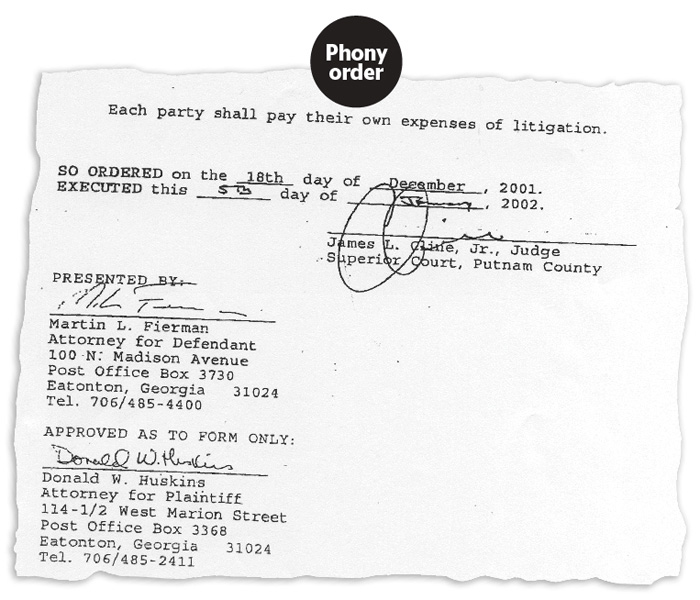
But this court order turned out to be a fake. Military and court officials agreed later that someone had forged the signatures of two lawyers and the Georgia judge.
Army leaders chose not to penalize Tata for adultery, which he did not deny. And they did not determine who created the phony court document and who forged the signatures. The forged court order supported Tony Tata’s side of a dispute regarding more than $3,000 in doctor’s bills for his daughter.
Instead, Tata finished his military career on a tide of praise. Shortly after his retirement took effect in June 2009, he was honored with the Army’s Distinguished Service Medal.
“I retired after 28 years honorably, with the highest noncombat award the chief of staff of the Army can give,” Tata, 56, said in an interview. “That would not have happened if there was anything in those thousands of documents that would have in any way impugned my character. That’s the only thing that’s relevant here.”
Tata gave The N&O online access to his Army personnel file. It included a glowing performance review in 2008 from Lt. Gen. Thomas F. Metz, director of the Pentagon’s Joint Improvised Explosive Device Defeat Organization.
“If I could promote one officer to Major General, I would promote Tony,” Metz wrote on Oct. 20, 2008. “He has the leadership skills, vision, experience, dedication, and values that our Army needs as we continue in this era of persistent conflict.”
But even as Tata’s three-star boss was calling him a “must for promotion” eight months before he was scheduled to retire, Army headquarters officials were still concerned about the bogus court order.
Daniel F. McCallum of the Army’s Office of General Counsel sent a copy of the phony document to court officials in Putnam County, Ga., “for your review and appropriate action.” He asked whether they were going to investigate.
“If you initiate an inquiry into this matter and your inquiry implicates Brigadier General Anthony Tata in any impropriety, please notify us immediately,” McCallum wrote on Oct. 27, 2008.
Tracy Tata discovered the phony document in summer 2007, and Tony Tata acknowledged that November that the court order he had given the inspector general’s investigators was not genuine.
He says he corrected the record and gave them the true document. It shows that the Georgia judge ruled generally in Tata’s favor, deciding not to increase his monthly child support payment – but without ruling on the medical bills or rebuking Tracy Tata, as the false document did.
Tata says he does not know who created the fake order with its phony signatures. It was inadvertently included, he says, with “over a thousand documents” he and his military lawyer gave the inspector general’s investigators in March 2007.
He said he had just returned from a 13-month combat tour and had only a couple of weeks to prepare his defense.
“I had just gotten back from Afghanistan when all this started happening,” Tata said. “When we saw there was something bogus in there, we cleared it up right away.”
‘Absolutely bitter’ divorce
Tata was an Army major at Fort Leavenworth, Kan., when he and Tracy divorced in April 1993 after nearly 10 years of marriage. The divorce decree set his child support obligations with an added proviso that Tony Tata would cover 52 percent of their daughter’s uninsured medical expenses.
Their daughter, Brooke, spent her youth in Georgia, where her mother was a pharmaceutical sales representative. Georgia court records show that, in the years after their split, Tata and his ex-wife fought continually over issues including money and Brooke’s visits with her father.
“These two were absolutely bitter toward each other, and I couldn’t fix that,” recalled lawyer Donald W. Huskins of Eatonton, Ga., who represented Tracy Tata.
Tony Tata’s former lawyer, Martin Fierman of Madison, Ga., said Tracy Tata was relentless in her efforts. “This was an ongoing thing with the ex-wife, interfering with Tata’s career, going to the Army and complaining about things,” Fierman said.
Tracy Tata, 57, has health problems and is effectively retired on full disability, according to her mother, Bunny Wiley. Reached at her home in Athens, Ga., Tracy Tata declined to comment.
In late 2006, citing a long-running feud about Brooke’s college expenses and disputed medical bills, Tracy Tata took her case to the Pentagon. Tony Tata, who had been promoted to brigadier general earlier that year, was serving in Afghanistan as deputy commander of the Army’s 10th Mountain Division.
Gen. Richard A. Cody, then the Army’s vice chief of staff, in February 2007 ordered an investigation of Tracy Tata’s allegations that Tony Tata had committed adultery while they were married, later used Army computers to hack into her personal email account, and failed to honor his child support obligations.
The military and adultery
Under the Uniform Code of Military Justice, adultery is a criminal offense in cases where it brings discredit to the armed forces or undermines military order and discipline.
It rarely is prosecuted as a stand-alone offense. Military officers charged with adultery usually are also accused of offenses related to the extramarital affairs, such as misusing government phones and credit cards or making false statements to investigators – or with more serious crimes such as sexual assault, sexual harassment or procuring a prostitute.
The inspector general’s report said Tata had sex one night in 1985 with an Army lieutenant when he was an Army captain, married nearly two years. Tata did not supervise the woman. She said in an affidavit that she had thought Tony Tata was single, but then, after they had sex, he told her he was married.
Tata had an affair with a civilian woman while he was separated from Tracy Tata in 1992, after she filed for divorce. He told investigators he ended the relationship “because he knew it was wrong,” the 2007 report stated.
“You know, I was separated when that happened,” Tata told The N&O. “Sure, military law says you’ve got to be divorced. OK, I get that, and I owned up to that.”
Tata had an affair with a second civilian woman and fathered a child out of wedlock in 1993. The baby boy was born in October, six months after the Tatas’ divorce took effect in April.
The Army investigators gave Tata the benefit of the doubt on this one. They accepted his assertion that he mistakenly believed his marriage had ended after a December 1992 court hearing, a few weeks before the baby was conceived.
But they concluded that the adultery charge was “substantiated” because of the other two affairs, which Tata did not dispute.
“That his conduct appeared to remain unknown by the Army for many years did not diminish the discreditable nature of at least two extra-marital sexual affairs,” the inspector general’s report said. “(Tata’s) actions reflected poor judgment and a pattern of misconduct. Under the circumstances, his misconduct was prejudicial to good order and discipline.”
The Army confirmed that The N&O’s copy of the report was authentic.
Tata and his son’s mother did not marry. He went to court in Mississippi with her in 1995 to give the child his name.
A bogus court order
Tracy Tata’s computer hacking and child support allegations were “not substantiated,” the inspector general concluded. The investigators pegged their child support decision to the outcome of a dispute the divorced couple had fought in a Georgia courtroom in 2001.
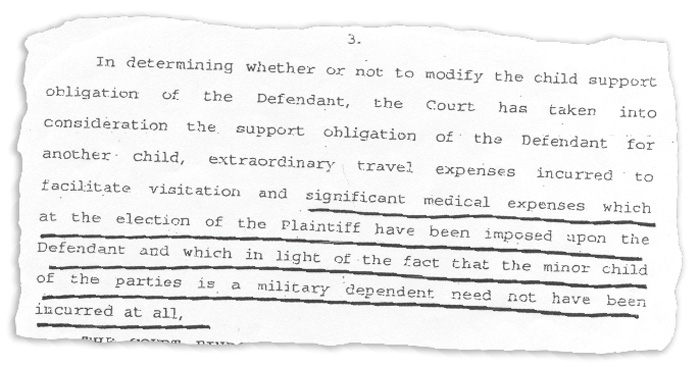
They cited a three-page document labeled as the “FINAL ORDER” by the Georgia judge, James L. Cline Jr. It was not Cline’s order. But it echoed words the judge had uttered in court, according to the 150-page transcript of a December 2001 hearing, about “significant medical expenses” that should not have been “incurred at all.”
The doctor’s bills were a secondary concern for Cline. He focused his genuine ruling on whether to increase Tony Tata’s monthly child support payments.
But in the Army’s 2007 investigation, the medical payments dispute was the central issue.
Army investigators focused on Tracy Tata’s claim that her ex-husband still owed her more than $3,000 for their daughter’s medical expenses. Tony Tata had stopped paying some bills after he accused her of filing medical claims against multiple insurance companies.
To bolster his defense, Tata obtained a sworn affidavit from Cline in March 2007, five years after the judge’s original ruling on child support payments. Cline said it was his opinion that Tracy Tata could have avoided “most, if not all” medical expenses for her daughter but “simply had refused” to use military health care providers.
When Judge Cline had issued his genuine final order in April 2002, however, he did not rule on medical bills or criticize Tracy Tata.
Tracy Tata discovered the bogus order after she received a copy of the inspector general’s report in summer 2007. Lawyers, court officials, Army officers and Tony Tata quickly agreed that the 2001 court document was phony. (Cline died in 2014.)
“The purported signature of Judge James L. Cline, Jr. is not authentic, and it appears to me to be a forgery,” Robin V. Rice, Putnam County’s deputy clerk of court, said in a sworn affidavit in November 2007. Huskins, Tracy Tata’s lawyer, asserted in an October 2007 affidavit that “the signature purporting to be mine” was “not made by me.” Fierman’s signature also had been faked.
In a November 2007 email to Gen. Alan Thrasher, then the Army’s deputy inspector general, Tata said he had mistakenly “believed the document I originally submitted ... to be a true and accurate rendering of the judge’s final decision.” He attached a copy of the genuine April 2002 order “to set the record straight.”
Tata says he had learned of the bogus order from his lawyer, Fierman, who says he does not know the document’s origin.
“I couldn’t tell you where it came from,” Fierman said in an interview. “I do not know how it came up.”
Even after Tata acknowledged that the document was false, generals and other officials in the Army’s offices of Inspector General, General Counsel and Legislative Liaison were fielding questions about it – and asking their own questions – in late 2008.
In the end, they do not appear to have been eager to find out who created the false document, how Tata got it and why he gave it to Army investigators. Tracy Tata wrote letters urging them to dig up the answers to those questions, but they declined.
Responding in August 2008 to an inquiry from then-U.S. Sen. Saxby Chambliss, R-Ga., Col. Debra Fix, the Army’s chief investigator, said “there was insufficient evidence to indicate that (Brig. Gen.) Tata knew the copy of the court order he submitted was not a true copy of the final court order or that he knew the signatures may not be genuine.”
In October 2008, McCallum of the Army’s General Counsel office suggested in his email to Putnam County that this might be a matter for Georgia officials to investigate.
The Putnam clerk of court replied that no crime had been committed in Georgia because no one had attempted to file the false order there.
Her office offered to assist in any Army investigation. But there wasn’t one.
In November 2008, Maj. Gen. Bernard S. Champoux said in a letter to Chambliss that Tracy Tata had protested the Army’s conclusion that “no further investigation of whether (Brig. Gen.) Tata knowingly or intentionally submitted a forged document in response to an inspector general inquiry is warranted.”
Decision to retire
Months earlier, in June 2008, Tony Tata had filed papers declaring his intention to leave the Army in 2009. He says the decision had nothing to do with the adultery cases or the phony court document. He had signed a book contract to write thrillers. And, noting that his parents were schoolteachers, he says he was eager to start a new career in education.
“And I wanted to retire early enough so that I could have a full second act, so to speak,” Tata said.
But a lawyer for Tracy Tata said there was another reason for his retirement. John W. Timmons Jr. of Athens, Ga., informed her that Fierman, Tony Tata’s lawyer, told him the investigation had ended Tata’s military career.
“Fierman related (Brig. Gen.) Tata’s career is effectively over because of all these problems, i.e. he will not be promoted to MG (major general),” Timmons said by email to Tracy Tata in December 2008. Asked recently whether he had said this to Timmons, Fierman said he has “zero recollection of that.”
Tata said the investigation had no bearing on his retirement or his prospects for promotion. “You’ve seen my personnel file,” he said. “It was spotless. That’s what the promotions board looks at.”
Tata did move on to education jobs. He served as a school administrator in Washington, D.C., before he was hired in 2010 as the Wake County school superintendent.
Ron Margiotta of Cary, who served then as Wake’s school board chairman, says Tata’s career as a military leader was “a great asset.” A consulting firm helped the school board find candidates for the job and checked Tata’s Army record, he said. The N&O reported extensively on Tata’s military career when he was hired as superintendent but only recently learned of the inspector general’s report.
“Why you leave as a brigadier general and not stay on to keep moving up the ladder was a question some of us had in mind,” Margiotta said. “And they satisfied us with all those questions. The checking they did showed that he didn’t leave under any adverse conditions.”
Tata says Cody, the Pentagon general who ordered the inspector general investigation and approved the investigation report four months later, determined that there was no reason to mention the adultery or the bogus court order in Tata’s personnel file.
Asked for comment, an Army spokesman said the officers who were in senior leadership positions when Tata’s case was investigated “are no longer in those positions or the Army.” Cody, now an aerospace industry executive, did not respond to The N&O’s request for an interview. Nor did McCallum, still in the Army General Counsel’s Office.
Tracy Tata cited the bogus order in a January 2009 letter to Putnam County officials, now on file with most of the rest of these documents in the county courthouse: “My ex went through a lot of effort to get out of paying $3,308.41 in child support arrearages!”
Tony Tata eventually paid her the money.
In October 2010, two months before he was hired as Wake school superintendent, Tony and Tracy Tata sought to resolve their financial and other conflicts in a five-page post-nuptial agreement. Although they agreed to keep the agreement confidential, Tracy Tata had it filed in the Warren County, Ga., courthouse.
The two warring parties promised never to speak ill of each other, on pain of a $10,000 penalty. They settled on Tracy Tata’s share (16.96 percent) of Tony Tata’s retirement pay, which then was $7,744 a month. And Tony Tata agreed to pay Tracy Tata $3,303.29 in “claimed unreimbursed medical and dental” bills for Brooke.
But, he added: “By paying this sum, Gen. Tata does not admit that such sum is due and owing.”
Tata responds
Tony Tata’s attorney, Gary Joyner of Raleigh, provided this statement from Tata:
“In four and a half years of public service in North Carolina, I believe we have made significant accomplishments during my tenure as Superintendent and Secretary of Transportation, including raising the scores of low-income students to their highest point ever in Wake County and securing a deal for the Bonner Bridge, which will serve the state for decades. It is inappropriate and unlawful for those motivated to tarnish my reputation to publish unsubstantiated allegations from two or three decades ago. I have served our nation, state and county with integrity and diligence in combat and in peacetime, as my military and public service records reflect.”
How a bogus court order from Georgia boosted a brigadier general’s case with Army investigators
1. Georgia Judge James L. Cline Jr. issued this “final order” in April 2002 to settle a domestic court dispute between Tony Tata and his ex-wife, Tracy, over child-support payments. Issues in the Georgia case resurfaced in an Army investigation five years later.

2. In March 2007, Brigadier General Tata gave investigators this phony version of Cline’s order, dated December 2001, with forged signatures of the judge and two lawyers. Tata later said he did not know where the bogus order came from or who created it. He said he gave it to Army investigators inadvertently. He corrected the record and gave them Cline’s genuine ruling in November 2007.
3. The Army Inspector General’s Office emphasized the December 2001 “final order” - unaware that it was bogus - to bolster its June 2007 conclusion that Tracy Tata was wrong to claim that Tony Tata owed her more than $3,000 for medical bills.
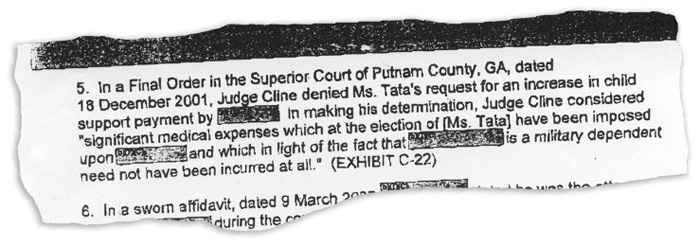
4. Quoting the phony court order, Army investigators rebuked Tracy Tata for burdening her ex-husband with expenses that “need not have been incurred at all.” Judge Cline had uttered similar words in court, observing that the Tatas’ daughter qualified for free military health care. But in his genuine final order, Cline did not criticize Tracy Tata or pass judgment on the doctor bills.
Why Tony Tata resigned from NCDOT
Tony Tata offers several reasons for his July 28 decision to step down immediately after two years as North Carolina’s state transportation secretary.
At the time, he said he needed to devote more attention to his two children and his third wife, Jodi. In June, Tata also had considered running against Republican U.S. Rep. Walter Jones of Farmville in 2016. Friends said he might challenge Rep. Renee Ellmers, a Republican from Dunn.
In a recent interview, Tata said he left the Department of Transportation partly because he “was polling for Congress at the time” and “that probably is not consistent with being a Cabinet member” for Republican Gov. Pat McCrory.
He added: “I’m not running for Congress this cycle and probably won’t ever.”
Tata said in July that he recently signed a contract to accelerate his side career as an author of military action thrillers – a role he promotes in TV news appearances on Fox News and CNN as a military commentator. Instead of producing one paperback novel a year – a job he said he previously managed by working nights and on weekends – he now will be writing for hardcover publication every six months.
“Between the two-book deal I just signed and opportunities in the future and really, truly needing to take a break and take a step back and focus on my family, I think all those things came together,” Tata said. “And this was the right time to do something.”
The day after he quit his DOT job, Tata was interviewed for this story about his Army career. He said he had not been aware that The News & Observer was looking at issues involving adultery and a bogus court document he gave Army investigators eight years ago, and that his DOT decision had nothing to do with these matters.
“No, I haven’t heard about this since 2007,” Tata said.
Bruce Siceloff: 919-829-4527, @Road_Worrier
Army generals punished for adultery
Brig. Gen. Jeffrey Sinclair pleaded guilty in 2014 to adultery, impeding an investigation and other charges stemming from a three-year, coercive affair with a female subordinate. He was fined $20,000 and ordered to repay government charge card bills related to his affair. The Army stripped Sinclair of two grades in rank and allowed him to retire with the pension and other benefits of a lieutenant colonel.
Brig. Gen. Bryan Roberts was removed from the command of Fort Jackson, S.C., in 2013, reduced in rank to colonel, and fined $5,000 for assault, adultery and conduct unbecoming an officer.
Gen. Kevin P. Byrnes, a four-star general, was relieved of his command shortly before his retirement in 2005 after he disobeyed orders to end an extramarital affair.
Retired Maj. Gen. David R.E. Hale was recalled to duty and court-martialed in 1999 for having affairs with the wives of four subordinates and lying about his adultery. He was fined and his rank reduced to brigadier general.
Maj. Gen. John J. Maher III was reduced to colonel and forced to retire in 1999 over affairs with the wives of two subordinates.
The Tata case timeline
December 2006: Tracy Tata asks the Army to investigate her ex-husband for adultery, computer hacking and failure to pay child support.
March 2007: Tony Tata hands over documents to Army investigators. They include a false court order bearing three fake signatures.
June 2007: The Army’s inspector general concludes that Tata had “at least two” extramarital affairs but rejects his ex-wife’s complaint that Tata had failed to support their daughter.
Summer 2007: Tracy Tata discovers the phony court order.
November 2007: Tony Tata acknowledges that the document he gave to Army investigators helpful to his case about support for his daughter was bogus. He says he doesn’t know how it was created, where it came from or who forged the signatures of two lawyers and a judge.
June 2008: Tata files papers saying he will leave the Army in a year.
October 2008: Tata receives a glowing performance review from his supervisor, a three-star general. His personnel file says nothing about adultery or the phony document. One week later, the Army General Counsel’s office suggests Putnam County, Ga., court officials investigate the origin of the document.
June 2009: Tata’s retirement from the Army becomes effective. His Army record is helpful in landing subsequent jobs in Washington, D.C., at Wake County schools and as state transportation secretary.
This story was originally published September 19, 2015 at 7:00 PM.