Democratic presidential hopeful Buttigieg stops in NC to worship, talk about poverty
An overflow crowd of all races and ages worshiped Sunday with Democratic presidential candidate Pete Buttigieg on his first campaign visit to North Carolina before engaging him in a conversation about poverty.
It’s not about left or right, liberal or conservative, said the Rev. William Barber II, pastor at Greenleaf Christian Church in Goldsboro and the former state NAACP president. Poverty is a “moral crisis” in this nation, Barber said, as he and the Rev. Renita Weems delivered a fiery call to action.
Weems, a senior fellow at the Center for American Progress and the first black woman to earn a doctorate in Old Testament studies, described how Moses led the Israelites from Egypt to the Red Sea as Pharoah mounted his army to stop them.
She compared that exodus with the black experience in America.
“Every generation has its own Pharoah, its own Red Sea. Every generation has its Berlin Wall. Every generation has its Edmund Pettus Bridge. Every generation has its border wall. Every generation has its Ferguson, and every generation has got to make a decision about where the line in the sand is,” she said, bringing the crowd to its feet.
Buttigieg’s visit comes at a time when he’s rising in the polls but still struggling to gain the support of African American voters, a critical group in Democratic primaries.
Buttigieg listened intently Sunday, head tilted up and to the side. He nodded slightly in time when the choir sang praise to God. The mayor of South Bend, Indiana, asked to visit Barber’s church, a spokeswoman said, and Barber asked Buttigieg to stay after the service for a community conversation.
Advisers typically tell politicians to avoid the words “poor” or “poverty,” because it’s not helpful politically, Buttigieg said.
“In an election like this, we have to think about whether we are making ourselves useful to those who are most vulnerable and those who are most in need,” he said during the community conversation.
Candidates also need to have “the political courage and wisdom” to address those issues, he said.
Barber, as president of Repairers of the Breach and co-chair of the Poor People’s Campaign, has focused closely on those issues.
The nonpartisan Poor People’s Campaign, which launched the Moral Monday movement in North Carolina, addresses “systemic racism, poverty, ecological devastation, militarism, and the distorted moral narrative of religious nationalism.” The campaign is in the midst of a 22-state “We Must Do M.O.R.E.” tour that will culminate June 20, 2020, in a Mass Poor People’s Assembly and Moral March on Washington.
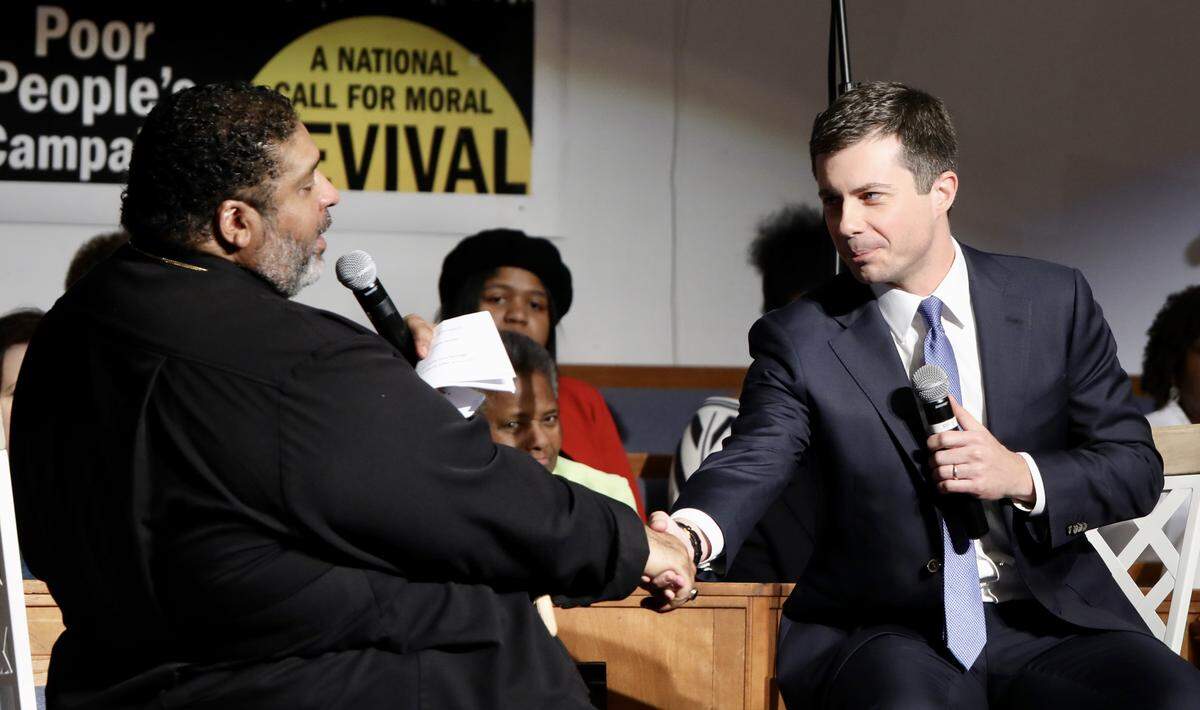
A nation is judged on how it treats its poor, its sick, its children, its women and its immigrants, Barber said before sitting down with Buttigieg for a nearly two-hour conversation about a range of issues, from poverty and voter suppression to how the federal government can address education gaps, health care and climate change.
Buttigieg pledged Sunday to support Barber’s push for a forum with all the Democratic candidates to talk about poverty.
A 2017 study by the Institute for Policy Studies and the Poor People’s Campaign reported that over 140 million Americans were low income or living below the federal poverty level. Roughly 47% were white, 17% were black and 27% were Hispanic, the report said.
According to the U.S. Census, that includes roughly 1.6 million people living in poverty in North Carolina, defined as a family of four earning $24,600 or less a year. Goldsboro was in one of the more hard-hit counties, with 25.9% of its population living in poverty, Census data shows.
Poverty is a complicated issue, Buttigieg said, but paying people a living wage is the first place to start. He also voiced support for doubling the number of union members nationwide and for federal action to counter anti-union policies in North Carolina and other “Right to Work” states.
“Sometimes it’s talked about like there’s some positive force, that the law of physics has pushed us to the (point where) we are now,” Buttigieg said. “Actually, it’s a consequence of specific policy choices ... and one of those policy choices is the minimum federal wage has been allowed to lapse.”
Healthcare also should be provided to all people, he said. Barber noted the North Carolina legislature’s decision not to expand Medicaid under the Affordable Care Act, affecting hundreds of thousands of people.
The failure to expand Medicaid “should not have happened,” Buttigieg said, “and for anybody to talk of morality when we are called to heal the sick ... is unconscionable.”
His plan, Buttigieg said, could cost the nation $1.5 trillion over 10 years, and provide insurance to those who cannot afford premiums for private plans. It will require letting Medicare negotiate the cost of prescriptions and rolling back the corporate tax breaks passed as part of President Donald Trump’s tax plan, he said.
“Compared to the cost of business as usual, I think it’s a small cost,” Buttigieg said.
The tour also gave Buttigieg a chance to court black voters, whose support he is struggling to gain, ahead of the 2020 primaries. The latest poll show former Vice President Joe Biden leading the Democratic field with 24% of the national vote, followed by Buttigieg, and Senators Elizabeth Warren and Bernie Sanders. A South Carolina poll, however, found Buttigieg with less than 1% support among black voters, who will cast their primary ballots Feb. 29.
While some pundits have suggested Buttigieg’s low support is because of his inexperience on the federal level, others have claimed that his identity as a gay man makes it hard for black churchgoers to back him.
Barber directly addressed that claim twice on Sunday as another attempt to divide people who demand change.
“That’s a false narrative created by the the National Organization for Marriage to separate people who when they come together are always pushing America forward,” he said.
Greenleaf congregant Pat Hokett said she is not impressed by the Democrats or the Republicans who plan to run for president in 2020. But the conversation was important, she said, because the poor have been neglected for so long.
“We’ve got some poor Republicans, we’ve got poor independents, some poor Democrats,” Hokett said. “God has blessed this country to be one of the richest countries in the world, and we shouldn’t have poor people sleeping out here in the streets.”
Buttigieg was expected to continue his tour in South Carolina on Sunday evening, when he planned to join a Fight for $15 discussion and then attend events across the state over the next two days. He also is scheduled to visit Alabama before returning to New Hampshire.
This story was originally published December 1, 2019 at 5:42 PM.