‘The power levers in our state’ run through its courts. Your choices for NC’s next justice
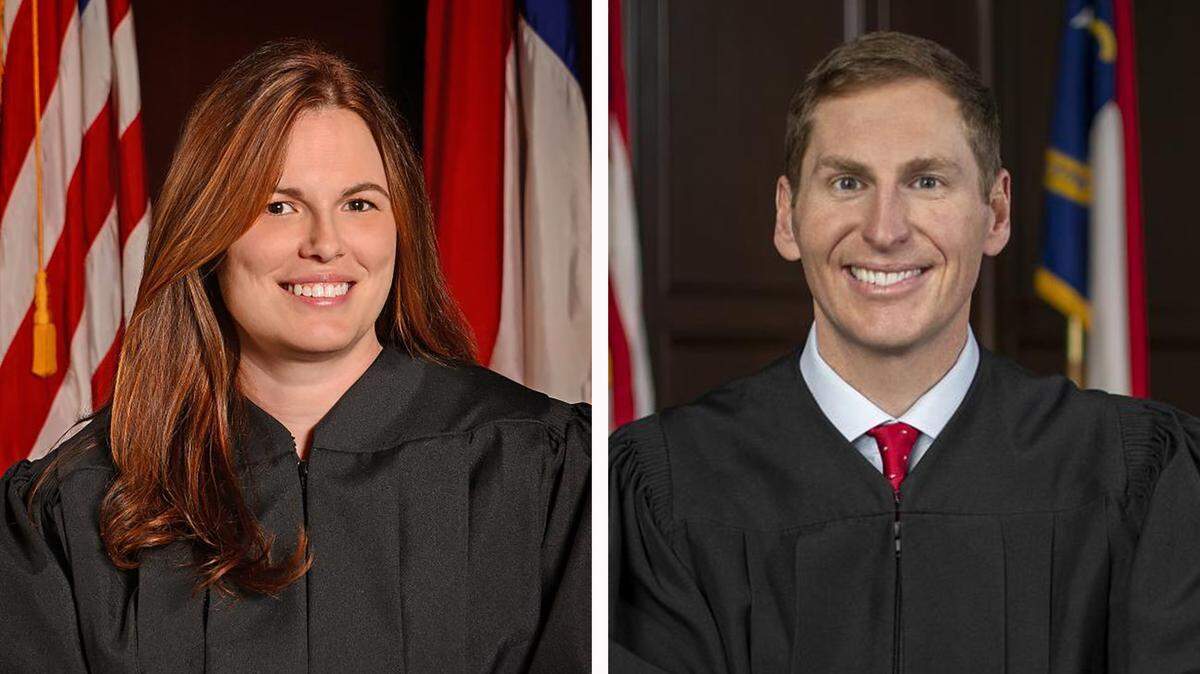
Amid presidential ballot shake-ups and gubernatorial attack ads, a neglected but consequential campaign is being waged in North Carolina politics for a seat on the state Supreme Court.
Incumbent Justice Allison Riggs, a Democrat appointed by Gov. Roy Cooper to fill a vacancy last year, aims to defend her seat against Republican challenger Jefferson Griffin, a judge on the Court of Appeals.
Their campaigns lack much of the public vitriol or big personalities present in races higher on the ballot — but the stakes are high.
For Democrats, the race is the first step in a four-year plan to wrest control of the high court back from the GOP.
For Republicans, the race is the chance to further solidify a conservative majority on a court that has already become an integral part of upholding the will of the state legislature.
As major cases dealing with elections, gubernatorial powers and public school funding await judgment, Riggs and Griffin campaign on very different visions of the high court’s duties – all while attempting to remain above the partisan fray.
The News & Observer spoke with both candidates about their experience, philosophy and politics, and looked at what their parties are doing to win the seat.
Values, politics and judicial philosophy
Although they’re running in a partisan election, Riggs and Griffin, both of whom are in their early 40s, emphasize that they are running to be impartial jurists rather than party loyalists.
Griffin, a Nash County native and lifelong Republican, has already won several judicial elections as a GOP candidate.
“It has no bearing on how I interpret the law,” Griffin said. “... Judicial philosophy and how I carry myself is a lot more pertinent than the letter by my name on the ballot.”
Riggs, who spent most of her career working at a progressive law firm, stresses that her career as an attorney taught her to examine all sides of an issue.
“I know people will try to put me in a box, but I have a lived experience that’s very diverse,” Riggs, who grew up in West Virginia, said. “My family is very politically diverse, so the lessons I’ve learned over the Thanksgiving dinner table are ones that I think are very helpful to me on the bench now — that ability to treat everyone with respect.”
That doesn’t mean either of them are shy about their values, though.
Griffin, a veteran and captain in the North Carolina Army National Guard, refers to himself as a conservative in campaign materials and speaks against “activist judges” who he believes “legislate from the bench.”
“I’d call myself more of an originalist than anything,” he said. “My interpretation of it is, I’m gonna look at this legal document, whatever it is, as of the time it was written, because if I don’t, if I say ‘well, I’ll look at it now,’ then I’m putting my spin on it.”
Riggs is even more specific about her beliefs.
“I think voters deserve to hear from their judges what their values are — and that’s not partisanship,” Riggs said. “I value reproductive freedoms. I value democracy and know that it doesn’t defend itself without people on the bench being willing to enforce the Constitution. I value having hard discussions about where we are on race equity.”
Experience in the courtroom
Both candidates bring over a decade of courtroom experience to the campaign, which can offer insight into how they’d serve on the high court.
For Riggs, most of that experience comes from the nearly 14 years she spent as a lawyer for the Southern Coalition for Social Justice, a law firm specializing in voting rights, justice system reform and environmental cases.
She handled several cases challenging North Carolina laws during her time at SCSJ, including a high-profile lawsuit accusing state Republicans of partisan gerrymandering that she argued before the U.S. Supreme Court.
Riggs also served as the lead counsel for the Moore v. Harper case, in which she argued against North Carolina lawmakers who posited a controversial legal theory stating that state courts should have no oversight over state redistricting plans. The case ultimately went to the U.S. Supreme Court, which rejected lawmakers’ theory last year.
Since becoming a judge (first on the Court of Appeals in 2023 and then on the state Supreme Court later the same year), Riggs has authored several decisions, though many of the high court’s more controversial cases happened before she took office.
Griffin has spent nearly 10 years as a judge: first at the District Court level in Wake County and then later as a judge on the Court of Appeals.
During that time he’s handled cases ranging in scope from domestic violence to constitutional interpretation.
If elected, Griffin would be the only justice on the state Supreme Court with experience as a trial court judge.
In 2021, Griffin wrote an opinion in a traffic stop case which rebutted the notion that racism exists in the criminal justice system.
“Defendant’s brief implies that U.S. citizens are treated differently under our laws based on the color of their skin,” he wrote. “I reject this argument. The law is color blind and applies equally to every citizen in the United States of America.”
Griffin also made headlines last year after signing on to an opinion stating that “life begins at conception.” That opinion was later withdrawn, making it “as if it never happened,” Griffin said. Three judges including Griffin ordered the withdrawal last November.
Griffin told The N&O he was unable to provide details about why the opinion was withdrawn.
Key rulings include cases on sexual abuse, school funding
When talking about the decisions she’s most proud of, Riggs points to a bipartisan opinion she authored last year when she was on the Court of Appeals.
In the case, the court upheld the SAFE Child Act, a state law that allowed victims of childhood sexual abuse to file lawsuits against their abusers that may otherwise have been blocked by the statute of limitations.
“I think it demonstrates that I wasn’t looking to just stick it to the legislature every time,” she said. “Because I know people speculated that I would be unfriendly to the legislature, which is not true.”
Cases involving the SAFE Child Act will be coming back before the Supreme Court this month. Given her previous involvement at the Court of Appeals level, Riggs said she would recuse herself from these cases.
Asked what cases he’s most proud of, Griffin pointed to his decision in the Hoke County v. Board of Education case — better known as Leandro. The case, which deals with funding for low-income school districts, has been going for 30 years now.
In 1994, several school districts sued to get more state funding, arguing that disparities in school resources violated the state constitution’s requirement of equal opportunity for all students.
The case has ricocheted between courts for years without a permanent resolution. It came to Griffin’s court in 2021 after a trial judge ordered the state to transfer $1.7 billion to public schools.
In a 2-1 decision, a panel of judges including Griffin blocked the transfer, writing in the majority opinion that “The Separation of Powers clause prevents the courts from stepping into the shoes of other branches of government.”
Griffin told The N&O that he found the case “extraordinary.”
“This is clearly a legislative function to appropriate money, and you can’t order that,” he said. “... You can make up 100 different reasons why that’s bad — think about a judge being able to appropriate money.”
Control of NC Supreme Court
Republicans will hold the majority on the Supreme Court until at least 2028.
NC Democratic Party Chair Anderson Clayton said defending Riggs’ seat is the first step in retaking the majority on the high court and overturning conservative rulings on voting, education and more.
“I think the state Supreme Court has done a lot to make itself stand in the line of North Carolinians getting what they need for their future,” Clayton said. “And that’s something that we’re desperately this year trying to prevent in future years.”
For the first time ever, the state Democratic Party has hired a judicial coordinated campaigns director to take the lead on the party’s court races. Republicans have had the position for years now as they’ve invested in flipping statewide courts red.
“In fairness to Republicans, I do believe in 2010 they sat down and realized that the power levers in our state ran through the state courts,” Clayton said.
Republicans’ investment in judicial races has paid off.
After the GOP swept statewide judicial races in 2022, the Supreme Court’s new conservative majority acted quickly to reverse key decisions from the court’s former Democratic majority.
Shortly after taking office, the court’s Republicans overturned a previous decision that had blocked North Carolina’s voter ID law. Because of that decision, voters will have to present ID to vote this year, the first time in a general election for president in the state.
The court’s Republican majority also reversed a previous ruling that had struck down the state’s electoral maps for gerrymandering. Going further than just reversing the decision, the court found that it had no authority over partisan gerrymandering at all — essentially giving state lawmakers free rein to draw electoral maps that favor their own party.
These rulings represented major wins for state Republicans who had spent years trying to implement a voter ID law and gain more control over the redistricting process.
With more legal battles expected to come over legislative authority, education funding and election laws, Republicans are focused on keeping the court conservative.
“We need to elect judges each cycle that are conservative constitutional justices,” Susan Mills, chair of the NC GOP Judicial Victory Fund. “Just because we have the majority this cycle does not mean that we’ll always keep it.”
Polls and money show close race
Few polls have been conducted on the Supreme Court race, and the ones that have been done show neither candidate with a sizable lead.
Carolina Forward, a progressive organization, found Riggs leading Griffin by 1 percentage point (41 to 40) in an August poll. Meanwhile, The Carolina Journal, which is owned by the conservative Locke Foundation, found Griffin to be 3 points ahead of Riggs in a August poll of likely voters.
Both candidates are treating it like a close race: criss-crossing the state on frequent campaign visits and raking in significant campaign contributions in the process.
Though Griffin started with an early fundraising lead over Riggs, she’s almost bridged the gap between them, according to quarterly campaign finance reports covering mid-February to the end of June.
As of June 30, Griffin had raised over $1.3 million in total. Riggs was close behind, having raised slightly over $1.1 million.
Each candidate has also been racking up endorsements.
In addition to left-leaning groups like Equality NC, Planned Parenthood and NC Asian Americans Together in Action, Riggs has also been endorsed by former U.S. Attorney General Eric Holder.
Griffin, on the other hand, has been endorsed by over a third of the state’s sheriffs as well as the NC Asian American Coalition.
Despite all of their campaigning, a down-ballot race like the state Supreme Court may be most affected by drama higher on the ticket.
Whether Griffin or Riggs comes out victorious could depend on which party’s voters are more energized by the change in the presidential ticket or the vitriol in the governor’s race.
Regardless, each candidate says they are laser-focused on the vision they have for the courts.
“I think that North Carolinians want judges who interpret the law and aren’t activists, who don’t go up there with any agenda,” Griffin said. “I go there just like I do as a soldier. I’m there to do my job, I have no policy agenda — I’m there to interpret the law.”
And as for Riggs:
“My background is one that I’m not looking to burn down the courts — I want our courts to work,” she said. “I just want us to live up to the aspirational promise because I know so many everyday North Carolinians need our courts to live up to that promise and want to be able to go to court and believe they’ll get a fair shake.”
Election Day is Nov. 5.