
‘Over the top’ ad features a fake Mark Robinson. What to know about AI in political ads.
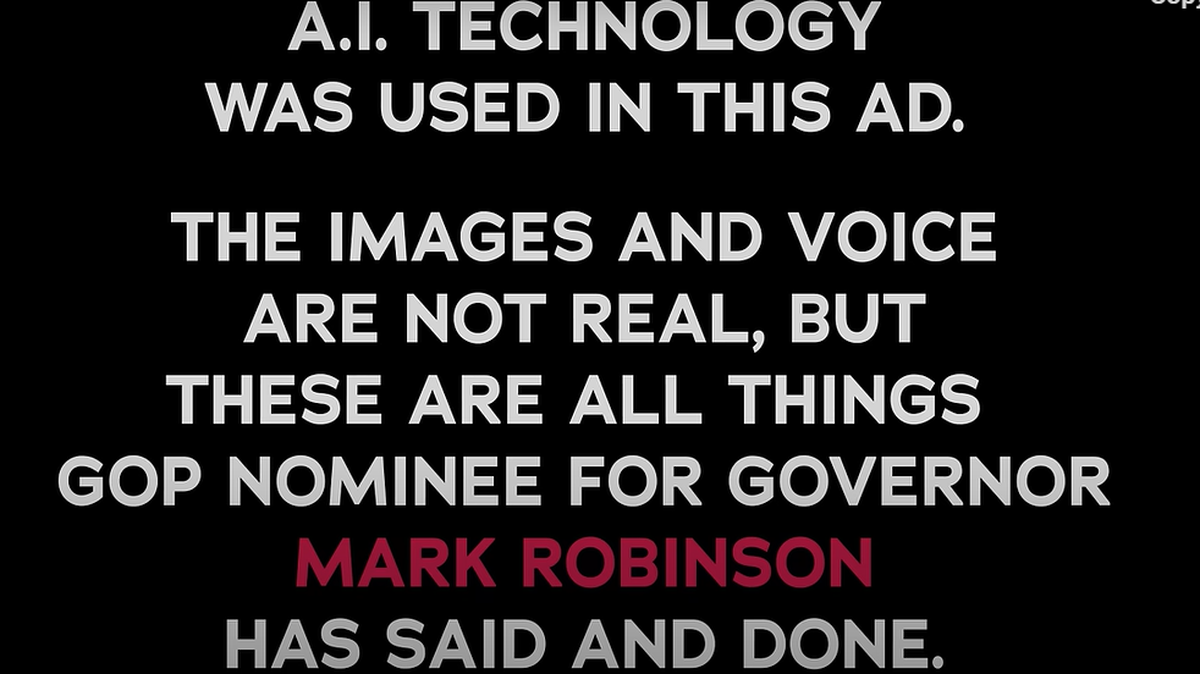
An advertisement featuring artificially generated video and audio of the Republican nominee for North Carolina governor could be a sign of what’s to come in political attacks.
We spoke to experts about the use of artificial intelligence in campaigns and how voters can tell when they’re seeing AI.
The ad begins with a disclaimer that artificial intelligence was used, but the statements are parodies of comments made by Lt. Gov. Mark Robinson. An AI-generated Robinson, with extra fingers on each hand, appears sharing conspiracy theories in front of a crowd wielding guns and flags.
The minute-long video launched on Sept. 24 and is expected to reach millions across cable networks and social media.
It was launched by Americans for Prosparody, the Super PAC behind parody campaigns like “Mark Rottenson for N.C.” The committee’s founder, Todd Stiefel, said his goal was to be humorous while crossing political boundaries. The ad was also intended to respond to pushback on his parody content.
“The ad not only mocks Mark Robinson but also mocks the entire kind of criticism that was waged against us about people claiming that our stuff was deceptive when it was over the top — not deceptive,” he said.
The video was generated by a graphic designer with no previous experience using AI software, according to Stiefel. “We wanted to lean into the absurdity of how AI screws things up, like the number of fingers and the wacky things that it does,” he said.
Artificial intelligence in political messaging
Josephine Lukito, an assistant professor of journalism and media at the University of Texas at Austin, said it’s not uncommon to see AI used against political candidates and parties internationally.
“But increasingly, and especially in the United States, we’re seeing it by third parties and other groups for either financial reasons or to make fun of political candidates,” she said. “We’ve definitely seen a marked rise in the use of artificial intelligence for political conversations broadly.”
Zelly Martin is a senior research fellow at the Center for Media Engagement at UT-Austin investigating how generative AI is used in the upcoming elections. (The Center for Media Engagement helps fund The News & Observer’s election fact-checking articles, like this one.)
Martin said the ad against Robinson is not the only prominent example of AI in politics — she noted examples of presidential candidate Donald Trump sharing artificially generated images of opponent Kamala Harris and Taylor Swift.
How to detect artificially generated content
Artificial intelligence is constantly evolving and can vary in quality. Experts in the field provided guidance on how to better detect artificially generated content.
Shomir Wilson, an associate professor at Pennsylvania State University, studies a branch of AI called natural language processing and says few tools can accurately detect AI-generated text. Popular software like GPTZero, he said, only gives a probability that content is artificial.
When it comes to detecting artificially generated audio, Lukito says you might notice AI’s monotonous tone and unnatural pauses.
Incorrect or unclear details can be evidence of AI-generated photos or videos. Martin said you can take notice of vague backgrounds with no identifiable markers. The edges of people and images, patterns, text and human hands can be inconsistent.
“What I would say is the most important thing to remember is that the same tips and tricks we used for previous media literacy and identifying disinformation can still be used here,” Martin said. She advised caution when watching or reading content that invokes strong emotions.
“If I see something that makes me feel really angry or very validated or really sad or extremely emotional in any way, I always check that piece of content against another news source,” Martin said.
Wilson added that it is increasingly important to use critical thinking as AI-generated content gets more difficult to detect.
Despite facing online criticism of the advertisement, Stiefel defends his use of artificial intelligence against Mark Robinson. “AI is just the latest tool for people to utilize for marketing,” he said. “Any new technology has the potential to be used for good or ill.”