NC Supreme Court race headed to recount with Allison Riggs leading Republican challenger
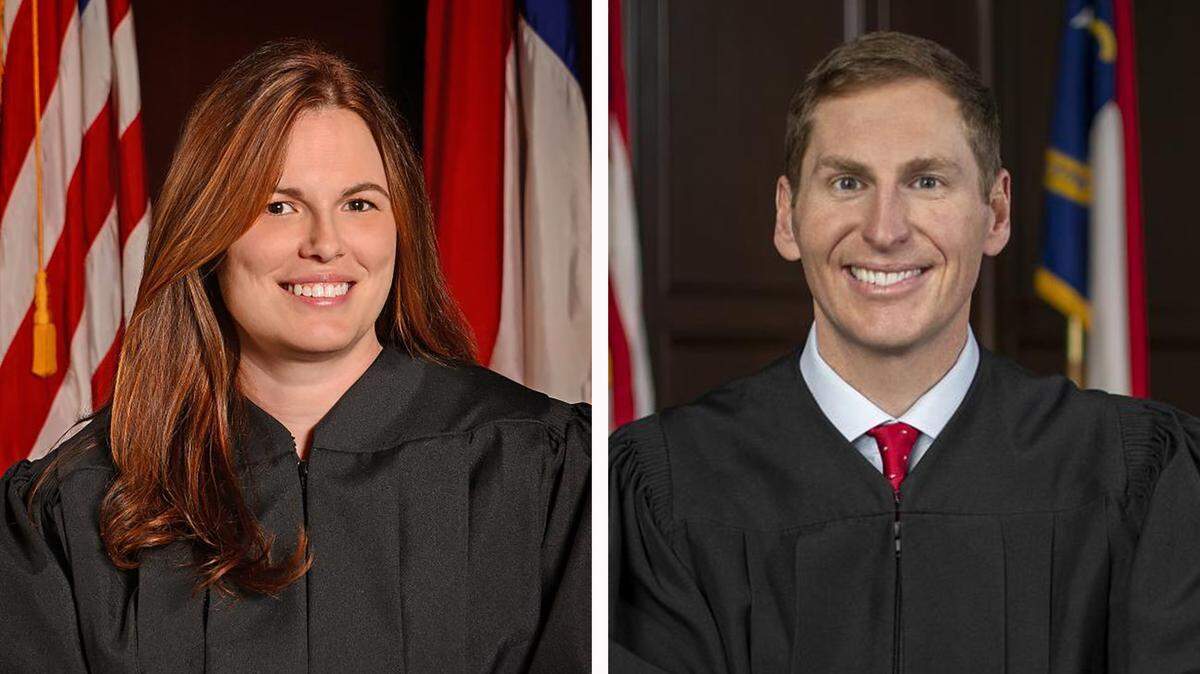
The North Carolina Supreme Court race is headed to a recount after incumbent Justice Allison Riggs, a Democrat, pulled ahead of her challenger, Republican Jefferson Griffin, by 625 votes after outstanding ballots were counted.
Though Griffin had initially led Riggs by about 10,000 votes after Election Night, the race eventually flipped as provisional ballots were counted — putting Riggs in the lead.
Griffin submitted his request for a recount to the State Board of Elections on Tuesday.
Second-place candidates in statewide races are permitted to demand a recount if the difference between them and the winner is less than 10,000 votes.
In a Monday press release, Riggs’ campaign said they expected a recount to be called.
“Recounts are a normal part of election processes and show our democracy at work,” Embry Owen, Riggs’ campaign manager, said. “They allow for transparency and inspire confidence in our electoral systems. Our team continues to feel gratitude for all election officials who are working hard to ensure a smooth, fair, and timely process.”
Griffin did not respond to a request for comment.
The recount must be completed by Nov. 27, which is the day after the state certifies the election.
If Riggs maintains her lead through the recount, she will prevent Republicans from growing their majority on the state Supreme Court, which is currently 5 to 2. Riggs and Justice Anita Earls are the only Democrats on the high court.
Democrats won’t have a chance to flip the court until 2028, when three Republican justices face reelection.
Griffin, joined by the North Carolina Republican Party, sued the State Board of Elections on Monday, alleging that it was not providing election data quickly enough for him to meet deadlines to file protests.
In particular, Griffin’s lawsuit says he requested a list of voters who are suspected to have voted both absentee and in-person, a list of voters who used curbside voting, a full list of felony convictions and a full list of deceased voters.
That data could form the basis for future legal challenges over the outcome of the race.
A spokesperson for the board said Griffin’s campaign has been provided with the requested data and were informed that they would receive it before the lawsuit was filed.
“But they served the agency with the lawsuit anyway,” the spokesperson, Pat Gannon, said. “In sum, this lawsuit is thoroughly unnecessary.”
Recount in race that could decide NC supermajority
Several other races are headed for recounts, including a race for the state House that appears to have broken the GOP supermajority. Rep. Frank Sossamon, a Granville County Republican, called for a recount in his race against Democrat Bryan Cohn.
With all ballots counted, Cohn held a 233-vote lead over Sossamon.
If the current results stand, Republicans will hold a veto-proof supermajority in the Senate, but will be one vote shy of a supermajority in the House.
The closest legislative election is in the Senate race between Republican Ashlee Adams, who led on Election Night by 38 votes, and Democratic Rep. Terence Everitt, who took a 134-vote lead once Wake County finalized its results.
Two Mecklenburg County races will also have a recount, including Republican Rep. Tricia Cotham’s race to keep her seat after switching parties last year. Cotham leads her opponent, Democrat Nicole Sidman, by 216 votes.
Republican Stacie McGinn is requesting a recount in her Senate race against Democrat Woodson Bradley — who won by 204 votes.
In the Spotlight designates ongoing topics of high interest that are driven by The News & Observer’s focus on accountability reporting.
This story was originally published November 19, 2024 at 11:57 AM.