How many people are losing access to SNAP because of the One Big Beautiful Bill?
AI-generated summary reviewed by our newsroom.
- Federal data show NC SNAP enrollment fell about 19% from March 2025 to March 2026.
- State health officials say NC enrollment fell from March 2025 to March 2026 by 13%.
- NCDHHS estimates about 12,537 lawfully present noncitizens could lose SNAP eligibility.
Good morning and welcome to Under the Dome. I’m Ronni Butts, one of this summer’s politics interns.
Below, you’ll find a dispatch from Luciana Perez Uribe Guinassi on the impact of cuts to food aid. Plus, our roundup of state politics coverage.
But first up: On a new episode of the Under the Dome podcast out Tuesday, host and higher education reporter Jane Winik Sartwell is joined by democracy reporter Kyle Ingram and legislative and lobbying reporter Esther Frances to talk about the new state budget, a recent veto from the governor’s office, early voting and a high-profile reassignment at the state auditor’s office.
And stay tuned to hear Jane, Kyle and Esther’s picks for Headliner of the Week. Listen to the episode wherever you get your podcasts.
A decline in SNAP enrollment in NC
The One Big Beautiful Bill Act passed Congress last July and was promptly signed into law by President Donald Trump. That means it is now just over a year old.
And as we’ve reported before, its provisions are having effects across numerous areas. One area it is impacting is the Supplemental Nutrition Assistance Program, or SNAP — often known as the food stamps program.
The SNAP changes under the bill include provisions that are not yet in effect but are already causing concern among state lawmakers, both Republican and Democratic, over potential costs and administrative burdens for states.
One change that is already in effect is expanded work requirements. Those requirements now apply to parents of teenagers age 14 and older. The changes also raise the age limit from 54 to 64 and eliminate some exemptions for people who are homeless, veterans and former foster care youth.
The law also limits SNAP access for some lawfully present immigrants.
The full number of people who may lose SNAP benefits because of those changes could take time to become clear.
North Carolina’s SNAP enrollment dropped roughly 19% between March 2025 and March 2026, according to the most recent federal data — one of the steepest declines in the country. An analysis of state data by the Center on Budget and Policy Priorities showed a somewhat smaller decline when looking at state data.
Asked about the drop and the differing data, the North Carolina Department of Health and Human Services said through a spokesperson that the decline is not as sharp as federal figures suggest and is largely not the result of the new work requirements.
NCDHHS spokesperson James Werner said North Carolina SNAP participation declined from 1.47 million participants in March 2025 to 1.27 million in March 2026. That is a decrease of 194,669 participants over a 12-month period, or a 13% decline in enrollment.
Werner said the larger decline reflected in the U.S. Department of Agriculture’s publicly available data was the result of a technical, system-based reporting error that understated North Carolina’s participant counts for several months. NCDHHS identified the issue, corrected the reporting defect and submitted revised data to USDA, he said.
He added that March 2025 enrollment was elevated because of Helene disaster response efforts.
North Carolina’s SNAP participation grew 4.3% between March 2024 and March 2025, compared with 1.5% nationally. As a result, year-over-year comparisons may overstate the underlying trend, Werner said.
Measured against March 2024, North Carolina’s SNAP participation is down approximately 9.5%, placing the state near the middle of states over that two-year period, he wrote.
Werner provided data to The News & Observer showing estimates of SNAP recipients who, ahead of implementation of the One Big Beautiful Bill Act, would be newly subject to screening for the expanded work requirements or an exemption. DHHS implemented the bill’s work requirements on Dec. 1, 2025.
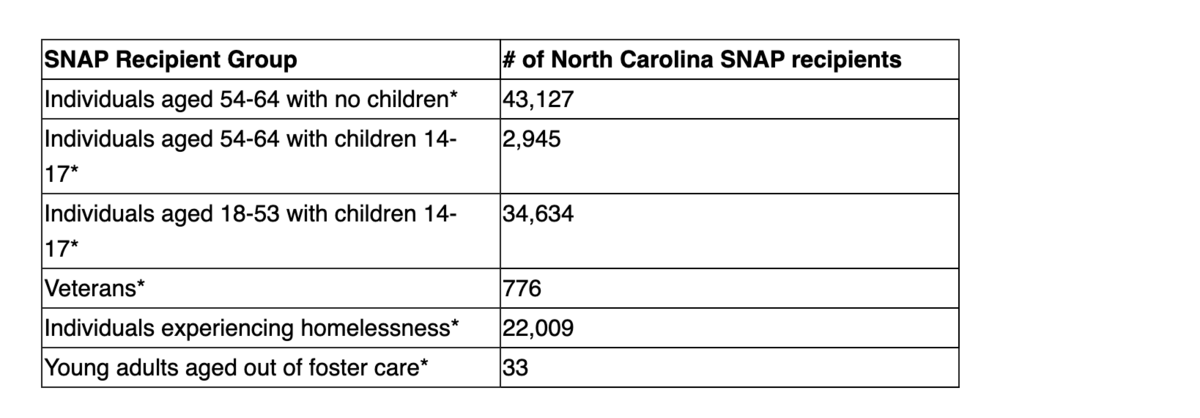
Werner said the individuals newly subject to the requirements had been or will be screened, with DHHS recertifying most households every six months.
Because the new rules are checked during SNAP renewals and allow for three additional months of benefits for people who do not meet the work requirements, most of the enrollment decline through March 2026 happened before the new work rules had fully taken effect. Werner said NCDHHS will have a clearer picture of the impact in the coming months.
NCDHHS estimates approximately 12,537 lawfully present noncitizens will be screened under the new eligibility rules and may become ineligible for SNAP benefits, Werner said.
— Luciana Perez Uribe Guinassi
Headlines you won’t want to miss
- Duke Energy, state officials reach settlement in NC electric rate hike case
- Shielded records & stripped money. How NC’s new budget alters college discipline
- NC’s State Health Plan switching who administers its members’ benefits, again
- NC State Health Plan approves new premium hikes, picks preferred network hospitals
- 3 Wake schools deemed unsafe for students. Can they be fixed before classes start?
- NC has changed teacher licensure laws. How it could impact your child’s school
- Why are NC flags at half-staff this week? Here’s what to know
Thank you for reading Under the Dome
That’s all for today! We’ll see you tomorrow.
- Ideas or feedback about our Under the Dome newsletter? Email our politics team at dome@newsobserver.com.
- Not a newsletter subscriber? Sign up here.
- Listen to the latest episode of our Under the Dome podcast here or wherever you get your podcasts.
- And learn more about issues facing North Carolina colleges and universities by subscribing to Higher Stakes, a weekly higher education newsletter from reporter Jane Winik Sartwell.
This story was originally published July 14, 2026 at 5:00 AM.