NC state employees’ health plan faces big changes. Here’s what’s coming in July

AI-generated summary reviewed by our newsroom.
- The NC State Health Plan Board of Trustees will vote on a new provider structure in July.
- Preferred, access, non-preferred and out-of-network tiers will change member costs.
- Plan aims to curb rising costs and reduce reliance on appropriations and premium raises.
North Carolina state employees enrolled in the State Health Plan could see big changes to their health coverage, with many of those changes riding on pivotal Board of Trustees votes set for July.
Republican State Treasurer Brad Briner, who is in charge of the plan, emphasized the significance at the board’s June meeting.
“July’s meeting is perhaps the most consequential meeting this board’s ever had,” Briner said.
On July 10, trustees are set to vote on a series of proposals affecting the hundreds of thousands of state workers, retirees and dependents covered by the plan.
Among the biggest changes is a new benefits structure that would steer members toward hospitals and physician practices designated as “preferred providers.”
Here’s how it’ll work, according to information shared to date, and a look at some other changes ahead:
Preferred providers
Under the preferred provider structure, which does not apply to retirees covered under Medicare Advantage plans, State Health Plan members will see lower costs, such as through reduced copays, when they use preferred providers.
Meanwhile, costs at “access” providers will be held at this year’s cost structure. There will also be non-preferred providers, where costs will be higher, and out-of-network providers.
That means some members could see savings or cost increases depending on who they see and whether they’re willing and able to switch providers.
For example, a specialist visit under a preferred provider would cost $40, compared with $65 under an access provider and 30% of the bill after the deductible is hit under a non-preferred provider.
The Board of Trustees will vote on the preferred provider contracts in July.
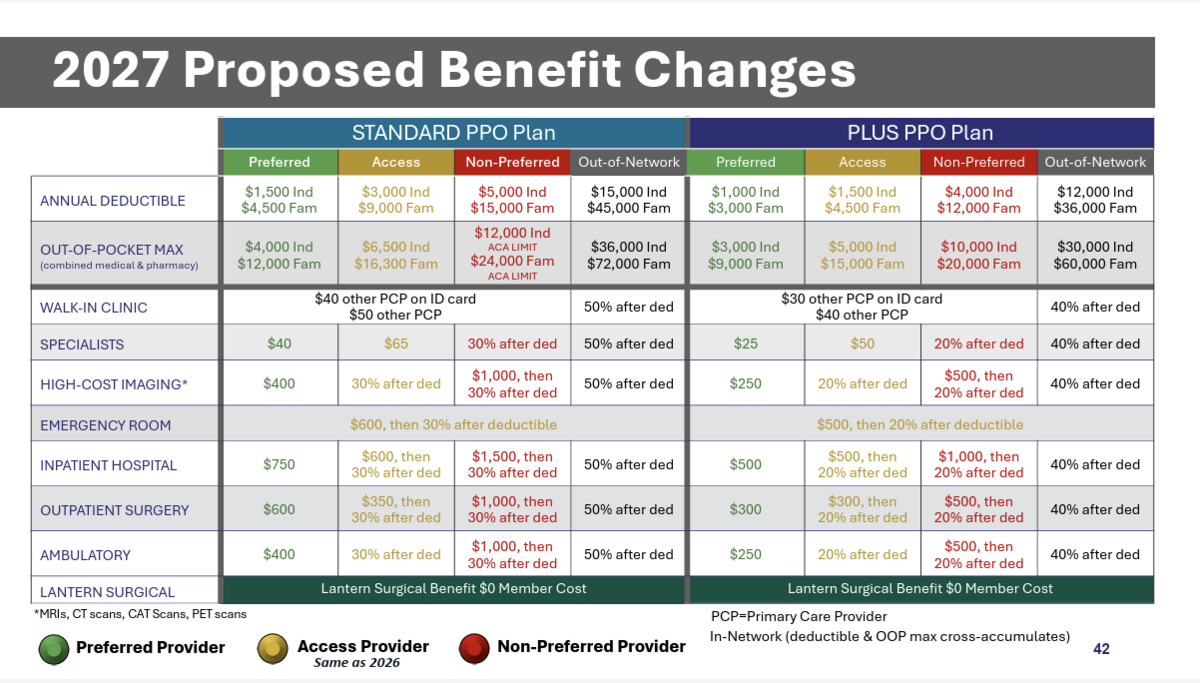
The State Health Plan has already been moving pieces to set up this system.
Contracts with health care providers
Earlier this year, the plan’s board of trustees had already approved contracts with three clinically integrated networks, or groups of health care providers: Aledade, Community Care Physician Network and UNC Health Alliance. Last year, the plan also implemented a surgical benefit with Lantern, a specialty care platform, to offer certain surgeries at no cost to plan members. As of November 2025, there were 60 providers in the Lantern model across the state. That’s grown to 194 as of June, with more than 1,000 procedures performed and over $12 million saved through the program, according to documents presented in the June meeting.
Tom Friedman, executive administrator of the State Health Plan, said in June the aim was to grow the network, such as in the northwest of the state, and to expand to cover more procedures.
As for the preferred provider contracts to be voted on in July, Briner said in June the plan has had “dialogue” with all major providers in the state, and if a provider was not ultimately selected as preferred, it’s because they do not “sufficiently value your business. They chose not to compete for it, either by refusing to bid at all or by holding their prices so high that we collectively did not have a choice.” Friedman said that by major providers, that means the plan has met with every health system, such as large hospitals, because that’s where spending is highest.
The majority of rural providers will be in the access tier, as there’s more limited capacity among providers there, said Friedman.
Meanwhile, the goal is for 35% to 70% of providers from large health systems in urban areas to be either in the access or preferred tier, Friedman said.
What the plan intends to offer
The plan also intends to offer maternity care, ongoing oncology care and transplant care at the access level. Emergency care costs will be in the access tier regardless of which tier a provider falls in — except if the tier is preferred, in which case members will be charged less. Out-of-pocket costs will cross-accumulate across tiers.
Board member Cyrus Vernon, of Yanceyville, a House speaker appointee to the board, said he had concerns about a shortage of doctors being made worse by the new structure.
“I’ve got a good friend that moved to North Carolina from the western part of the country, he’s been here three years. He’s still looking for a doctor,” he said.
“When you start taking doctors out of a mix, because they no longer fit the plan, or whatever, and you have people to try to find a doctor, you’ve given them a very difficult task,” he said.
As for the reasoning behind the changes to the plan?
State Health Plan officials have said it is to start getting rising health care costs down and to tackle a previously projected $1.4 billion deficit forecast for future years, reducing reliance on budget appropriations and premium increases.
But the change to the plan entails an inherent risk. For it to work, people will need to shift to lower-cost providers, Friedman said.
Success, he said, would look like 90% of plan members going to preferred or access providers, with those savings used to fund population health initiatives.
What is WakeMed’s network status?
During the board meeting in June, references were also made throughout to WakeMed officials saying it would be out of network with the State Health Plan.
For Wake County residents relying on WakeMed, that would be a big deal.
But is that actually the case?
No, said Friedman.
“There’s some confusion here. I think some folks have interpreted it as ‘they didn’t talk to us about the preferred tier, so they’re going to be out of network,’” Friedman said in June during the board meeting.
He said the CEO of WakeMed, Donald Gintzig, “may have misspoken” when he said WakeMed was going to be out of network with the State Health Plan. Friedman said he and Gintzig had spoken and that the intention was for WakeMed to be in the access tier.
“We need to make sure that people in the Wake County area have a place to deliver babies. That is a big deal. They’re one of the largest in the country delivering babies,” Friedman said.
Loretta Boniti, spokesperson for the plan, said in an email to The News & Observer that the plan had staff at a previous WakeMed community meeting where Gintzig stated that WakeMed would be out-of-network with the State Health Plan next year.
WakeMed has held a series of public forums on its planned merger with Charlotte-based Atrium Health.
Regarding WakeMed being in the access tier for 2027, Boniti said “there are no concerns as members will still be able to utilize WakeMed in-network as they do today with only one favorable change to their copay.”
“So members will still be able to utilize their services as they do today. Members can choose to seek care at a Preferred Provider, but it’s not required and is up to the member,” Boniti said.
WakeMed did not respond to a request for comment sent last week.
Other changes to NC’s State Health Plan
The plan has already faced several changes. The board voted in 2025 to raise premiums for non-retiree members in 2026, and voted in June to raise out-of-pocket costs starting in 2027 for Medicare Advantage members.
Further premium hikes are also on the table for July votes. According to previous statements from plan officials and Briner, these adjustments for State Health Plan members will likely be structured as a percentage of salary growth — meaning if a member currently pays $50 and receives a 5% raise, their monthly premium would adjust to $52.50.
The board is also expected to vote on the third-party administrator services contract and pharmacy benefit manager contract, both set to begin in January 2028. Aetna currently serves as the State Health Plan’s third-party administrator. Its pharmacy benefit manager is CVS Caremark.