NC state workers have questions after State Health Plan switches network & insurer
AI-generated summary reviewed by our newsroom.
- State Health Plan trustees voted to raise most members’ premiums about 5% in 2027.
- The tiered preferred vs non-preferred network applies only to self-funded options.
- Blue Cross Blue Shield will resume administering the State Health Plan in January 2028.
How much will my premiums go up?
If my provider wasn’t picked as one of the providers preferred by the State Health Plan, how long will that last?
If I’m retired, will these changes affect me?
Those are just some of the many questions that have flooded into the State Employees Association of North Carolina’s social media sites, said Ardis Watkins, the organization’s executive director.
“It’s a lot of change at one time. So my first thought is, this is really hard for the members to digest,” she said.
“We’re getting that from our social media. We’re inundated with questions.”
Most recently, the health plan’s Board of Trustees voted Friday to:
- Increase premiums for most members by about 5% of their current premium amount in 2027 — not 5% of their salary.
- Move to a tiered provider network system that creates different cost levels based on whether members use “preferred” or “non-preferred” providers. This change applies to members who are enrolled in the plan’s self-funded options, where the state pays medical claims while a private insurer administers benefits, and not those in the plan’s Medicare Advantage plan.
- Return to Blue Cross Blue Shield of North Carolina as the State Health Plan’s administrator beginning in January 2028. This doesn’t affect Medicare Advantage plans, either.
Watkins said the changes will take time for members to understand, but she believes the state’s approach to increasing competition by naming some hospital providers as preferred, leading to lower costs to members who use them, should be given an opportunity to work.
“The method the treasurer’s office is trying to employ right now to increase the competition is something that, while it’s complex and hard to understand, we do need to give it time,” Watkins said. “If it works, then we might see premiums even come down in the future.”
As for the switch from Aetna, which has administered the plan since last year, to Blue Cross?
“There was a huge outcry from folks about Aetna,” Watkins said. “But before that, when Blue Cross had it, there was a huge outcry about Blue Cross. I think what folks have experienced is they’ve had it with the system. Period.”
Changes under first-term treasurer
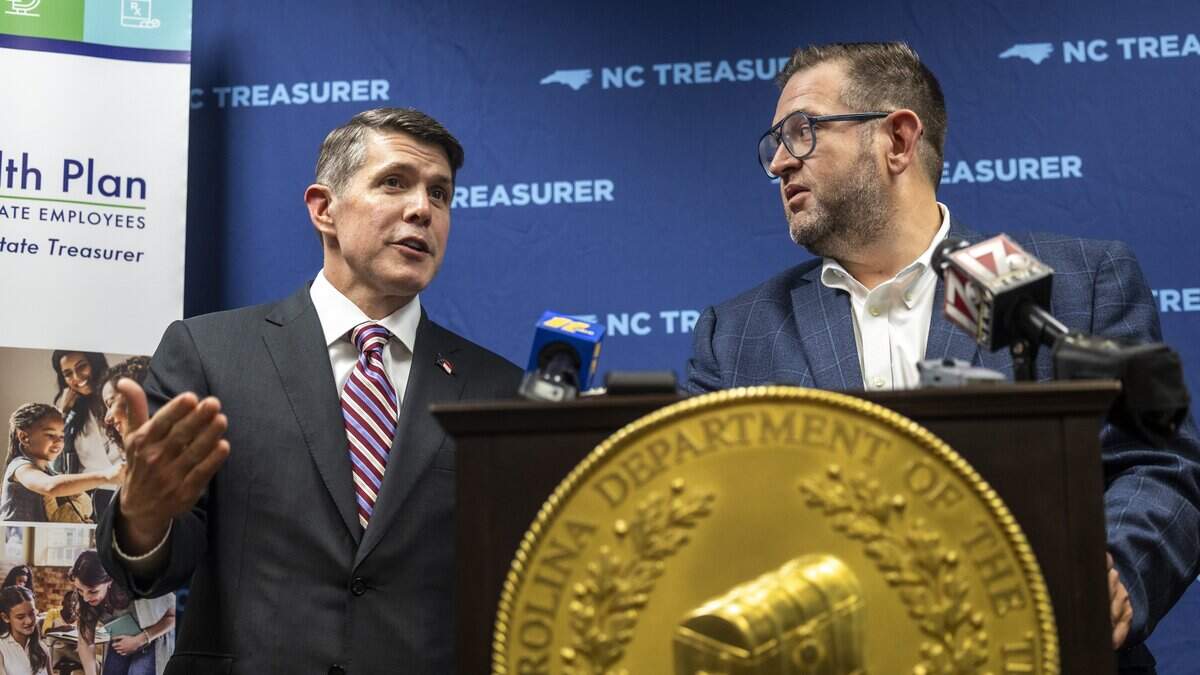
Since Republican Treasurer Brad Briner took control of the State Health Plan upon taking office last year, he has overhauled many aspects of how the program previously operated, with state employees and retirees facing significant adjustments as changes are made to the insurance program that serves roughly 750,000 beneficiaries.
Under the previous treasurer, Dale Folwell, also a Republican, premiums were frozen for years, but the plan’s deficits steadily climbed. Folwell also frequently criticized what he called the health care “cartel,” a term he used to describe powerful players in the health care industry — including hospitals, health systems and health care associations — that he argued contributed to high costs and a lack of transparency in medical pricing.
Folwell implemented the Clear Pricing Project, a reimbursement model that tied medical payments to a set percentage above Medicare rates. The program was later rolled back by Briner’s office, which has said it led to costs and not savings, as only providers who were paid less than that rate joined, leading the state to pay more.
Watkins said the model could have worked with more political support behind it. “There has to be the political courage for it to work. And there was bipartisan resistance to what he wanted to do,” she said.
“Faced with the political reality that there simply wasn’t the courage to stand up to hospital systems, something else has to happen,” Watkins said. “And I think that’s what Treasurer Briner is working with right now — trying to find a creative approach that kind of uses the market itself and competition to force people to the table with a more reasonable price.”
Briner has taken on changes he’s said are aimed at tackling those rising costs, as well as increasing the benefit members see from their plan.
Communications on the changes
It is a lot to track.
State employees may find themselves weighing whether to switch providers to take advantage of potential savings, while also preparing for another major transition.
And it’s pretty important.
If state employees use non-preferred providers and don’t switch, it could mean paying thousands of dollars more for care.
Tom Friedman, the State Health Plan’s executive director, said during the July meeting that affordability would be a central focus as the plan moves forward with major changes.
“Affordability is going to be the theme of the conversation we’re having,” Friedman said. “While we can’t make everything’s price go down, I think we have a great example of a lot of costs going down.”
The plan ran a survey this year to get member feedback. Friedman said the plan would continue seeking feedback from members as changes are implemented.
“This (survey) is something that I would commit to doing every year, particularly with such significant changes within the plan coming,” he said. “We need to hear from members what is working and what’s not.”
Communicating all these complex changes to a large membership will be a challenge, he said.
“We all have our own styles of how we receive communication, and that’s going to be the challenge of everything we’re doing today and describing today,” Friedman said. “We have to do all those things — lots of times, very clearly and simply. And I’m going to screw up how we say stuff a lot of times, and we’re going to have to refine the message over and over.”
Perspective of a state employee
John Baley, the director of psychology at the Black Mountain Neuro-Medical Treatment Center, a state facility, said he has learned about many of the upcoming State Health Plan changes through news reports and communications from SEANC.
The changes, he said, appear as though “they are trying to move the system in two different directions at once.”
Baley said that some groups of state employees, including workers at UNC Health and ECU Health, have been able to choose health coverage outside of the plan.
He said those departures could affect the plan’s risk pool, particularly if higher-paid employees with lower health care costs leave, leaving a smaller pool of members to cover claims.
He said some of the new changes, including premium increases without significant pay raises, “will accelerate that process and overall weaken the State Health Plan.”
Lawmakers passed, and Democratic Gov. Josh Stein signed, a budget drafted by Republicans that provides a 3% raise to most state employees, with some receiving higher raises.
Baley also said the State Health Plan’s income-based premium structure, which charges lower premiums to lower-income employees and higher premiums to higher-income employees, may not go far enough in accounting for the differences among state workers.
He said premium increases have a larger impact on lower-paid members of his team, including nurses, certified nursing assistants and behavioral technicians, than they do on him personally.
These higher costs could make it harder for the state to recruit and retain employees at a time when many agencies are already facing hiring challenges and staffing shortages, Baley said.
Beyond his concerns about the plan’s financial changes, Baley said he has heard confusion among employees about what the new preferred provider network will mean for them.
“They’re busy working, and they don’t have time to sort through the preferred provider distinctions,” he said.
Survey of members
As for the survey conducted by the State Health Plan, that was done from April 22 to May 27 to gather feedback on several issues, including upcoming changes to the plan.
About 20,000 active and non-Medicare members responded, along with about 15,000 Medicare members, according to data presented during the July meeting by Beth Horner, the plans’ director of communications.
The largest share of responses came from public school employees (38%), followed by state agency employees (29%) and university employees (11%).
On the preferred provider program, 91% of respondents said they were familiar with it.
Members were also asked whether they would rather have lower monthly premiums or lower out-of-pocket costs when they receive care. Responses were divided:
- 33% preferred lower monthly premiums for office visits and services, even if that meant higher co-pays.
- 26% preferred higher monthly premiums with lower co-pays for medications.
- 22% preferred higher monthly premiums with lower co-pays for office visits and services.
- 20% preferred lower monthly premiums with higher co-pays for medications.