
Here’s what that new blob on the hurricane center map means
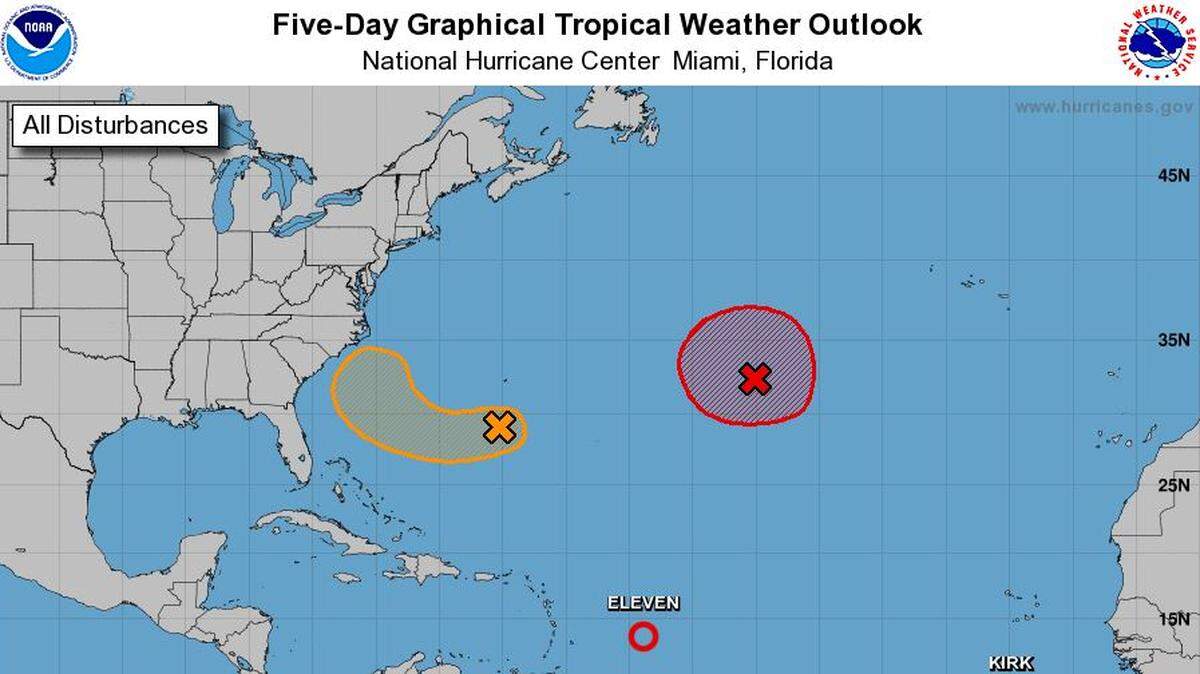
A storm brewing in the Atlantic Ocean now has a 40 percent chance of becoming another tropical storm in the next five days, up from a 20 percent chance just two days ago, according to the National Weather Service.
But weather patterns this week should keep the system from developing into anything major, Dennis Feltgen, spokesman for the National Hurricane Center in Miami, told The Charlotte Observer in a phone interview on Saturday.
“We don’t expect it to be a hurricane,” Feltgen said. “This thing’s going to run into a pretty hostile environment by the middle of the week.”
As for that blob on the hurricane center’s 2 p.m. Saturday Tropical Weather Outlook map that shows the system zeroing in on the Carolinas?
The blob is not a storm track, Feltgen said. Rather, it’s the massive area in where the system could develop, he said.
This is the same system that the National Weather Service’s office in Charleston mistakenly called the remnants of Hurricane Florence, in a tweet Thursday night.
An official with the National Hurricane Center took issue with that characterization.
“The system we currently have in the Tropical Weather Outlook near Bermuda is not the “remnant low” of Florence as the NWS office in Charleston stated in their tweet,” said Michael J. Brennan in an email to McClatchy on Thursday night. Brennan is a branch chief with the Hurricane Specialist Unit.
“The surface low associated with Florence became elongated and lost definition over the mid-Atlantic states, and evolved into a much larger weather system associated with a front that moved off the east coast earlier this week. This new low developed from part of that larger system, but it is not closely enough associated with Florence to be called its direct remnants.”
If the storm does form into a tropical storm, it would get a different name.
Florence, which made landfall as a Category 1 hurricane on Sept. 14 in Wrightsville Beach, N.C., brought heavy winds and rain to the Carolinas before heading up the East Coast, spawning deadly tornadoes and flooding in Virginia and rain up the coast before it, as Brennan says, “became elongated and lost definition.”
Florence has been linked to 43 deaths in the Carolinas and Virginia.
The thought of another storm even threatening the East Coast is enough to worry those still drying out from Florence.
The new low was about 200 miles south of Bermuda and producing “disorganized shower and thunderstorm activity,” the National Hurricane Center tweeted at 2 p.m. Saturday.
“Strong upper-level winds and dry air are expected to limit development for the next day or so,” the hurricane center said in a “Tropical Weather Outlook update, “but conditions could become more conducive for some development of this system by early next week.”
That’s when the low is expected to move west and “west-northwestward,” the center tweeted, boosting its chances of becoming a storm to 40 percent.
By the middle of the week, upper-level winds “are likely to increase again, which would limit additional development as the system turns northward and moves closer to the Southeastern coast.”
Hurricane Florence approached Bermuda from its southeast.
Brennan wrote that the weather system “does not pose any immediate threat to the U.S., but we’ll continue to monitor it.”
This story was originally published September 20, 2018 at 9:01 PM.