Nursing assistant brought a mask to her adult-care job. She wasn’t allowed to wear it.
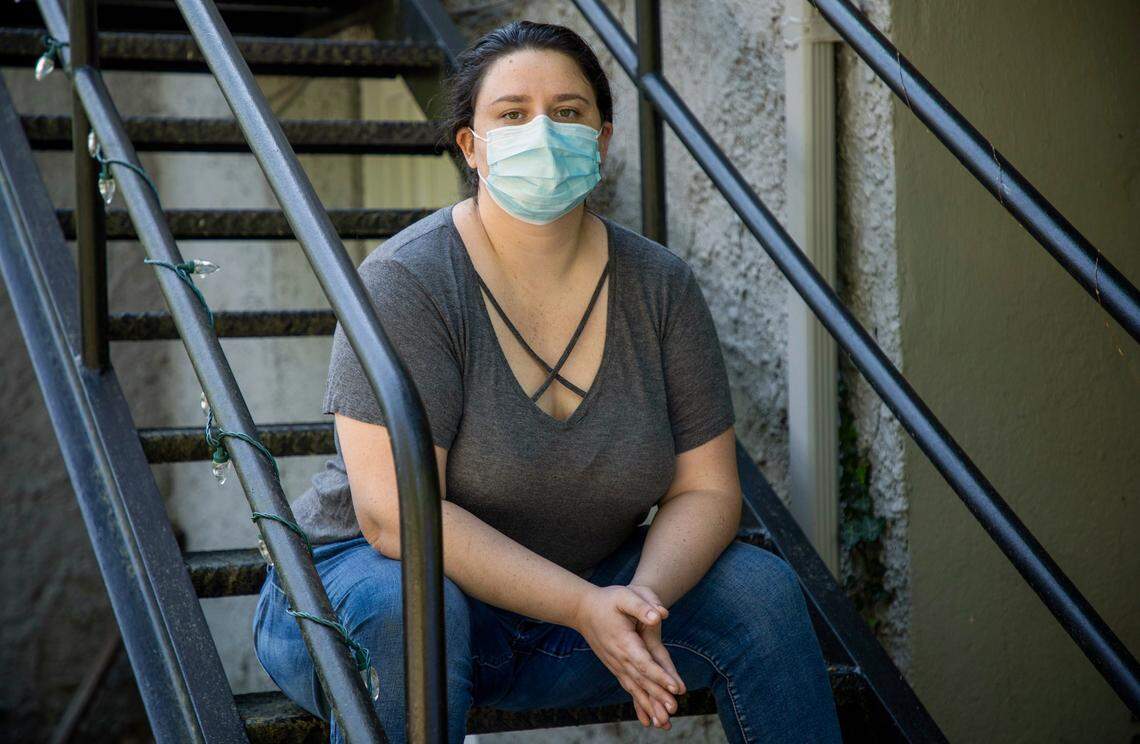
When Emily Richardson arrived for her shift at a Durham assisted living facility earlier this week, she thought she had come prepared. She brought a blue surgical facemask from home, and she planned to wear it while she offered residents care ranging from bathing to changing clothes.
Instead, 30 minutes after she’d come to work at Carolina Reserve, near The Streets at Southpoint in Durham, Richardson left. Her supervisors wouldn’t allow her to wear her mask, and Richardson, a certified nursing assistant, said she told them she didn’t feel comfortable working without one.
“To which the response was, ‘Why — these people haven’t been anywhere,’” Richardson, 28, said during a phone interview. “I’m like, well, I’m not concerned for my health, I’m concerned that — because I went to the gas station and the grocery store — that I might infect these very vulnerable people if I’m not wearing a mask.
“Which is the whole point of wearing a mask, is not to protect yourself, but to protect others.”
Richardson’s experience raises important questions amid the pandemic. At elder-care facilities that lack personal protective equipment for their employees, how can those employees protect themselves — and, in turn, protect an at-risk elderly population? And how do facilities navigate mandates that sometimes conflict or leave questions unanswered, creating confusion?
Hours after she left work, Richardson shared her story in a Facebook group devoted to coronavirus news in Durham County. She wrote that she’d been fired for trying to wear a mask. She accused Carolina Reserve of disregarding a county order directing employees of such facilities to wear masks.
“Not only are they not providing masks, they are not ALLOWING employees to wear masks, even if they are brought from home — totally disregarding the county and city Stay at Home Order,” Richardson wrote.
As of Friday, North Carolina has at least 23 ongoing outbreaks of coronavirus cases in long-term care facilities, including in Wake, Orange and Johnston counties, according to the state’s coronavirus website. Many of those cases are among staff members. An outbreak is considered two or more cases.
Gov. Roy Cooper announced an executive order Wednesday with new mandatory requirements for skilled nursing facilities that require all staff to wear face masks at all times. The order came as he announced 60 cases and two deaths at an Orange County nursing home.
‘Outrageous and a violation’
Dozens of people responded to her account, most expressing outrage. Charlie Reece, a Durham city councilman, replied that Richardson’s experience was “outrageous and a violation of the joint city-county stay at home order.”
To Richardson and others, that order, issued on April 3, was clear enough. There, on the sixth page of a 15-page document, in a section outlining guidelines related to social distancing and sanitation requirements, it was spelled out: “Businesses providing services in a residential setting shall have their employees wear a mask covering the mouth and nose.”
Richardson said she showed the order to her supervisors. Those supervisors, she said, told her that the facility’s parent company, Navion Senior Solutions, hadn’t implemented a policy about employees wearing masks, and that “there was nothing coming in from the CDC and they hadn’t heard from DHHS yet, and that’s who they answer to on the county level.”
“It was a big run-around,” Richardson said. “They were really doubling down on not wanting me to wear my mask. And it seemed like, really absurd.”
Cooper’s executive order, effective April 10, includes a requirement to “implement universal use of facemasks for all staff while in the facility, assuming supplies are available.” Staff are expected to wear the mask at all times, even on breaks or when they’re not around patients, according to the governor’s office. If masks are unavailable, cloth face coverings are recommended.
The order also requires staff to be screened before entering the facility and increased monitoring of residents when they are admitted.
Residential area or healthcare facility?
In a written statement, Kellee Agee, the chief operating officer of Navion Senior Solutions, argued that the Durham County order that Richardson referenced did not apply to Carolina Reserve.
“The requirements for masks you reference were for residential areas,” Agee wrote. “Carolina Reserve is a healthcare facility ... masks were not required at healthcare facilities, nursing homes or assisted living facilities.
Further, Agee wrote, Durham County advised Carolina Reserve “to take our guidance” from the North Carolina Department of Health and Human Services. Agee wrote that she was still awaiting “written guidance” from the state.
Meanwhile, Richardson says her colleagues have all been forced to continue working without masks.
In a separate statement from Carolina Reserve, where a manager referred questions to his supervisor, who in turn responded through a public relations firm, the facility described Richardson’s account as “inaccurate.”
Was she fired or did she fail to report?
Richardson said she was fired and that her supervisor said that if she left on Tuesday, she would not be included on future schedules. The company, meanwhile, disputed that and said it hadn’t terminated or furloughed any employees.
In response to Richardson’s desire to wear her own mask, the company wrote: “Infectious disease protocols do not permit the use of personal or homemade masks within assisted living facilities in North Carolina. After learning of the regulation, the employee decided not to report for duty.”
Richardson said she hoped that wearing a mask would offer those she cared for some level of comfort while she provided services that required her to maintain close contact.
Wendy Jacobs, chairwoman of the Durham County Board of Commissioners, signed the stay-at-home order the county released on April 3. It is full of guidelines and mandates designed to slow the spread of COVID-19.
Jacobs, like Richardson, says she thought the county order made it clear enough that employees in residential facilities should be wearing masks.
“Businesses providing services in a residential setting shall have employees wear a mask covering the mouth and nose,” Jacobs said, reading over the order with her name on it. “So you can certainly interpret that any type of a facility that is a residence, like an adult long-term care, adult care — that’s where people are living, right?”
In its statement, Navion Senior Solutions said that it had ordered 1,000 facemasks for Carolina Reserve. It placed that order “weeks ago,” it said, but the shipment had been delayed. In the meantime, it argued that employees weren’t allowed to bring their own masks, and that it was awaiting further guidance from the state health department.
Jacobs said she has asked the Durham County health department to investigate the situation.
This story was originally published April 10, 2020 at 5:15 PM.