
Crew digs up 20-foot whale buried in 2018 on Outer Banks beach. The smell was awful
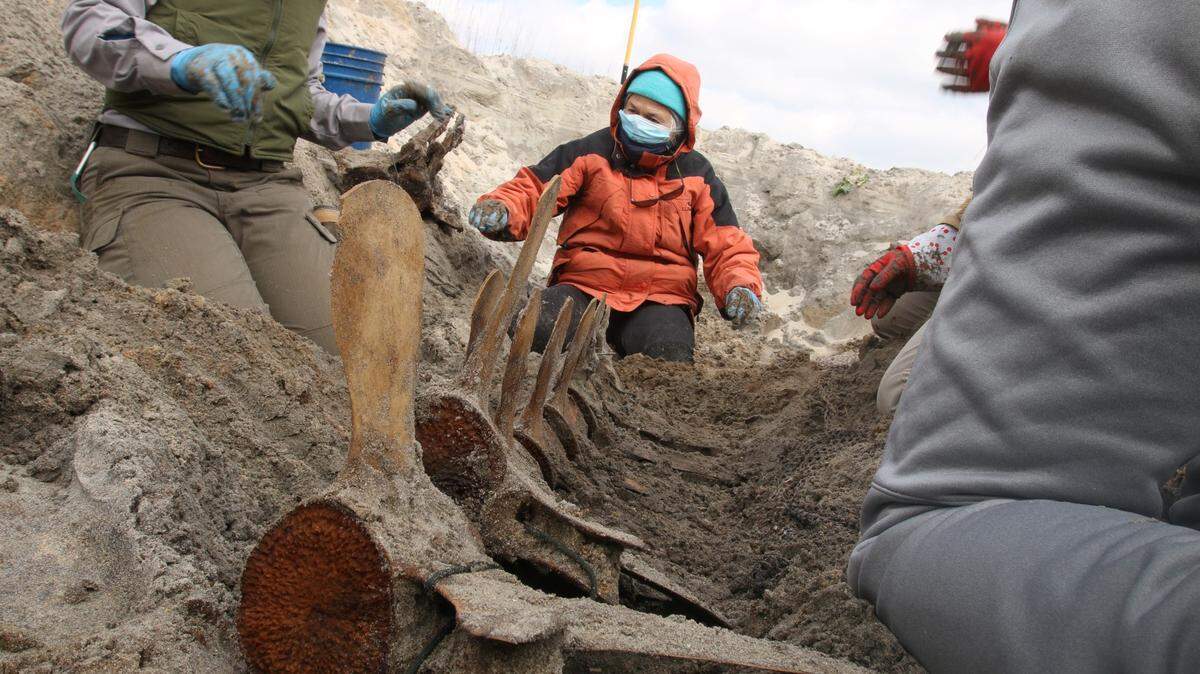
A dead 20-foot whale literally rose from its grave days ago on the Outer Banks, as part of a smelly science project to collect its 2-year-old remains for display.
The exhumation took place at Cape Lookout National Seashore and park officials say COVID-19 safety masks doubled as a way “to filter out the residual stench” that clung to the sand.
“About 2 years ago a Minke whale was found dead on the beach,” the park service explained in a Feb. 24 Facebook post.
“The whale’s carcass was buried in the beach in an out-of-the-way area where hopefully no one would encounter it. The buried whale was then allowed to naturally decompose, with the hope that we could retrieve the skeleton later for research or for exhibition.”
It took the help of a front end loader to find the burial spot, then shovels were carefully used to remove the individual bones, the park said.
The last of the remains were plucked from the sand over the weekend, according to the N.C. State University Center for Marine Sciences and Technology.
University officials said the bones will be pieced back together for display at the Bonehenge Whale Center in Beaufort. The center, which is currently not open to the public, is a research facility dedicated to the study of North Carolina’s “whales, dolphins, and porpoises,” according to its Facebook page.
Researchers have not said how the 20-foot, 6-inch female whale died, despite performing a necropsy. The carcass was found stranded and dead on Dec. 23, 2018, N.C. State officials said. National Park Service Facebook posts show it was one of at least two minke whales found stranded and dead at Cape Lookout over a 13-month period.
Minke whales live up to 50 years and can grow to 35 feet and 20,000 pounds, according to NOAA Fisheries. The biggest threats to the species include the whaling industry, “vessel strikes” and “entanglement in fishing gear,” NOAA says.
This story was originally published February 25, 2021 at 10:44 AM.