2024 will bring a total solar eclipse. Here’s how it will look across North Carolina
Don’t look now — and don’t look at all without special protective eyewear — but a total solar eclipse is coming to North America this spring, the last one that will zip across the continent until 2044 and 2045.
It will happen April 8. That’s two months from now, but if you plan to watch it, you’ll need time to get ready. It’s not safe to just wander into the yard and look up for the two or three minutes it will be visible.
Here’s what to know to be a solar skywatcher.
What’s a total solar eclipse?
If you were trying to juggle Venus, Jupiter and Mars during 5th-grade science when Mr. McBride was explaining it, here it is again, from NASA:
“Sometimes when the Moon orbits Earth, the Moon moves between the Sun and Earth. When this happens, the Moon blocks the light of the Sun from reaching Earth. This causes an eclipse of the Sun, or a solar eclipse. During a solar eclipse, the Moon casts a shadow onto Earth.”
There are three types of solar eclipse:
▪ Total, where the sun, moon and Earth are in a direct line. For those in the center of the moon’s shadow, the light of the sun can’t reach the Earth for up to about four minutes. At peak magnitude — when the moon completely covers the sun — it will look like dusk or dawn outside.
▪ Partial, when the sun, moon and Earth are not exactly aligned. From the Earth, it looks like there’s a dark shadow on part of the sun.
▪ Annular, where the eclipse happens at a time when the moon is farthest from the Earth, and closer to the sun, marking it appear smaller. When it passes in front of the sun, the moon doesn’t completely cover it, and the light from the sun creates a ring around the moon. It’s like a black dinner plate centered on a golden charger plate at a nice dinner.
How often do total solar eclipses happen?
According to Space.com, a total solar eclipse happens somewhere in the world about every 18 months. The path of totality of the eclipse, the area on Earth that is directly in line with the sun and the moon, is only 60 to 70 miles wide. Its width and where it is on the Earth vary because of the moon’s orbit and other factors.
So the likelihood of the path of totality falling in the same place twice is low.
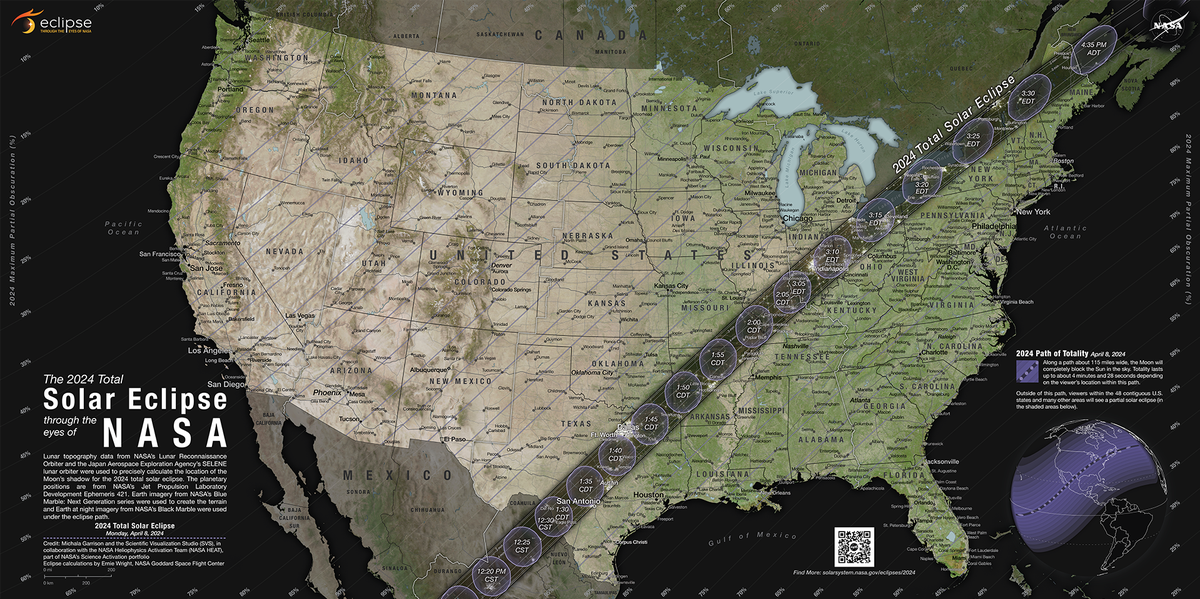
The path of totality across the United States for this eclipse will stretch from Texas to Maine.
What will it look like in North Carolina?
North Carolina isn’t in the path of totality, so this event will look like a partial eclipse here and in the rest of the country.
The magnitude of the eclipse will be a little larger in western North Carolina, closer to the path of totality, and a little smaller near the coast, farther from the path.
The timing of the eclipse will vary slightly also, but the eclipse will be visible in North Carolina from just before 2 p.m. to around 4:30 p.m. on April 8.
The peak of magnitude at any location happens at the midpoint of the eclipse.
The website eclipse2024.org has a database you can search to see what time the eclipse will happen in a particular city and what the magnitude will be. In North Carolina, the magnitude will range from almost 87% in Cherokee to 76% in Wilmington.
That site also has a simulator that allows you to see what the eclipse will look like from a particular city from start to finish, with an increasingly greedy Cookie Monster-sized bite disappearing from the sun’s circle as the eclipse progresses.
Where is the closest place to see it in totality?
From Raleigh or Charlotte, the closest places inside the path of totality are in Ohio. There, the path will be about 125 miles at its widest and will include:
▪ Dayton (508 miles from Raleigh; 456 miles from Charlotte)
▪ Akron (530 miles from Raleigh, 478 miles from Charlotte)
▪ Cleveland (566 miles from Raleigh; 514 miles from Charlotte)
▪ Smaller towns such as Mount Vernon (514 miles from Raleigh; 462 miles from Charlotte) and Middletown (527 miles from Raleigh; 454 miles from Charlotte)
The closest town in the path appears to be little Xenia, Ohio: 491 miles from Raleigh and 439 miles from Charlotte.
However, the closer you get to the center of the path, the longer you’ll be at full eclipse. So in Xenia, on the edge of the path, totality will last for 1 minute, 17 seconds.
Cuyahoga Valley National Park, north of Akron, closer to the center of the path — 543 miles from Raleigh; 492 miles from Charlotte — will be in totality for 2 minutes 55 seconds. The park is expecting big crowds.
Mansfield, Ohio, 492 miles from Charlotte and 543 miles from Raleigh, and surrounding Richland County expect to host thousands of visitors for the eclipse. Totality will last more than 3 minutes there.
How to view it safely
Watching the actual eclipse is much trickier than looking at a computer simulation.
Looking at the sun without proper protection, however briefly and however much of it is blocked by the moon, can cause permanent damage to the retina. Don’t be tempted, even for a second.
▪ NASA says, “Viewing any part of the bright sun through a camera lens, binoculars, or a telescope without a special-purpose solar filter secured over the front of the optics will instantly cause severe eye injury.”
▪ Instead, dig out the glasses you got for the last total solar eclipse visible from North Carolina, in August 2017, or the ones you had for the eclipse last October, which you didn’t get to use because it was too cloudy to see much.
▪ Or get some new ones, being careful to order ones that comply with international standards. These are thousands of times darker than regular sunglasses, which won’t protect no matter how many extra pairs you put on.
The American Astronomical Society and others list vendors selling safe solar viewers. The glasses often sell out before the eclipse, so order early.

Remember that the pinhole camera is a way to view the eclipse without looking at it. If you use this method and aren’t wearing protective glasses, look only at the image cast onto the cardboard, never at the actual sun.
This story was originally published February 7, 2024 at 10:49 AM.