NCDOT knew I-40 would flood in Asheville 2 days before Helene hit. Here’s how
As it flows north into Asheville, the French Broad River passes under Interstate 40 and takes a hard right, paralleling the highway for about a mile before turning again toward the city’s River Arts District.
As the N.C. Department of Transportation braced for Hurricane Helene, this stretch of I-40 was not a place engineers expected to worry about, despite its proximity to the river. That changed when the department’s two-year-old flood warning system began predicting the French Broad would put as much as two feet of water onto the highway.
“I was shocked when they told me that,” said Chad Franklin, NCDOT’s intelligent transportation systems engineer for the region that includes Asheville. “It had never flooded before.”
The initial prediction from the flood-warning system came on Wednesday, Sept. 25, a day before Helene had even come ashore in Florida. As the storm moved inland and the rainfall predictions grew more dire, so did the predicted flooding.
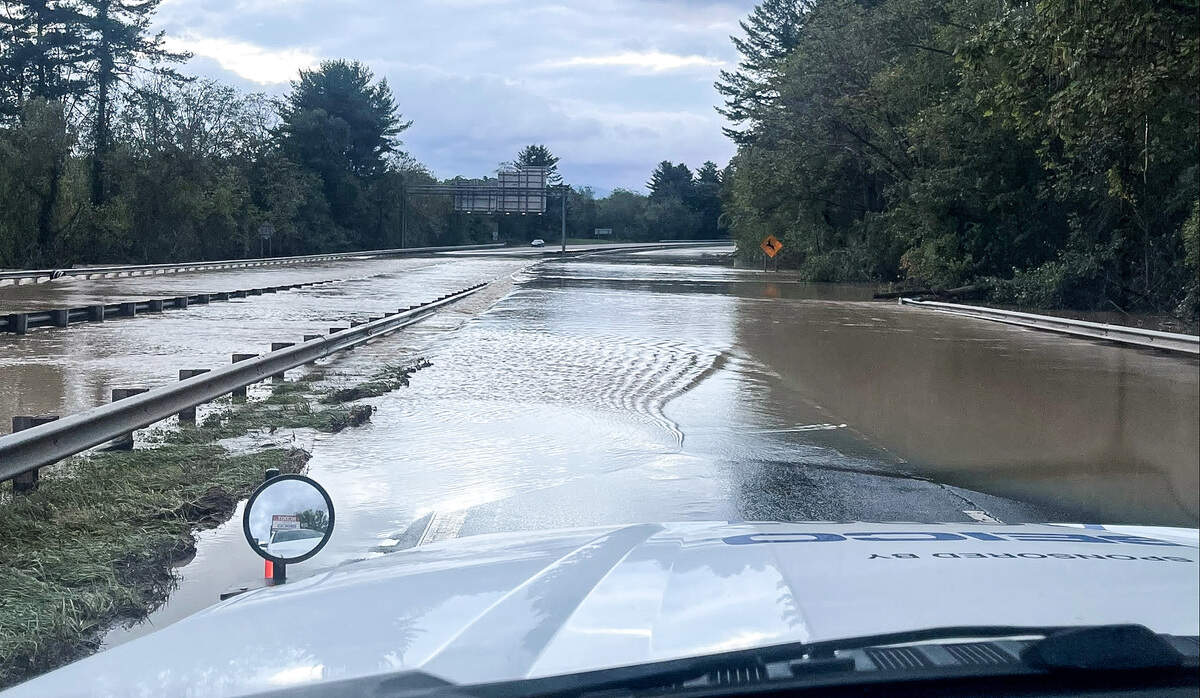
Before dawn on Friday, Sept. 27, Franklin dispatched NCDOT safety patrol trucks to I-40, with orders to shut it down as soon as water reached the pavement. Just before 1 p.m., as the remnants of Helene were moving out of Western North Carolina, they and state troopers closed the highway as the French Broad continued to rise.
“That flooding was more than we’d ever seen before in that area,” Franklin said. “Had we not closed it that soon, we might have had people driving onto a flooded highway, and the results could have been deadly.”
Water from the French Broad eventually reached as much as 8 feet deep on I-40 and didn’t fully recede until the following night.
The preemptive closing of I-40 is perhaps the clearest example of how NCDOT is using gauges and computer programs to show where its roads and bridges are vulnerable to flooding. The department says early warnings from the system, paired with first-hand accounts from local law enforcement, fire departments and emergency management officials, helped it close numerous roads in Western North Carolina before flooding became dangerous for drivers.
The system uses rainfall data, software, computer models and hundreds of stream gauges to show where road flooding is likely to happen in advance and monitor flood waters at key locations in real time. NCDOT engineers can remotely track flood conditions at more than 15,000 bridges and culverts and 2,000 miles of state-maintained roads.
A system inspired by flooding in Eastern North Carolina
The system was inspired by the Flood Inundation Mapping and Alert Network or FIMAN, an early-warning system for flooding the state developed several years ago.
FIMAN was designed to show where flooding might inundate homes and businesses. After seeing the system used during Hurricane Florence in 2018, NCDOT set out to develop a version of its own for roads.
NCDOT initially focused on building the system in the eastern third of the state, where Florence and Hurricane Matthew two years earlier had produced historic flooding and where the majority of local, state and federal stream and river gauges are located.
Only 12 of the 100 gauges NCDOT draws detailed data from statewide are located in the mountains, said spokesman Andrew Barksdale. Each gauge helps the department track flooding at several nearby roads and bridges.
“In partnership with N.C. Emergency Management and with legislative funding, we plan to add over 100 stream and river gauges across Western NC over the next few years to improve storm impact monitoring and response,” Barksdale wrote in an email.
NCDOT will also tweak how the system works based on its experience with Helene.
For example, the department lost contact with some of its river gauges when cell service went down and will look to communicate via satellite in the future. And because rain and flooding were so bad during Helene, the system generated thousands of text alerts, overwhelming NCDOT employees. The department is working on a way to summarize alerts to reduce the volume during big storms.
“Our goal is to save lives,” Matt Lauffer, NCDOT’s state hydraulics engineer, said in a written statement. “So, we’re taking the lessons we learn from each storm and applying those to make this tool even better.”
This story was originally published November 19, 2024 at 10:50 AM.