State lawmakers proposed a trawling ban threatening NC shrimpers’ livelihoods.
Conservation groups said trawling damages ecosystems and have tried to limit it.
Cheap imports and mislabeling in restaurants cause more challenges for shrimpers.
After testing the waters part time for seven years, Adam Dietz quit his auto body mechanic job in March to make shrimping his full-time occupation.
Just three months later, as he was about to start his first season as a commercial shrimper, he and his wife saw a Facebook post about a move in Raleigh to ban shrimp trawling.
It included Pamlico Sound and Adams Creek, where Dietz works his 42-foot boat named for his grandmother: Rebecca Ann.
“We were definitely extremely nervous,” Brittany Dietz, Adam’s wife, said. “We got honestly, very scared for our future.”
In June, Adam and Brittany, who live in Beaufort, joined hundreds of commercial fishermen in Raleigh to speak out against the career-ending ban.
The surprise move, just the latest threat to North Carolina’s commercial shrimpers, did not become law. But no one expects smooth sailing for the Dietzes and other shrimpers, whose numbers have decreased in recent years.
Hundreds of people associated with the commercial fishing industry traveled to the General Assembly in June to oppose a bill that would prohibit shrimp trawling in inshore fishing waters and in the Atlantic Ocean within a half-mile of the shore. Robert Willett rwillett@newsobserver.com
Threats from recreational fishermen, conservationists
The groups, which bring together recreational anglers and conservationists, said trawling damages ecosystems that are fish nurseries and kills marine life that gets trapped in nets as bycatch.
Both have a history of efforts to restrict shrimpers.
In 2016 and 2019, the N.C. Wildlife Federation petitioned the state Marine Fisheries Commission to limit commercial shrimpers by restricting trawling in additional inshore waters, banning trawling on Tuesdays and Thursdays, reducing maximum net sizes by half and decreasing allowed tow times.
Those rules were not adopted, though shrimpers do live with state-imposed limits. They can’t trawl inshore waters from Friday night until Sunday evening, and multiple waterways are off-limits to trawling, according to the state’s shrimp management plan.
In 2020, the CCA and 86 individuals filed a lawsuit against the State of North Carolina, alleging that it has failed its duty to protect coastal fisheries resources for current and future generations. The initial complaint refers to trawling by commercial fishermen as one of the “destructive practices” the state allows.
The lawsuit has not been resolved.
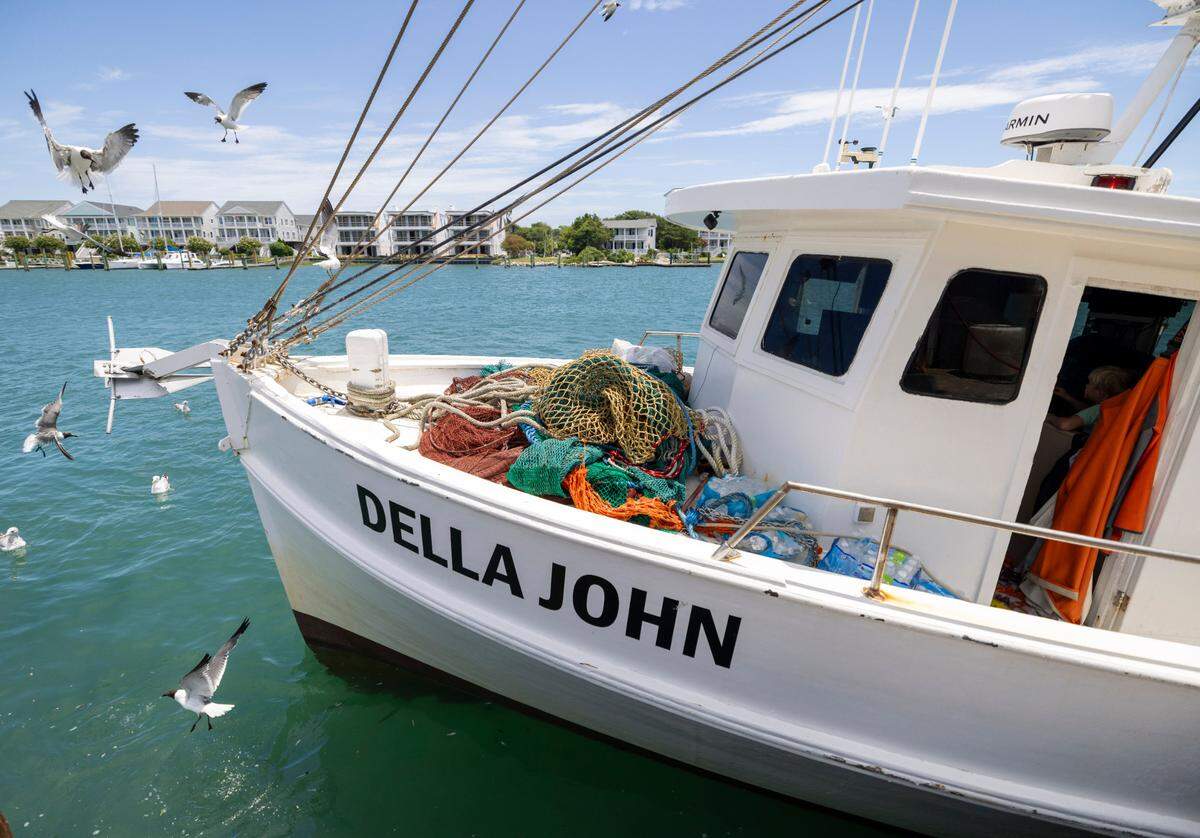
Thomas Smith’s Della John trawled the Neuse River during a July fishing trip. That body of water would have been off limits to shrimpers like him, if state senators passed House Bill 442. Robert Willett rwillett@newsobserver.com
Competition from imported shrimp
The proposed ban on trawling came months after what looked like rare good news for shrimpers in North Carolina.President Donald Trump announced tariffs that many U.S. shrimpers saw as much-needed assistance.
For decades, North Carolina shrimpers have faced foreign competition from often cheaper imported shrimp.
Imported shrimp totals more than 1 billion pounds annually, most of it coming from India, Ecuador, Indonesia and Vietnam, according to data from the National Oceanic and Atmospheric Administration. For comparison, wild-caught shrimp hauled in by North Carolina fishermen totaled less than 10 million pounds annually from 2019-23, according to Division of Marine Fisheries data.
Nancy Edens, a co-owner of B.F. Millis & Sons Seafood in Sneads Ferry, said most of the company’s customers are members of the public, but it also sells shrimp, fish, oysters and clams to wholesalers. If any fresh seafood that can’t be sold locally is leftover, B.F. Millis & Sons tries selling to a processor.
But last year, Edens said, there was too much shrimp available, and even the processors wouldn’t buy from the company.
“That’s all we want, is just a good price, what our shrimp are worth — to be able to compete, to be able to feed our families, to be able to work,” Edens said.
Still, some shrimpers and others in North Carolina’s seafood industry said cost is only part of the problem, and that the public isn’t aware that the shrimp they eat may not be caught locally, which many people value.
One industry group, the Southern Shrimp Alliance, hired SeaD Consulting to genetically test shrimp from dozens of restaurants around Wilmington in April. The study found that 34 of 44 restaurants visited were serving imported, farm-raised shrimp while implying or marketing them as domestic, wild-caught shrimp.
Capt. Billy Davis and his crew brought more than 10,000 pounds of shrimp caught in the Neuse and South rivers to the Davis Seafood fish house in Sneads Ferry on July 16. Robert Willett rwillett@newsobserver.com
Things no one can change
When it comes to challenges, there are all sorts of uncertainty for commercial fishermen and shrimpers that just comes from working outdoorsin conditionsthat they cannot control.
Weather is unpredictable — and dangerous. Summer thunderstorms, with their waterspouts and lightning, can be brutal in the sounds.
Strong winds can make waters too rough for boats. And if boats are trawling in an area including the Pamlico Sound, which is miles wide in places, they could be stranded, unable to reach land. So if captains know those winds are coming, they may have to wait for better weather conditions before they can take out their boats.
During a fishing trip this month, Capt. Billy Davis took his boat from the docks at Sneads Ferry to the South and Neuse Rivers.
Eight hours of travel used up expensive fuel. This time of year, shrimp are smaller — and cheaper — so he needs to catch more than he would later in the year, when shrimp are fuller grown. But there was no way to know how much shrimp he would catch.
“The only difference between us and a farmer is we don’t see what’s in our field,” Davis said. “We’ve got to have faith.”
Renee Umsted is The News & Observer’s Affordability Reporter. She writes about what it costs to live in the Triangle, with a consumer-focused approach. She has a degree in journalism from TCU.