Tracking Isaias? Your interpretation of hurricane ‘spaghetti’ models could be ‘dangerous’
Emergency management officials have warned that Hurricane Isaias, currently treading water off the coast of the Bahamas, is too far out to accurately predict its impact on the southeastern U.S.
But computer models are showing similar trajectories.
All those colorful strands plotting the path of Hurricane Isaias are what’s known as a spaghetti model, or spaghetti plot. The patchwork of lines curving, bending and bucking across a sea of blue as they approach land, look as if someone chucked a handful of al dente spaghetti against the wall — hence its name.
The closer the cluster of lines, the higher the forecast confidence, according to The Weather Channel.
But meteorologists told The News & Observer on Saturday that people without training shouldn’t try to interpret spaghetti models.
“It’s kind of misleading and dangerous in the hands of non-meteorologists or non-tropical meteorologists,” said Joel Cline, a tropical program coordinator for the National Weather Service. “It’s more meant for tropical meteorologists to look at for guidance.”
Cline said the spaghetti model is a series of lines that have various data points. That data can include a hurricane’s wind speed, moisture, circumference or how it will affect certain regions.
Aaron Swiggett, a meterologist for the National Weather Service in Raleigh, said one piece of bad data can drastically throw off a model.
Swiggett said that though the spaghetti plots make a great visual on social media, it’s important to turn to officials for an actual interpretation of what those models mean.
The spaghetti model for Isaias published by the South Florida Water Management District on Friday afternoon shows a relatively tight cluster of lines hugging the coast of Florida, Georgia, South Carolina and North Carolina as the storm moves north.
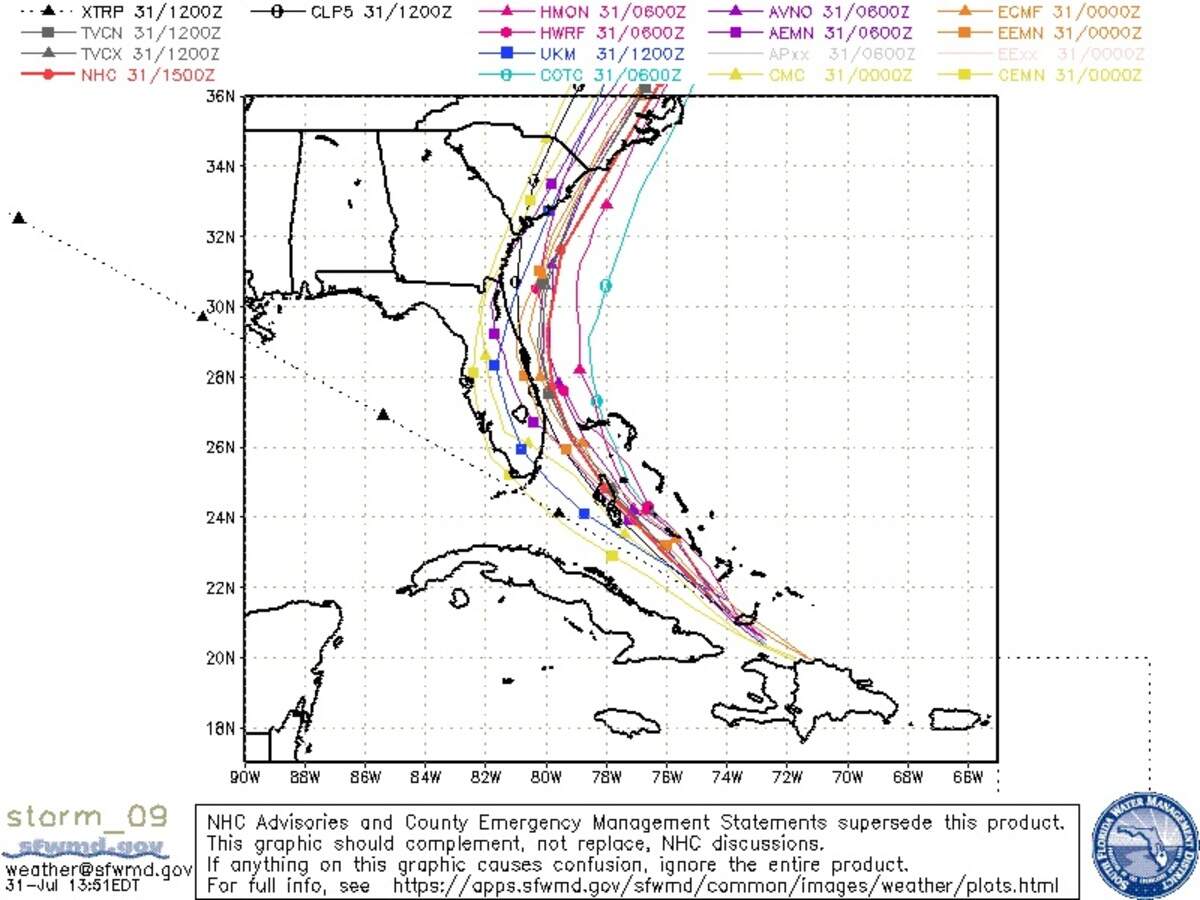
CNN storm tracker’s spaghetti model shows a similar trajectory for Isaias, as does a spaghetti model by the storm tracker website Cycloclane.
But spaghetti models don’t show a storm’s projected impact, according to The Weather Channel, and they aren’t always right, The Palm Beach Post reported.
“Experts caution it’s misleading to consistently tout one model over another because the whacked out rainbows aren’t always what they seem,” according to the Post. “Models have different purposes, and how they arrive at their end result is through a carefully chosen set of equations that differs depending on the programmer.”
Cline said the colors are nothing more than to help meteorologists quickly identify what model they are reading.
Each line has a different name belonging to a different model. The National Hurricane Center lists eight on its website that all measure track and intensity differently.
The most common include the “Navy Global Environmental Model,” run by the United States Navy’s Fleet Numerical Meteorology and Oceanography Center, as well as the the American (GFS) and European (ECMWF) models — which are run by the U.S. government and a group of European countries, respectively, CNN reported.
According to an analysis of the South Florida Water Management District’s spaghetti model by the Brevard Times, the American model forecasts Isaias moving “offshore and parallel to the east coast of Florida.”
The European models “bring Isaias closer to Florida’s east coast,” the Brevard Times reported.
Spaghetti plots are “useful for seeing how confident all of the models are,” according to Cycloclane, a cyclone and hurricane tracker. The National Hurricane Center and other government agencies will “release an official best guess path based on their analysis of the different model data and other factors,” but it can be helpful to check the spaghetti plot to see how confident they are in that forecast.
A disjointed spaghetti model — such as Hurricane Karen’s last year — suggests less confidence.
Cline said Isaias’ spaghetti plot began as a very disjointed model without a clear center.
Swiggett said the National Weather Service heavily relies on the National Hurricane Center’s analysis of various models and then studies trends seen within the hurricane including speed, moisture and direction. Still, he said, it’s hard to predict what a hurricane will do more than three days out.
According to the National Hurricane Center’s 11 a.m. EDT Saturday update, Hurricane Isaias is moving northwest at 12 mph. Using the various model data currently available, the federal agency’s “best guess path” puts it off the southeast coast of Florida late Saturday before churning north to Georgia and arriving in the Carolinas overnight Monday.
This story was originally published July 31, 2020 at 3:55 PM.