Can hurricanes come back to life? ‘Zombie tropical storm’ Paulette reforms in Atlantic
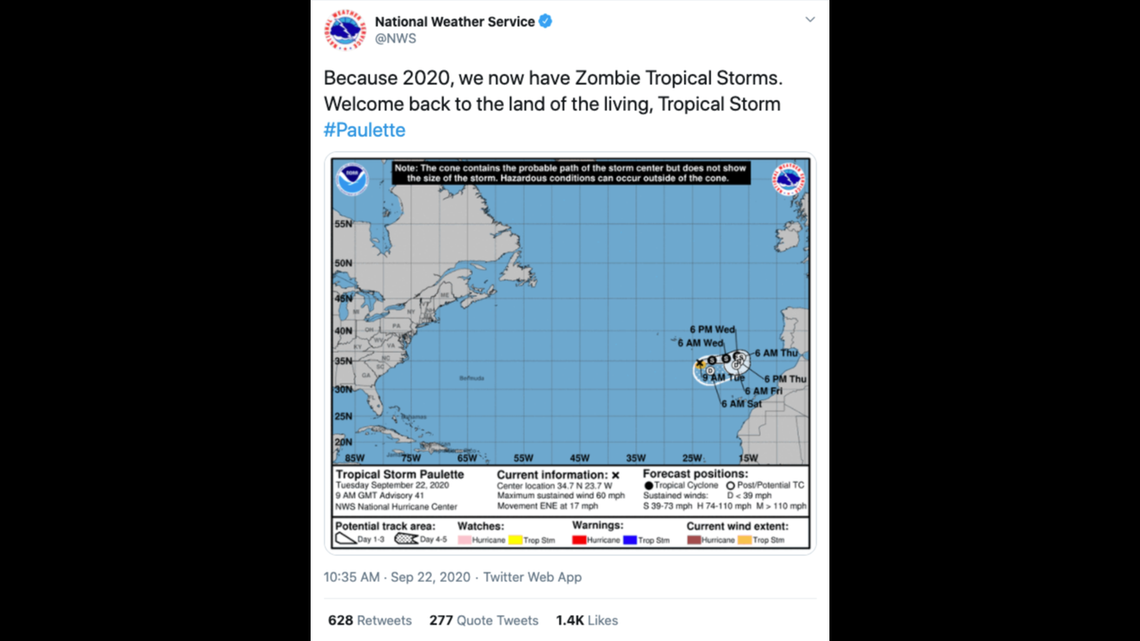
In a year plagued by a global pandemic, civil unrest, raging wildfires and an overactive hurricane season, the National Weather Service has gifted the U.S. a new horror — zombie storms.
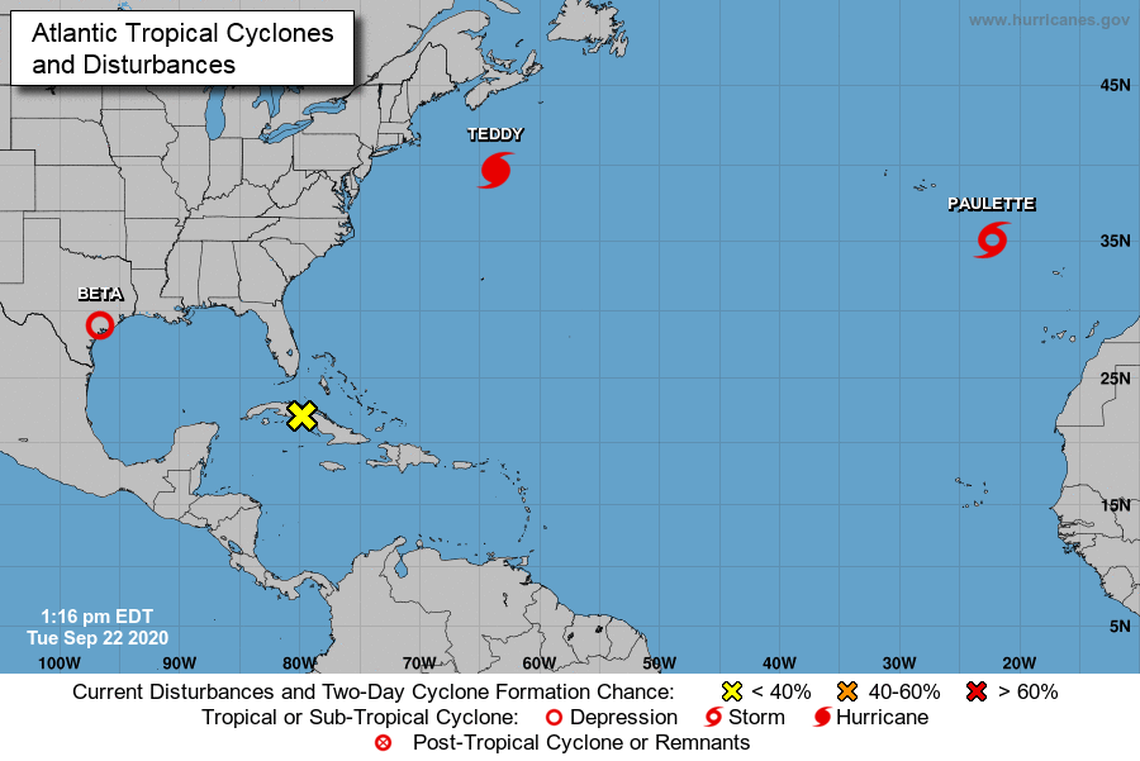
Paulette, which made rare landfall in Bermuda as a Category 1 hurricane more than a week ago, has reformed off the coast of northwest Africa, according to forecasters. The weather service has dubbed it a “zombie tropical storm.”
“Because 2020, we now have Zombie Tropical Storms,” forecasters said. “Welcome back to the land of the living, Tropical Storm #Paulette.”
As of Tuesday afternoon, the much-weakened tropical storm was located about 335 miles southeast of the Azores, a set of islands in the north Atlantic Ocean near Portugal, according to the National Hurricane Center.
It was moving east at 14 mph with maximum sustained winds of 40 mph, forecasters said.
The hurricane center said the storm had little chance of hitting land and would likely dissipate in the next few days.
“If the deep convection does not return to Paulette soon, then the cyclone could be declared a remnant low by as early as (Tuesday) evening,” forecasters wrote in an 11 a.m. update, the Miami Herald reported.
Paulette’s first life
Hurricane Paulette first emerged in the Atlantic more than a week ago when it made landfall in Bermuda on Sept. 14, the Associated Press reported.
The hurricane, which strengthened to a Category 2 storm while hovering over the British territory, is one of less than 10 storms to make “direct landfall on the tiny island in the middle of the Atlantic since the National Hurricane Center began tracking such disasters in the 1850s,” according to the AP.
Few reports of damage and no deaths or injuries were reported in the immediate aftermath, the AP reported.
After leaving Bermuda, Paulette “turned east and lost strength in the middle of the Atlantic,” according to KRIS 6.
“NWS observed the storm’s eyewall had eroded and made what they thought was their final advisory on Sept. 16,” the TV station reported.
Other ‘zombie storms’
Tropical Storm Paulette is not the first to rejoin the land of the living.
In 2013, Hurricane Humberto formed in the Atlantic as a Category 1 storm that drenched the southern Cape Verde Islands with “minor flooding” and some downed trees but no deaths, the Orlando Sentinel reported.
Forecasters expected the storm to die off as it continued north, which it did — at first, according to the newspaper.
“But then, the unthinkable happened,” the Sentinel reported. “The wind eased. Bursts of strong convection were seen. Thunderstorms boomed into development. Rain fell, and Humberto rose from the grave.”
NASA reportedly dubbed it a “zombie tropical storm” at the time.
Tropical cyclones downgrade to what is known as post-tropical status when their “inner core isn’t warm anymore,” but they can “still have a well-defined circulation,” Bay News 9 reported. Weather forecasters will continue to track the storm, which “can stay quite strong even after transitioning,” according to the TV station.
But The Old Farmer’s Almanac reported the downgrade in activity doesn’t make it any less dangerous.
“The problem is that a hurricane may lose its name, its structure and even its place on National Hurricane Center tracking maps, but remain dangerously strong, even deadly,” the Almanac says. “The hurricanes may have died, but as long as the remnants travel over relatively warm water, they still have a lot of energy and flooding rainfall.”
NASA has reported the reformation of tropical cyclones isn’t all that common.
Still, the agency’s satellite imagery was able to capture Tropical Cyclone Aere reforming in the South China Sea in 2016.
The storm’s original track took it south of Hong Kong off the southeastern coast of China, where forecasters said it began dissipating on Oct. 11. But the storm reemerged two days later as a “zombie tropical storm” forecast to make landfall in Vietnam, according to NASA.
Similar occurrences have also been recorded on the West Coast.
Hurricane Ana hit Hawaii in 2015 before it “made a U-Turn and stormed the Pacific Northwest,” The Old Farmer’s Almanac reported.
Ana’s rebirth was made possible by the perfect set of weather conditions — warm water pushed north in the Pacific Ocean by El Niño combined with the Pineapple Express, which sometimes carries tropical weather from Hawaii to the Pacific Northwest, according to the Almanac.
In this instance, it “grabbed the remnants of Ana and took it for a ride.”