
Code Orange air quality alert returns to Triangle. What’s causing it, and what to do
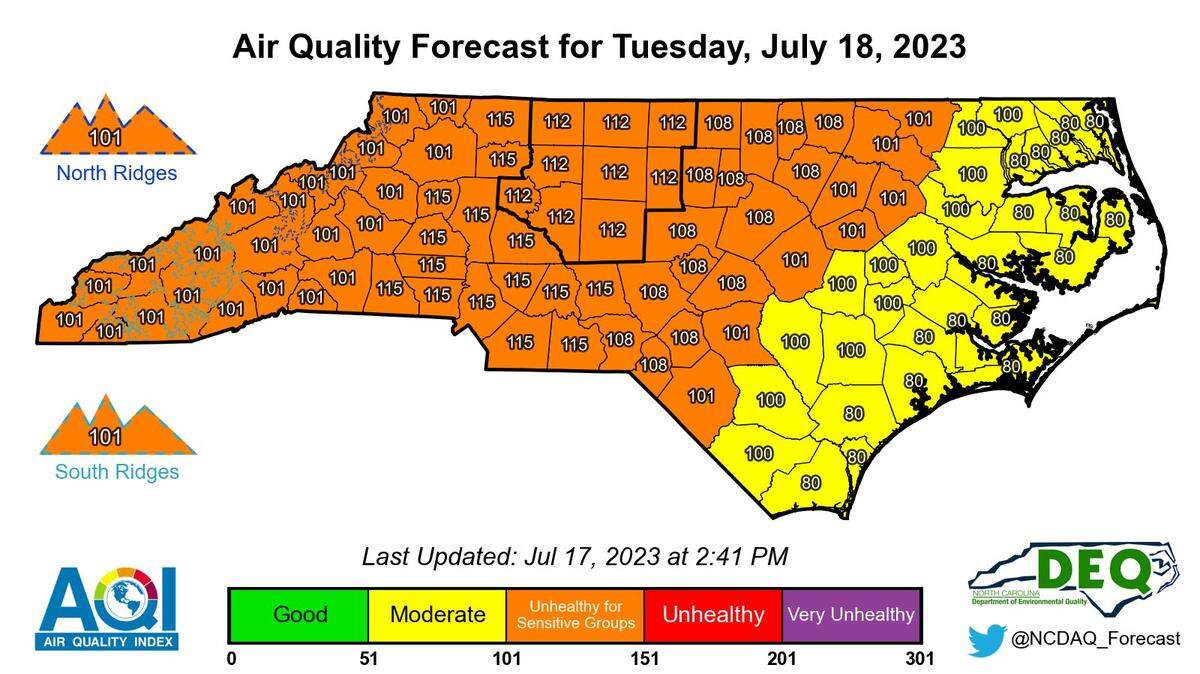
A Code Orange air quality alert has been issued across large parts of North Carolina again due to a plume of smoke that has drifted south from Canadian wildfires.
The N.C. Department of Environmental Quality’s Division of Air Quality (DAQ) issued the alert for much of central and western North Carolina for Tuesday, July 18 in its most recent forecast.
Code Orange on the Air Quality Index represents unhealthy air quality for sensitive groups. Older adults, children of any age, and people with respiratory conditions such as asthma should limit prolonged or heavy exertion outdoors.
Smoke can carry elevated levels of fine particulate matter, or PM2.5, which consists of particles smaller than the width of a human hair. These particles can reach deep in the lungs and aggravate asthma and other lung conditions and have been linked to heart conditions.
According to its most recent forecast, the DAQ expected air quality impacts from smoke to be greatest Tuesday morning, with gradually improving conditions as the day progressed. It expects conditions to slowly improve through Thursday and Friday.
What’s bringing the smoke?
According to National Weather Service meteorologist Chrissy Anderson, the winds are in the right place in the atmosphere to bring the wildfire smoke from Canada to our area.
The smoke is sandwiched between a ridge and a trough, which go together like a wave, Anderson said. A ridge brings the smoke upward, like a rainbow, while a trough brings the wind downward and back upward, like a roller-coaster.
In high-pressure systems, winds tend to blow in a clockwise direction, and are helping to bring the wildfire smoke down from Canada. They’re curving down from Michigan over Pennsylvania, Virginia and North Carolina, then are curving from east to west over Georgia, and south to north over Tennessee.
The ridges, troughs, and high-pressure systems are all contributing to the smoky haze we see outside.
What to do on Code Orange days?
Although it’s OK for people to be outside, DEQ recommends that people in Code Orange areas should limit their time outside and take breaks, The News & Observer previously reported.
Ozone and emissions levels tend to be higher near cities, according to the American Lung Association. The group says people should consider reducing their own emissions, too, by using less energy at home.
This story was originally published July 18, 2023 at 1:34 PM.